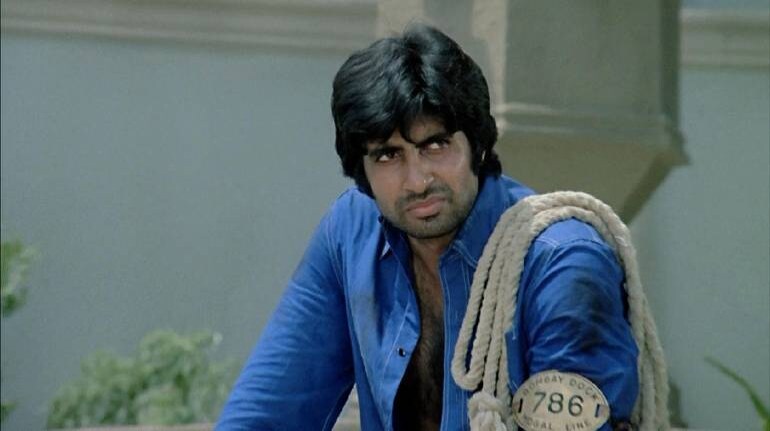
A little over a month ago, a retrospective of Amitabh Bachchan’s films sent his fans into a tizzy. The four-day festival was timed to coincide with the actor’s 80th birthday celebrations (October 11). It involved screening some of Bachchan’s most seminal work – as the Angry Young Man in films like Deewaar and Kaala Patthar, as Yash Chopra’s romantic poet in Kabhi Kabhie and also featured some of his laugh-out-loud comic avatars in films like Amar Akbar Anthony and Namak Halaal. Such was the response to the retrospective that even before the start of the four-day extravaganza, the organizers had to add screens to cater to the enormous demand.
The festival was a runaway success. Videos of fans dancing to ‘Khaike paan Benaras waala’ (Don) in the theatre did the rounds of social media even as others repeatedly forwarded the moment when Bachchan delivers the iconic ‘Main aaj bhi phenkey huey paisey nahin uthaata’ (I still don't pick up money that's been thrown down) in Deewaar on their local WhatsApp groups. The celebration of these moments, more than 40 years after they had first appeared on silver screen, only reinforced one irrefutable truth about Bachchan – that he continues to hold sway on millions of people in this country.
Bachchan’s peak may well be close to half-a-century in the rear-view mirror, but his swagger, the singular baritone and the zingy one-liners remind people of their heyday. This isn’t only nostalgia working overtime, but a much more complex chain of emotions that overwhelm. Revisiting Bachchan of the 1970s and early 1980s is reconnecting with one’s youth. It is a celebration of idealism and masculinity. It’s the ‘I-can-take-on-the-world’ phenomenon in the way that Clint Eastwood could outgun the bad guys in the Spaghetti Westerns, just with a cigar twirling in his mouth and a revolver in his hand.
One could possibly extend the same argument to the effect a retrospective of the great Dilip Kumar’s films would have. The late thespian, however, conjured a different set of emotions. Where Kumar wallowed over his misery, Bachchan boldly battled his circumstances. Devdas and the Angry Young Man could never stand in for each other, which is why Kumar drank himself to death in Bimal Roy’s film while Bachchan’s demise was always how the underdog must go – with a bullet to his body (a la Sholay or Deewaar or Don or Shakti). One wept copiously at his misery, the other made you cry as he paid with his life to make his way out of misfortune.
Perhaps, this is why fans were left disappointed with Bachchan when the actor essayed a number of authoritarian characters (Sooryavansham, Mohabbatein, Kabhi Khushi Kabhie Gham, Black) in the 1990s and 2000s. The ultimate outsider, the man who challenged the status quo had turned into the morally conservative elder in these films. As the writer-professor Mustansir Dalvi wrote of The Big B in this period:
“Bachchan’s role was metonymous with all that was wrong in our increasingly conservative society… Where did the rebelliousness go? Who was this dodgy daddy/uncle type figure who was borderline distasteful? … Bachchan seemed to find increasing comfort as a patriarch full of misogynistic bluster and self-righteousness… The outsider was now domesticated, assimilated in the mainstream, the upholder of some of the most venal values.”
Fortunately, this was a phase. The last decade has seen Bachchan embrace a number of roles that do not carry the totalitarian overtones of his work from the late-1990s and early-noughties. Be it the child figure Auro dealing with progeria in Paa (2009), or the septuagenarian Bhashkor Banerjee obsessed with his bowel movements in Piku (2015), or the stingy character looking to benefit from his begum’s passing in Gulabo-Sitabo (2020), Bachchan has been unafraid to play quirky characters in more recent times.
Even when put in a position of authority – Pink (2016) or Jhund (2022) – an ageing Bachchan has stood up for the oppressed, like he would have in his heyday. In doing this, he is very much like Shekhar urf Tiger, the eldest sibling in Mukul Anand’s commercial blockbuster Hum (1991), a man with an action-packed past, who could kick and punch his way past bad men for a just cause.
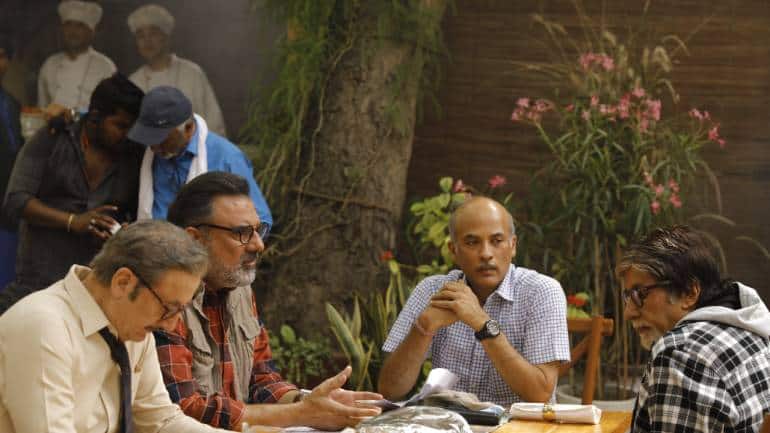 Anupam Kher, Boman Irani, Sooraj Barjatya and Amitabh Bachchan on the sets of 'Uunchai'.
Which now brings us to Uunchai, the latest Sooraj Barjatya offering that will see Bachchan fulfil the wish of a deceased friend. This won’t be a novel, grey character like the one he played in Aks (2001) or Nishabd (2007), but it will see the Dadasaheb Phalke-winner in a warmer, affectionate avatar like the one he essayed in Baghban (2003). Much like the narrative of the film, this is about Bachchan, very much in the autumn of his career, hoping to give his fans one last hurrah. Fans cheer Bachchan on because he gives them the opportunity to relive their past vicariously through him. The historian Priya Satia said it best, when she wrote for Scroll:
“Bachchan is postcolonial India, and humanity, in all its incarnations, from the most noble to the most disgraceful. Bachchan, like that India, is the comeback kid. Ever on the make. Ever willing to reinvent himself. Recovery from near-death accident on set. Bouncing back from disastrous political career. From financial disaster. Overnight gameshow host. At his best in the most desperate of moments.”
That is why fans should go and watch Bachchan in the theatre. He carries something of us in him and there is something of him in us.
Discover the latest Business News, Sensex, and Nifty updates. Obtain Personal Finance insights, tax queries, and expert opinions on Moneycontrol or download the Moneycontrol App to stay updated!
Find the best of Al News in one place, specially curated for you every weekend.
Stay on top of the latest tech trends and biggest startup news.