






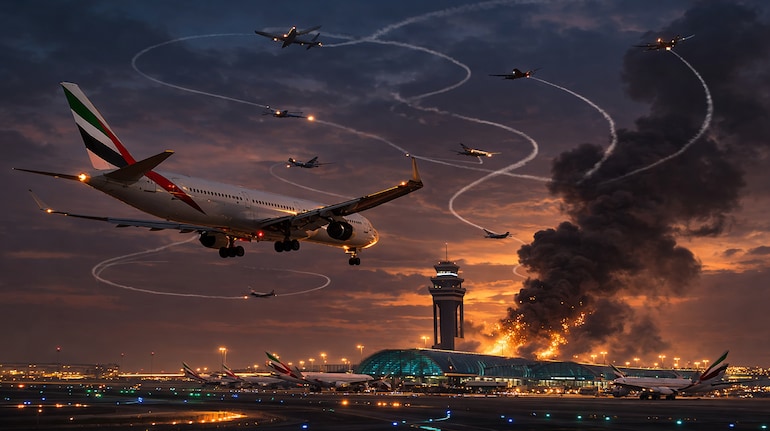
Fresh concerns have emerged over flight safety at Dubai International Airport after multiple aircraft reportedly aborted their final approach due to smoke rising near the runway area.
According to flight tracking platform Flightradar24, several aircraft, including planes operated by Emirates, were seen circling in holding patterns or diverting from their landing paths on Saturday as the situation unfolded near the airport.
Author Shanaka Anslem Perera, in a post on X, claimed that smoke was visible near Terminal 3, around Gate C18, with initial reports suggesting it could be debris from intercepted Iranian projectiles or possibly a fresh strike. However, there has been no official confirmation yet from Emirates or Dubai Airports regarding the cause of the smoke.
Perera said the incident occurred less than an hour before his post, raising fresh questions about the safety of operations at one of the world’s busiest aviation hubs.
'A major challenge for pilots,' says Parera
Highlighting the broader implications, he wrote that the situation creates a unique challenge for pilots approaching Dubai International Airport, as they now have to calculate whether the runway and surrounding airspace will remain clear of debris by the time their aircraft touches down.
“Every pilot approaching DXB must now calculate whether the airfield will still be clear of debris by the time their wheels touch,” he wrote, suggesting that uncertainty around falling interceptor debris has turned routine landings into complex risk assessments.
Dubai International Airport was the world’s busiest airport for international passengers before the current conflict, handling about 92 million travellers in 2024. The airport serves as the main hub for Emirates, connecting destinations across six continents.
Operations at the airport were previously disrupted on March 1, when interceptor debris reportedly struck the airport area and the Burj Al Arab, forcing authorities to suspend scheduled flights. Limited services resumed days later, but at significantly reduced capacity.
Perera noted that operations had restarted at roughly 25% of normal levels, with about 106 flights per day, compared with more than 400 daily flights before the conflict.
Meanwhile, the European Union Aviation Safety Agency (EASA) has extended its warning about the risks of flying through Gulf airspace until March 11, citing the ongoing security situation in the region.
Perera argued that the latest incident shows how quickly disruptions can return, even as limited flight operations attempt to stabilise.
He also highlighted how deeply aviation is tied to Dubai’s economic model, pointing out that the city built its global reputation as a transit hub connecting continents. According to him, around 20% of Dubai’s GDP is linked to aviation and tourism, sectors that depend heavily on smooth operations at Dubai International Airport.
The uncertainty now facing pilots, airlines and passengers reflects how the ongoing conflict is reshaping air travel in the Gulf region.
“The hub that once connected the world is now struggling to function normally,” Perera wrote, adding that aircraft circling over the Arabian Sea symbolise the strain placed on Dubai’s aviation-dependent economy as geopolitical tensions escalate.
Discover the latest Business News, Sensex, and Nifty updates. Obtain Personal Finance insights, tax queries, and expert opinions on Moneycontrol or download the Moneycontrol App to stay updated!
Find the best of Al News in one place, specially curated for you every weekend.
Stay on top of the latest tech trends and biggest startup news.




