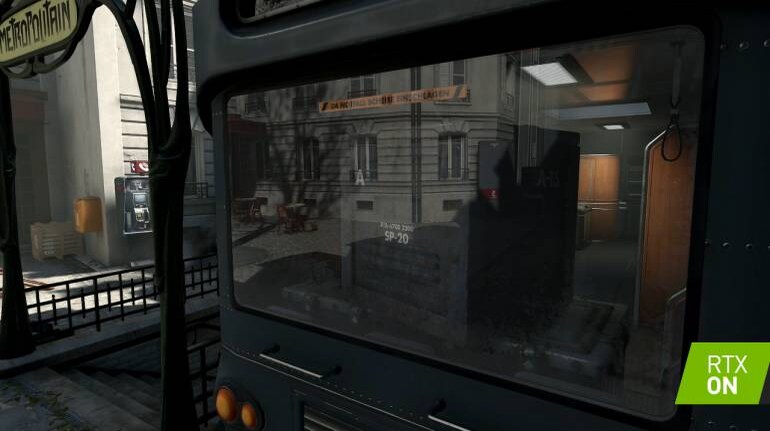
At the ongoing Game Developer's Conference (GDC), Nvidia has showed off technical demos of Raytracing running on an ARM based MediaTek processor. The company says that this shows how advanced graphical options can be extended to a broader range of devices.
The demos included a port of Wolfenstein: Youngblood running on an ARM based processor with RTX (Raytracing) and DLSS both enabled. They also showed off a demo of The Bistro using RTX Direct Illumination (RTXDI) and NVIDIA's Optix AI-Acceleration Denoiser (NRD) enabled.
The MediaTek Kompanio 1200 processor was paired with a GeForce RTX 3060 GPU for the demos. These were made possible because the company ported several RTX SDKs on ARM devices -
Deep Learning Super Sampling (DLSS), which uses AI to boost frame rates and generate beautiful, sharp images for games.
RTX Direct Illumination (RTXDI), which lets developers add dynamic lighting to their gaming environments.
NVIDIA Optix AI-Acceleration Denoiser (NRD), which uses AI to render high-fidelity images faster.
RTX Memory Utility (RTXMU), which optimizes the way applications use graphics memory.
RTX Global Illumination (RTXGI), which helps recreate the way light bounces around in real-world environments.
The company also announced that the RTXDI, NRD and RTXMU SDKs were now available for ARM devices with Linux and Chromium. RTXGI and DLSS will follow soon.
“RTX is the most ground breaking technology to come to PC gaming in the last two decades,” said PC Tseng, general manager of MediaTek's intelligent multimedia business unit. “MediaTek and NVIDIA are laying the foundation for a new category of Arm-based high-performance PCs.”


Discover the latest Business News, Sensex, and Nifty updates. Obtain Personal Finance insights, tax queries, and expert opinions on Moneycontrol or download the Moneycontrol App to stay updated!
Find the best of Al News in one place, specially curated for you every weekend.
Stay on top of the latest tech trends and biggest startup news.