



The Assassin’s Creed franchise has an interesting backstory, emerging as it did from the ashes of a possible Prince of Persia: The Sands of Time sequel. The premise took the gameplay loop out into an open-world, and expanded on the concepts of stealth and assassination. And while the franchise was indeed born in West Asia — in the area known then as the Holy Land, it has never since returned to the region.
There were jaunts over to Italy, France, across the Atlantic to the US, then over to Egypt, a stopover at Greece and what seemed like an interminable residency in Medieval England and Norway. Now, around 15 years since Altaïr Ibn-La'Ahad found himself involved in the Crusades back in the 12th Century, the series has returned to West Asia, specifically Baghdad in its Golden Age.
I’d imagined that going back to the geographical region might have been off the cards for Assassin’s Creed since it would first, seem like retreading ground already trodden by Prince of Persia and second, there was a Sands of Time reboot on the way. Regardless, with the latter seemingly dead and buried for all intents and purposes and the aforementioned decade-and-a-half having passed, we’re back in the region. And it’s never looked better!
 (Image: Ubisoft)
Stripped down and visually stunning
Even though we’ve come to expect pretty good graphics from the Assassin’s Creed games, I was most impressed by the way 9th Century Baghdad looks. Prior to firing up the game, I had only seen a handful of preview screenshots and clips. On the strength of those bits and bobs, it seemed like the environments may be pretty at first, but would soon begin to feel very samey.
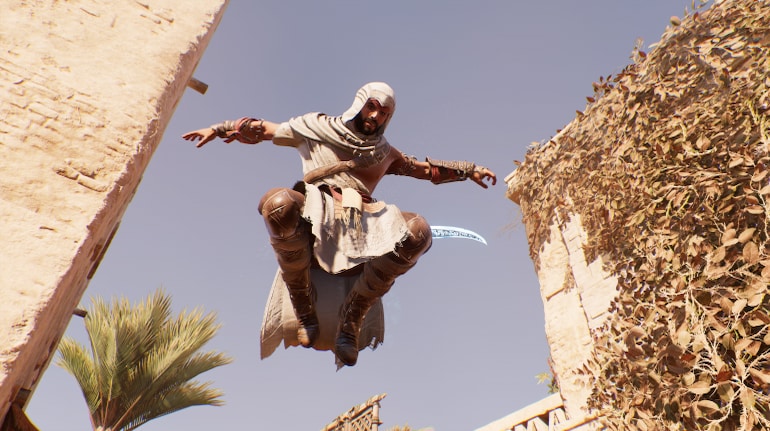
Roaming through Baghdad and its surrounding areas for yourself is a whole different story though. From the rendering of flora and the lifelike lighting to the texture of the sand and the incredibly well-reproduced architecture, Assassin’s Creed Mirage is an absolute delight to explore. Whether on camelback, horseback or just traversing rooftops and alleys using protagonist Basim Ibn Ishaq’s parkour abilities, you’ll spend a fair bit of time observing your surroundings.
As you travel the width and breadth of the area at your disposal, you’ll come to appreciate the subtle changes of terrain, the bustling markets, the silent alleyways and the useful canals — extremely handy to mount a quick escape when you find yourself in a tight spot. Baghdad is divided into four districts — including the dusty, industrial area of Karhk, the far greener Round City and The Alamut, home to the original assassins. Each of these distinctly different areas are home to citizens and bystanders who often react differently to your shenanigans.
Now if the name Basim rings a bell, it’s probably because he’s one of the main antagonists in Assassin's Creed Valhalla. Mirage then, is his origin story — charting his rise through the ranks of the Hidden Ones. And it’s a tight and focused story that should take you around 20 to 22 hours to complete. This does seem a bit odd after the lengthy oeuvres that were Origins, Odyssey and Valhalla, but it’s the direction the series is taking now.
A large part of this is the decision to shrink down the size of the overall map to a fraction of the one you traverse in Valhalla. Gone are the pockmarked maps covered with all sorts of random points of interest, and in their place is far more concise cartography. It’s the same with missions and instead of a journal filled with all sorts of quests, subquests and random activities, there’s a cluster of investigations. For what it’s worth they are missions with sub-missions built in, but it’s a nice way to present it, and is definitely less fatiguing than having to scroll through a list of quests that seems to get longer and longer.
 (Image: Ubisoft)
The new ways and the old ones
Aside from the aesthetic of the game, one of the things I’ve enjoyed most about Mirage is the return to stealth — the trademark of the series until it got waylaid with ambitions of turning you into a Greek warrior and a Viking. For starters, you are extremely underpowered as a swordfighter and efforts to fight your way out of trouble will likely result in you having your backside handed to you. And so, you’re going to need to be more tactical and strategic about how you plot your assaults.
This is where Mirage really shines. Making you aware of your limitations early pushes you to explore ways to get an advantage. So whether that’s hiring a set of sellswords to create a distraction for you or to just look for a quieter path into a guarded area, the game leaves it upto you to decide. If you’re going to go with the first option, more often than not you’re going to have to grease their palms with tokens. Tokens (Power Tokens, Merchant Tokens and Scholar Tokens that serve different purposes) have to be earned through contracts — a form of mini side quests that are brought to you by the various bureaux of Hidden Ones across the map’s districts.
Each fortress to be infiltrated and assassination to be carried out plays out like a complex puzzle that needs to be figured out before you can set about executing it. Waver from the plan and you’ll either need to improvise or flee and re-attempt it later. Figuring out these three-dimensional puzzle boxes was my favourite aspect of Mirage.
Compared to previous editions, and unfortunately those comparisons are inescapable, the story this time around is a leaner affair. Once again the historical research is top-tier, and while the twists and swerves are memorable, you’re unlikely to get bogged down by the weight of the narrative. This is something that serves the game well and like the focus on stealth and assassination, harks back to an older era of Assassin’s Creed games.
 (Image: Ubisoft)
But really, what’s new?
The need to move away from the Origins, Odyssey and Valhalla school of thought was apparent because while they certainly had their moments, they had moved away from the unique identity of Assassin’s Creed games. With the three titles mentioned above, the series had turned into a bunch of action-adventure games with RPG elements — the likes of which are a dime a dozen these days.
And so, I welcome the decision to go back to what made the series unique. Sadly, by doing so, Mirage also takes the series back in time to a style of game that is over a decade old. Tearing down posters to reduce notoriety, jumping into carts full of hay to the sound of an eagle screeching and walking alongside four people to ‘blend in’ are signature moves for the series. However, they’re also quite outdated and Mirage does little to show me how the franchise has moved forward since the days of Altaïr all those years ago.
On one hand, I understand that Mirage (which retails at Rs 3,499, which is a lot lower than the going rate for new AAA games) is probably not meant to be a flagship title, and as such should be received as such. However, the inability to introduce new ideas and thinking into the series seems lazy. Even the parkour feels like right out of the playbook of Ezio Auditore da Firenze (Assassin’s Creed II).
Here’s hoping that the upcoming slate of Assassin’s Creed games bring something new to the table, or else the franchise is in danger of being assassinated by waning interest.
Game reviewed on Xbox Series X. Review code provided by publisher

Discover the latest Business News, Sensex, and Nifty updates. Obtain Personal Finance insights, tax queries, and expert opinions on Moneycontrol or download the Moneycontrol App to stay updated!
Find the best of Al News in one place, specially curated for you every weekend.
Stay on top of the latest tech trends and biggest startup news.