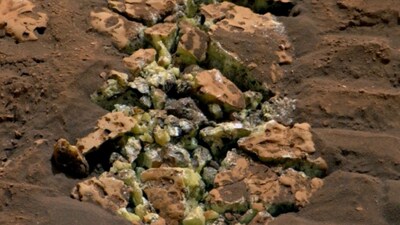
A routine drive by NASA’s Curiosity rover accidentally cracked open a Martian rock, revealing rare yellow sulfur crystals. The strange discovery has scientists questioning how such an unexpected mineral formed there.
NASA quietly let a Mars rover think for itself in December 2025. Behind this shift stands Vandi Verma, whose work hints at how future missions may explore worlds alone.
NASA’s Perseverance rover has uncovered signs of an ancient Martian shoreline, hinting at long-lasting lakes, subsurface water activity, and conditions that may once have supported life on the Red Planet.
The rover has explored Jezero Crater since 2021. Its SuperCam instrument recorded audio and electromagnetic signals. These signals revealed tiny electrical discharges on Mars.
The Perseverance rover on Mars imaged 3I/ATLAS with its Right Navigation Camera (Navcam), this image assists both scientific observation and rover navigation across Martian terrain.
The rock comes from a dry riverbed called the Bright Angel Formation. This region contains sedimentary rocks composed of silt and clay.
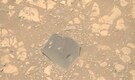
NASA’s Perseverance rover has spotted a strange, helmet on Mars, sparking curiosity among scientists and space enthusiasts about its origins and what secrets it might reveal about the Red Planet.
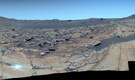
NASA’s Perseverance rover recently shared a detailed panorama of the Red Planet’s terrain, offering a striking glimpse of rippling sands, far-off hills, and a curious boulder that seems oddly out of place.
Mars attracts attention in an odd way. This time, it has to do with a skull-shaped rock rather than cold poles or old rivers.
The Mars Sample Return project intends to bring Mars samples to Earth. The Perseverance rover has been gathering rocks and soil since 2021.
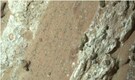
NASA's Perseverance rover uncovers intriguing rock sample on Mars, nicknamed 'Cheyava Falls,' which may hold evidence of ancient microbial life and water on the Red Planet.
NASA’s Perseverance Mars rover is using Artificial Intelligence (AI) to find minerals amidst the rocks on the Red Planet
The MOXIE experiment helps astronauts on Mars to produce oxygen for fuel and breathing.