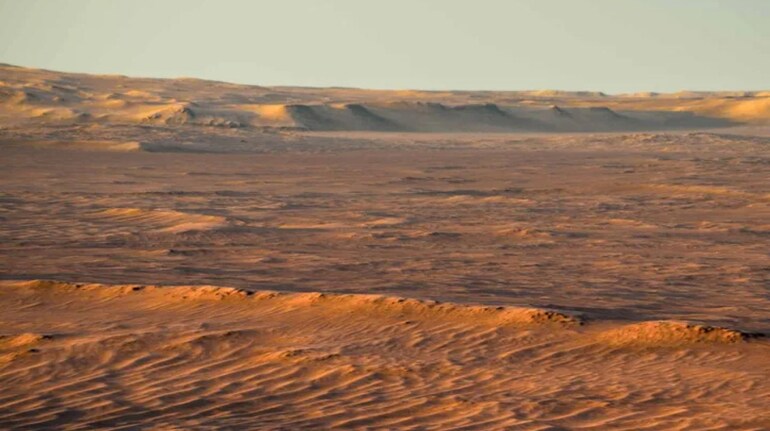

NASA’s Perseverance rover has revealed new clues about ancient Mars, scientists said on Sunday, after analysing rock formations suggesting a long-lost lakeside environment inside Jezero crater.
The findings point to a vast lake existing around 3.5 billion years ago. Researchers say the discovery strengthens theories about Mars once hosting habitable conditions. The study was led by Imperial College London scientists. Results were published in the Journal of Geophysical Research: Planets.
The rover identified geological features resembling ancient beach shorelines. These formations were found within Jezero crater’s Margin unit. Scientists say waves once shaped rocks along this Martian shoreline. Evidence suggests water remained stable longer than previously believed.
Ancient Mars Lake and Shoreline Evidence
Researchers found rounded sand-sized grains within the Margin unit. These grains contained olivine and carbonate minerals. Such rounded shapes typically form through prolonged wave activity. Scientists believe these materials mark a former shoreline environment.
Local bedrock appears eroded by repeated wave action. The erosion patterns closely resemble ancient Earth shorelines. Scientists say this strengthens arguments for persistent surface water. The area likely hosted calm lake conditions for extended periods.
Alex Jones led the research at Imperial College London. Jones is a PhD researcher within Earth Science Engineering. He said shorelines are habitable environments on Earth. Carbonate minerals can preserve environmental records over time.
Jones said carbonate formation can trap chemical signatures. These signatures may reveal details about ancient conditions. The findings suggest Mars experienced a warmer, wetter climate. Such environments are considered favourable for potential life.
Subsurface Water and Martian Habitability
The study also identified rocks altered by subsurface water. Researchers believe water circulated beneath the surface extensively. This process altered rocks across vast geological timescales. The transformation supports earlier research findings on Martian water activity.
Professor Sanjeev Gupta contributed to the study. Gupta works within Imperial’s Department of Earth Science Engineering. He said subsurface hydrothermal environments can support microbial life. On Earth, such systems sustain life without sunlight.
The research extends timelines for possible Martian habitability. Calm lake conditions likely existed earlier than assumed. Scientists believe Mars once shared similarities with early Earth. Liquid water may have shaped Mars’s surface more extensively.
Perseverance Rover and Future Research
Perseverance has explored Jezero crater since 2021. The rover collects core samples of rock and regolith. These samples may return to Earth through future missions. Scientists hope laboratory analysis will reveal further insights.
The international research team continues analysing collected samples. Findings could help answer questions about ancient life. Mars’s environmental history remains under close scientific investigation. The discovery marks another step toward understanding planetary evolution.
Scientists say the findings reshape views of Mars’s past. Ancient shorelines suggest long-lasting water stability. Researchers believe more discoveries lie ahead within Jezero crater. Perseverance continues its mission across the Martian surface.
Discover the latest Business News, Sensex, and Nifty updates. Obtain Personal Finance insights, tax queries, and expert opinions on Moneycontrol or download the Moneycontrol App to stay updated!
Find the best of Al News in one place, specially curated for you every weekend.
Stay on top of the latest tech trends and biggest startup news.