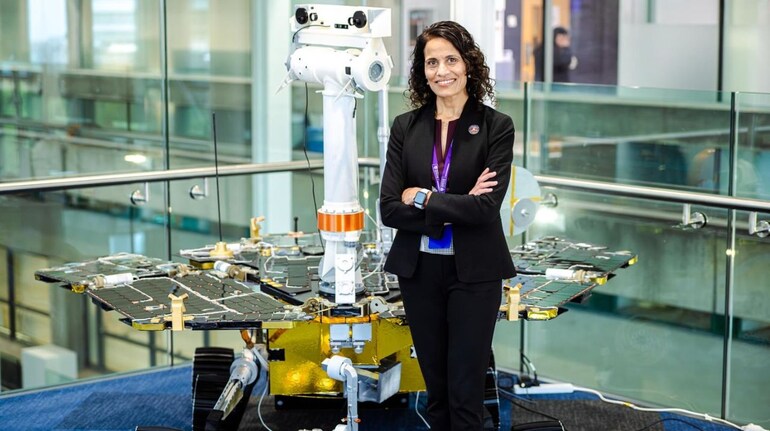

In December 2025, NASA quietly tested autonomous driving on Mars, placing Indian-origin roboticist Vandi Verma at the centre of a major shift in robotic exploration, after the Perseverance rover completed AI-planned drives on December 8 and 10.
The test marked the first time a Mars rover followed routes planned by artificial intelligence. Earlier missions depended entirely on human teams planning every movement from Earth. Commands were sent step by step across millions of kilometres. The latest experiment showed rovers could independently analyse terrain and choose safer paths. This ability becomes critical as missions move farther from Earth. Communication delays make real-time human control increasingly impractical.
Who is Vandi Verma
Vandi Verma was born in India and raised around aviation settings. Her father served in the Indian Air Force for years. Frequent relocations exposed her to aircraft and engineering early. She completed her schooling in India before higher studies. Verma studied electrical engineering at Punjab Engineering College, Chandigarh.
She later moved to the United States for advanced education. At Carnegie Mellon University, she specialised in robotics research. She earned both a master’s degree and doctorate there. Her work focused on autonomous systems and fault diagnosis. These skills later proved crucial for planetary robotics.
NASA rover operations and AI driving
Verma joined NASA’s Jet Propulsion Laboratory in 2007. She became part of the core Mars rover operations team. Over time, she worked on Spirit, Opportunity and Curiosity missions. She also plays a key role in Perseverance operations. Today, she serves as Chief Engineer for Robotic Operations. Her role oversees rover movement, safety and autonomy testing. For the December 2025 test, AI analysed images and navigation data.
It identified rocks, slopes and sandy regions autonomously. The system produced complete driving routes with planned waypoints. Engineers tested these routes using a Perseverance digital twin. Simulations examined hundreds of thousands of data points carefully. After validation, the commands were transmitted to Mars. Perseverance successfully followed the AI-designed route on surface.
What it means for future missions
Verma said AI could simplify perception, localisation and planning tasks. The technology may reduce workload for human rover operators. NASA expects such systems to enable longer rover drives. Faster exploration could improve identification of valuable scientific sites. Administrator Jared Isaacman called the test a preview of future missions. He said autonomy supports efficient operations far from Earth. JPL official Matt Wallace highlighted intelligent systems across platforms. He referred to rovers, drones and surface technologies working together. NASA believes autonomy will support Moon missions under Artemis. It may also shape future human missions to Mars.
Discover the latest Business News, Sensex, and Nifty updates. Obtain Personal Finance insights, tax queries, and expert opinions on Moneycontrol or download the Moneycontrol App to stay updated!
Find the best of Al News in one place, specially curated for you every weekend.
Stay on top of the latest tech trends and biggest startup news.