-
India Rips Into Pakistan at UNSC Over Kashmir, Terrorism and Democracy
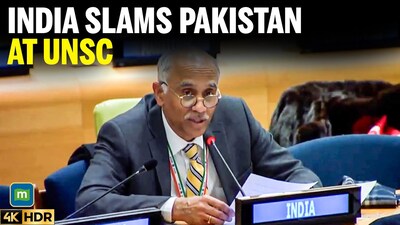
India delivered a sharp rebuke to Pakistan at the UN Security Council, calling out Islamabad’s “unique” way of respecting democracy by jailing a prime minister and granting lifetime immunity to its army chief. New Delhi reaffirmed Jammu & Kashmir as an integral part of India and vowed to counter Pakistan-sponsored terrorism in all forms.
-

PM Modi To Visit Kashmir On June 6, First Visit Since Pahalgam Terror Attack
Prime Minister Narendra Modi is set to visit Jammu and Kashmir on June 6, 2025, marking his first trip to the region following the Pahalgam terror attack and Operation Sindoor. During this visit, he will inaugurate the Chenab Bridge, hailed as the world’s highest railway bridge at 1,178 feet above the Chenab River. Union Minister Jitendra Singh described the event as "history in the making." The bridge, located between Bakkal and Kauri in the Reasi district, is a critical link in the Katra-Banihal section of the Udhampur-Srinagar-Baramulla Railway Link (USBRL) project, which is valued at ₹35,000 crore. This ambitious infrastructure project aims to enhance connectivity in the region and integrate it more closely with the rest of India. Meanwhile, Union Home Minister Amit Shah has paid several visits to Jammu and Kashmir in recent months, underscoring the region’s strategic and political significance in national development and security.
-
TRF Commander Shahid Kuttay Involved in Pahalgam Terror Attack Neutralised in Operation Keller
Operation Keller was launched by the Indian Army on May 13 in Jammu and Kashmir’s Shopian district.The action followed specific intelligence inputs from a Rashtriya Rifles unit regarding the presence of terrorists in the Shoekal Keller area. During the operation, three hardcore terrorists were neutralised after a heavy exchange of fire. Among those killed was Shahid Kuttay, a top commander of Lashkar-e-Taiba (LeT), who was reportedly involved in the April 22 Pahalgam terror attack. Alongside Kuttay, Adnan Shafi, a terrorist affiliated with The Resistance Front (TRF), was also gunned down. The identity of the third terrorist is yet to be confirmed. Kuttay had joined the terror ranks in 2023 and was classified as a Category “A” terrorist, according to officials.
-
UN Chief Speaks With India, Pakistan Amid Escalating Tensions Post Pahalgam Attack | N18G
ollowing the April 22 terrorist attack in Pahalgam, Jammu and Kashmir, which killed 26 civilians—mostly tourists—tensions have sharply escalated between India and Pakistan. The United Nations Secretary-General Antonio Guterres strongly condemned the attack and warned that a conflict between the nuclear-armed neighbors would have catastrophic global consequences. He personally contacted Indian Foreign Minister S. Jaishankar and Pakistani Prime Minister Shehbaz Sharif, urging de-escalation and emphasizing his firm stance against terrorism. India has blamed cross-border elements for the attack and taken several diplomatic and strategic steps, including downgrading ties with Pakistan, suspending the Indus Waters Treaty, and closing the Attari land-transit post. Prime Minister Narendra Modi has vowed the “harshest response” and granted the armed forces full operational freedom. Meanwhile, Pakistan rejected India's accusations and called for a neutral investigation. The international community is closely monitoring the situation, fearing that further escalation could destabilize the region and threaten global security.
-
Pahalgam Terror Attack World Leaders Express Condolences And Paid Tributes
World leaders expressed their condolences and paid tribute following a horrific terror attack in Jammu and Kashmir that claimed the lives of dozens, including an intelligence officer and several tourists. The tragedy unfolded in the scenic town of Pahalgam, where 26 people were killed and many others injured after terrorists opened fire. Eyewitnesses reported hearing multiple rounds of gunfire in Baisaran Valley as a group of terrorists emerged from the forest and began shooting indiscriminately at a crowd—primarily tourists—before retreating back into the woods.
-
India exposes Pakistan at UN: Kashmir rant backfires!
In a powerful address at the United Nations, India’s First Secretary, Bhavika Mangalanandan, took aim at Pakistan's Prime Minister Shehbaz Sharif for his remarks on Kashmir. She called out Pakistan's history of cross-border terrorism and hypocrisy, highlighting its military governance and global reputation for violence. This video dives into Mangalanandan's strong rebuttal, Pakistan's ongoing issues with terrorism, and the broader implications for regional security. Join us for a detailed analysis of this tense exchange at the UN and its impact on India-Pakistan relations.
-
Indians Escape To Serene Mountains Of J&K’s Bandipora Amid Heatwave Spells
The Gurez Valley in J&K’s Bandipora district experienced a surge in tourists escaping the heatwave gripping India. The influx boosted local employment, particularly for the educated youth, due to the newfound peace and border tourism. Visitors praised the valley's beauty, safety, and warm hospitality, encouraging others to experience Kashmir's charm. Watch!
-
Lok Sabha Election 2024: Kashmir's Baramulla registers approximately 59 percent voter turnout
Baramulla constituency in Kashmir made history by recording approximately 59 percent voter turnout when polling was held on May 20th during the fifth phase of the 2024 General Elections. This is an all-time high since the constituency was established in 1967.
-
Pakistan Foreign Office asks Indian politicians to stop involving Pakistan in electoral discourse
Protests erupted in Pakistan-occupied Kashmir (PoK) amidst Pakistan's escalating economic crisis, with people taking to the streets to protest against skyrocketing inflation. Clashes between demonstrators and authorities resulted in 3 deaths and 90 injuries. On May 14, the Pakistan Foreign Office urged Indian politicians to refrain from involving Pakistan in their electoral discourse, accusing India of exploiting anti-Pakistan sentiment for electoral gains.
-
Violent Protest Breaks in PoK over Rising Inflation and Load Shedding | Police Use Force Against Protestors
On May 9, a violent clash occurred between police forces and residents from the Dadyal area of Pakistan-occupied Kashmir (PoK). The protest erupted due to grievances over soaring inflation and frequent power outages. The confrontation resulted in numerous injuries, prompting Pakistani authorities to impose a curfew in the region, halting all activities. Before the escalation, demonstrators had cautioned against the use of force by Pakistani authorities. Political activist Amjad Ayub Mirza strongly condemned the incident, stressing that violence against peaceful protesters in PoK is unacceptable. Mirza further highlighted the outbreak of riots in Dadyal, where hundreds of protesters took to the streets, particularly in Tatapani.
-
Khelo India Winter Games conclude with spectacular ceremony | All You Need to Know
The Khelo India Winter Games in Gulmarg concluded with a vibrant ceremony of sportsmanship and talent. Amidst cheers from dignitaries and spectators, athletes received accolades for their unwavering dedication and outstanding performances. Watch to know more.
-
Pakistan PM Shehbaz Sharif wants 'honest talks' with PM Modi | Pakistan wants to discuss Kashmir
-
Pakistan PM Raises Kashmir Issue In China | Sharif meet Xi | Xi Promises “Unbreakable” Ties
-
Good governance meet resolves to develop J&K, Ladakh as models of administrative excellence
-
After 48 years, UN Security Council will talk Kashmir
-
J&K to be Union Territory with Legislature, Ladakh without: Here's the difference
-
Article 370 on Jammu and Kashmir's special status revoked, announces Amit Shah
-
What is Article 35A? Here's all you need to know
-
Shahid Afridi bats for 'independent' Kashmir, says Pakistan can't even manage its 4 provinces
-
UN releases first of its kind report on rights status in Kashmir, PoK
-
Four policemen killed in IED blast in Kashmir's Sopore
-
Demonetisation: Tackling terror financing is victory in itself, says AG of India
-
Indian Army avenges Uri with surgical strikes, Pakistan denies
-
India strikes terror camps on Line of Control
-
J&K India's integral part, Pak must stop dreaming: Sushma Swaraj