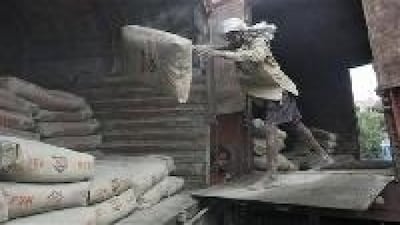
Adani Group, a late entrant in the cement sector, now contributes to nearly 30 per cent of the cement used for India’s homes and infrastructure.
Dalmia Bharat intends to grow cement capacity at a CAGR of 14-15% over the next decade to reach 100+ MT by 2030 Description: Dalmia Bharat is one of the largest cement manufacturers in the country, having a cement capacity of ~47MT at present. The company is focused on becoming a pan-India player in coming years.
Kotak Institutional Equities warns that Indian cement companies' valuations, driven by a $100 billion market cap, appear unsustainable given weak demand, high costs, and unrealistic sales expectations.
Cement prices fell across regions in July 2024, squeezing industry margins, with demand expected to recover only in the latter half of FY25.
Recently, Adani and Ultratech have focussed on southern India, with Adani acquiring Penna Cement in June and Ultratech increasing its stake in India Cements to a majority control on July 28
Large cement companies have sufficient levers in terms of cost synergies and branding, which along with quality improvement and green energy usage, could lift realisations over time
Aggressive volume push at the expense of pricing resulted in an about 6% sequential decline in cement prices to Rs 370- Rs 375 on average per 50 kg bag in the fourth quarter.
In 2018, the Geological Survey of India (GSI) discovered potential zones of high grade limemud and limesand off Gujarat and Maharashtra coasts. These are useful for cement companies that can cut down on the raw material import bills.
During Q3, UltraTech, ACC, Ambuja and Shree Cement saw their consolidated net profit soar on the back of healthy demand and lower costs.
Supported by healthy demand prospects, the capacity addition in the cement industry is estimated at 63-69 million metric tonnes (MT) between FY24 and FY25, ICRA said.
Arora says investors have to be very nimble-footed when they play the commodities sector, as opposed to looking at it from a long-term investment call.
The cement industry estimates a cumulative output loss of about 64 billion won ($47.81 million) as of Monday, lobby group Korea Cement Association said.
Shree Cement aims to scale at least 25 percent or 10 MTPA capacity inorganically in the next five years, said Chairman HM Bangur
The country’s third largest cement producer is manoeuvring to protect its turf amid a fight in the industry between two billionaires.
Year-on-year decline likely to be deepest in the past 10 years.
Industrywide utilisation will drop from 70% for FY22 to 65% as faster new capacity additions overtake demand growth, limiting pricing power amid anticipation that the sector would consolidate further, by a report
The cement production in the first 11 months of FY22 was at 323 million MT, which is higher by 22 per cent Y-o-Y.
ICRA AVP & Sector Head, Corporate Ratings, Anupama Reddy said that despite the increase in the net sales realisations by 5 per cent, the Operating Profit Before Interest, Taxes, Depreciation and Amortisation (OPBITDA) per metric tonne declined by 10 per cent Y-o-Y in the first 9 months of FY2022 to Rs 1,124.
Galloping coal prices hit cement-maker; pandemic- and rain-induced drop in demand also hurts
High input prices and energy costs hit India cement makers in the second quarter, but a benign demand outlook promises to lift the fortunes of the industry in the second half of the financial year.
With respect to project financing, the National Investment and Infrastructure Fund can play a big role in channelising long-term funds – both debt and equity - to the infrastructure sector.
Channel checks by analysts indicate slow recovery in demand post festive season. Prices are either flat or showing signs of moderation
Company Managing Director and noted industrialist N Srinivasan told reporters that the COVID-19 factor has resulted in the cement industry seeing a 25 percent decline in March compared to last year, while capacity utilisation for the sector, as well as the company, was below normal levels.
Cement demand had declined in FY20, which was only the second instance of a decline in the past 15 years, after the demonetisation affected FY17.