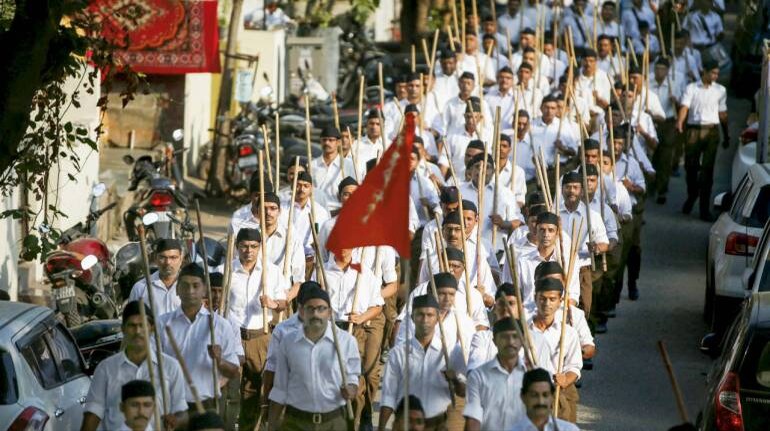
A full-time volunteer in the Rashtriya Swayamsevak Sangh (RSS) is known as ‘Pracharak’. The life of a Pracharak is based on celibacy, dedication and commitment. Generally, those who have attended three major training camps of the RSS known as, ‘Sangh Shiksha Varga’, are deputed as Pracharak.
Some of the full-time volunteers in the RSS are also known as ‘Vistarak’. The difference between a Vistarak and a Pracharak is that the Vistarak spends upto one year as a full-time volunteer while the Pracharak has an experience of more than one year as a full-timer.
Currently, there are around 6,000 Pracharaks which work in RSS and three dozen other organisations which are its ideological mentee.
Postcards Without AddressPracharaks are said to be postcards without address as they can be deployed anywhere, anytime for any type of organisational work. They are ready to take up any responsibility and dedicate themselves completely for the task. Traditionally, the RSS sarsanghchalak, sarkaryavah and sah-sarkaryavahs are all pracharaks. Most of the departments/verticals within the organisation are also headed by the Pracharaks.
A pracharak doesn’t marry. The importance of the Pracharaks can be gauged from the fact that the two Prime Ministers produced by the Bharatiya Janata Party, Atal Bihari Vajpayee and Narendra Modi have been RSS Pracharaks. The all-powerful post of ‘General Secretary (organisation)’, in all state units of the BJP as well as at the national level is entrusted to an RSS Pracharak only.
The life of a Pracharak is challenging. They stay in the RSS office and travel extensively to expand the ideology of the Sangh. Even the senior-most Pracharaks submit their travel bills diligently and get reimbursed. They travel with the cheapest possible means of travel and make do with only a couple of dresses. They get up early in the morning before dawn and sleep late in the night working for 16-20 hours every day for organisational work. They are paid a basic stipend to take care of their day-to-day expenses which is less than the pocket money of a city-bred average Indian teenager.
Most of the Pracharaks prefer to have their meals at the homes of Swayamsevaks. This helps them to connect with a larger number of people. Many Pracharaks spend a few years as full-time volunteers and then go back to their normal life. They get married, earn their livelihood by working somewhere or starting a business and remain connected with the RSS lifelong. No one is stopped, cajoled or pursued to stop being a Pracharak. The decision is absolutely based on the free will of a Pracharak.
The concept of Pracharak has its roots in the early years of the RSS. After it was established in 1925, initially the RSS founder Dr. Keshav Baliram Hedgewar was the only full-time volunteer. He used to travel extensively to expand the activities of the RSS by starting new Shakhas.
As the RSS’ work started expanding, on certain occasions, some senior colleagues of Dr. Hedgewar also started visiting certain areas and Shakhas to interact with the Swayamsevaks and other potential recruits there.
Initially, some of the college students who had become Swayamsevaks were sent during their summer break to the Vidarbha and Mahakaushal area. They spent around four-six weeks there and started the RSS Shakhas. They were called ‘Vistarak’.
Until 1932, the word ‘Pracharak’ was not officially used in the RSS circles. Most of the Swayamsevaks were very young, only a few like Babasaheb Apte and Dadarao Parmarth were of much older age. Apte used to work in an insurance company in Nagpur. Parmarth had an excellent command over the English language and was a highly influential motivational speaker. The RSS expanded its reach initially in districts like Wardha and Bhandara in Maharashtra where several Shakhas had started.
There was an increasing need for Swayamsevaks who could spend a few days in the places where new Shakhas were set-up. Dr. Hedgewar used to travel extensively himself and personally guided the work at most of these places but with rapid expansion of the RSS, it was becoming difficult for him to reach everywhere. Some of the elder Swayamsevaks started visiting the areas where new Shakhas were set up. They used to stay there for a few days and then come back to Nagpur.
By 1932, senior RSS workers Dadarao Parmarth, Babasaheb Apte, Rambhau Jamgade and Gopalrao Yerkuntwar had expressed their strong desire to work full-time to expand the RSS outreach.In the second half of 1932, they became full-time workers of the RSS and were deputed in different parts of the state of Maharashtra to carry forward the RSS work. Parmath went to Pune, Yerkuntwar went to Sangli (Maharashtra) and Jamgade was deputed for Yavatmal. They comprised the first batch of RSS Pracharaks and Dr. Hedgewar delivered an emotional address at a small function organised to formally start the tradition of becoming an RSS Pracharak. The robust tradition of becoming RSS Pracharak attracted many young and talented men in the years to come.
The RSS’ work expanded in other parts of the country in 1930s with Pracharaks playing an important role. By 1937, in addition to several parts of Maharashtra, Swayamsevaks had started attending the RSS Shakhas at Mahakaushal in Madhya Pradesh and Benares (Varanasi) in Uttar Pradesh.
By this time, the need was felt to expand the RSS’ work to Punjab, Delhi and other parts of the country. Dr. Hedgewar devised a unique and very effective strategy to meet this requirement. Those young Swayamsevaks in Nagpur who wanted to go out of the city for higher studies were motivated to go to those areas where new Shakhas were to be started. While studying they would also work for the RSS. Thus, under a well-planned strategy, Bhaurao Deoras (brother of third RSS Chief, Balasaheb Deoras), went to Lucknow in Uttar Pradesh to pursue BCom and LLB.
Krishna Joshi chose Sialkot (pre-partition Punjab) to take up his higher studies, Digambar Paturkar went to Lahore (pre-partition Punjab) and Moreshwar Munje went to Rawalpindi.
Meanwhile another group of college students opted to become Pracharaks after finishing their college education in Nagpur. This group comprised Vasantrao Oak, who went to Delhi and Bapurao Divakar, Narhari Parkhi and Mukundrao Munje who went to Patna, Danapur and Munger respectively in Bihar. Narayan Tarte was stationed in Gwalior (Madhya Pradesh) as a Pracharak.
Tarte deeply influenced a teenager in Gwalior, who later on became the Prime Minister of India. Atal Bihari Vajpayee, the first Swayamsevak to become the Prime Minister of India, recalls, “A Pracharak, Shri Narayanrao Tarte had come from Nagpur to start the Shakha. He was indeed a superb human being; a very simple man, a thinker and an expert organiser. What I am today is the making of Shri Tarte. Next to him I was inspired by Deendayal Upadhyaya and Bhaurao Deoras.” Vajpayee himself was so deeply influenced by the RSS Pracharaks in his formative years that he gave up his studies in 1947 to become an RSS Pracharak.
Earlier RSSFACTS columns can be read here.
Arun Anand has authored two books on the RSS. His X handle is @ArunAnandLive. Views are personal, and do not represent the stand of this publication.Discover the latest Business News, Sensex, and Nifty updates. Obtain Personal Finance insights, tax queries, and expert opinions on Moneycontrol or download the Moneycontrol App to stay updated!
Find the best of Al News in one place, specially curated for you every weekend.
Stay on top of the latest tech trends and biggest startup news.