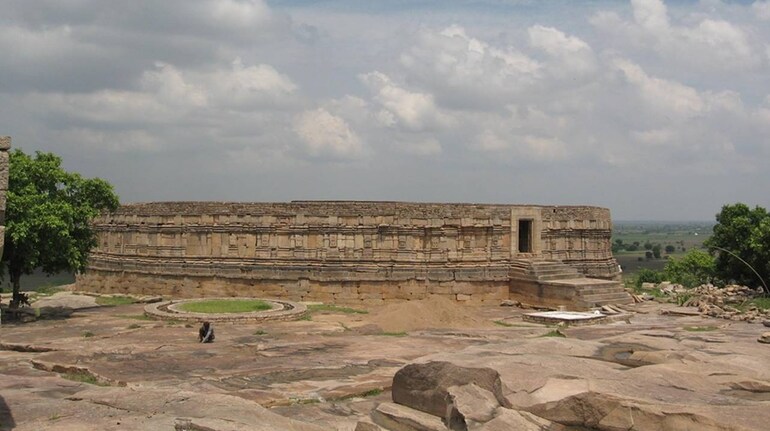
Sometime between 1979 and 1982, she was taken from her home in a village in Uttar Pradesh; carried away by a group of men. Shifted via a network of traffickers, she was taken to Europe and sold. Moving through various hands, she found herself in Paris and it was in 2013 that a woman named Martine Schrimpf ensured that she safely reached the Indian Embassy in France.
Inhabitants of roofless temples
This, however, is not about a lady but refers to a Vrishanana Yogini idol. ‘Vrishanana’ means ‘buffalo-faced’ and the idol, nearly 400 kilograms in weight, found its way into the private collection of Robert Schrimpf. After his death, his widow returned the idol. The story did not end there. A decade later, two other idols from the same temple – a Chamunda and a Gaumukhi – were found in the shed of a garden in England. The temple these idols came from was in a lonely spot and had no door, no lock, not even a roof. That was because the Yoginis needed to commune with the skies in the dark of night. Or so legends would have us believe!
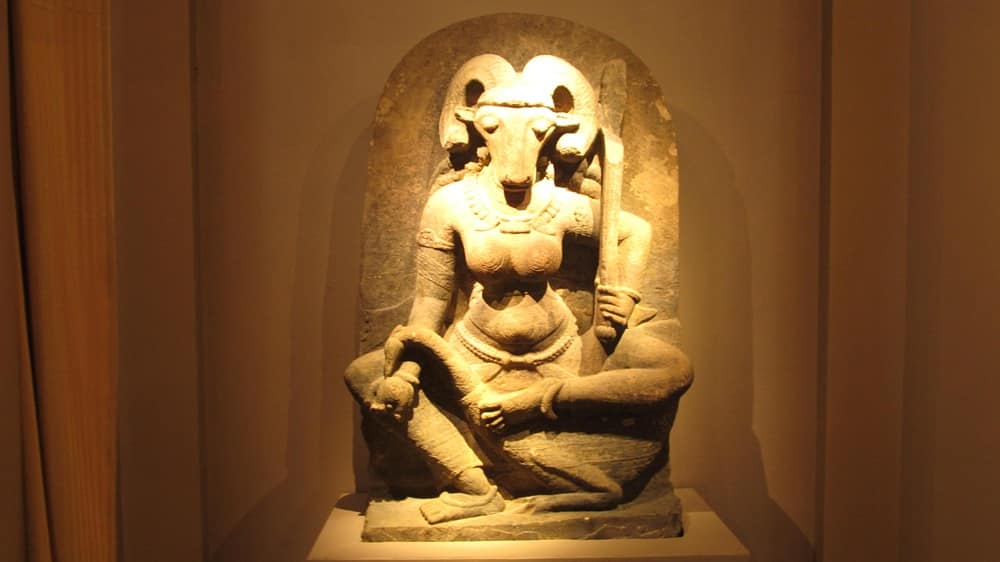 Lokhari's Vrishanana Yogini seen at Delhi's National Museum on her return. (Source: Arjun Kumar)
High noon between 9th and 12th centuries CE
The Yoginis were a branch of the Hindu pantheon that emerged between the 9th and 12th centuries CE and then faded away. Their shrines went into disuse and were abandoned, gradually forgotten though the odd place remained in worship till the 16th century. The shrines were rediscovered in the 19th century, only to become a puzzle to scholars. Unique in design because of their roofless and uniquely circular structure, the Yogini temples straddle a belt across central and eastern India, and it is in this zone that some of them are still spotted today.
Among the notable ones is a hilltop shrine at Mitaoli, in Morena district of Madhya Pradesh. Forget a shikhara and a mandapa, this is a roofless shrine built within concentric circles.
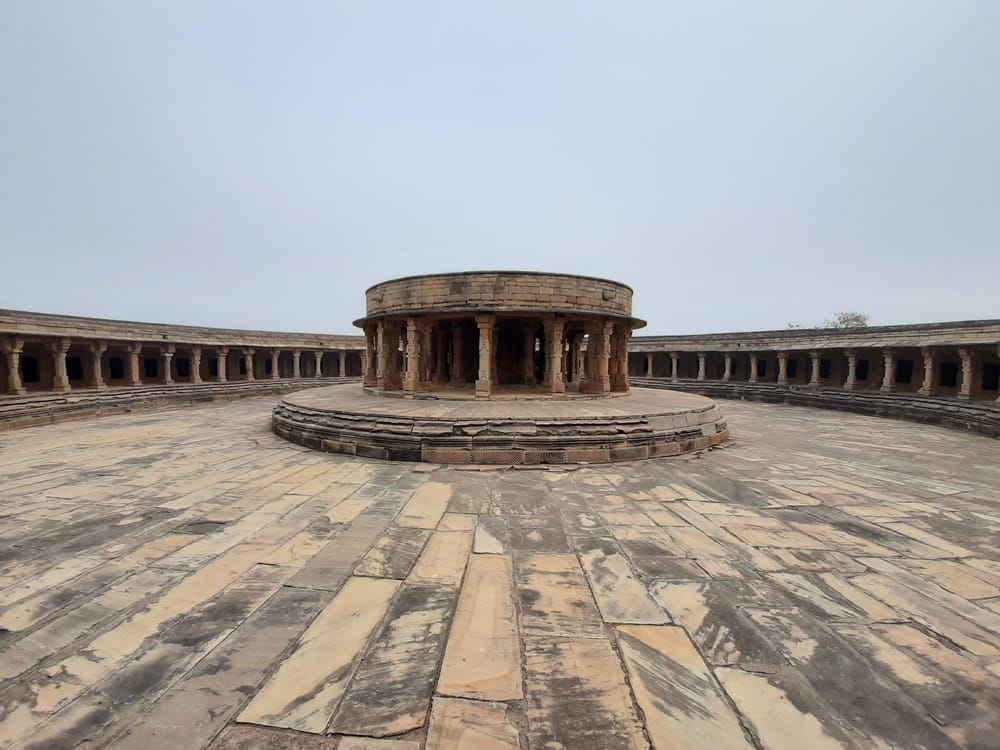 Central shrine of Mitaoli's Chaunsath Yogini Temple, which is said to have served as a prototype for the design of India's old Parliament. (Source: Arjun Kumar)
Sometimes, this shrine is spoken of as having been the prototype for the design of India’s old Parliament.
A visitor enters through a small doorway which leads into a pillared corridor running around a courtyard. Accessible from this corridor are small rooms, each containing a Shiva Linga. The Mitaoli temple is a Chaunsath Yogini shrine, which means that each of these rooms originally had a Yogini idol within, with sixty-four idols in all. But like those at Lokhari, Mitaoli’s Yoginis too have vanished. And never been traced again. In the middle of the courtyard is another circular structure, a central shrine which may have had a Shiva icon. An inscription at the site has helped identify 11th century as its time of construction.
Rectangular Yogini temple at Khajuraho
Travelling east, one finds a ruined Yogini shrine outside the village of Dudhai, in Uttar Pradesh’s Lalitpur district. From the ruins, it is apparent that this too was a circular structure. The pattern changes at a Yogini temple outside Khajuraho to a rectangle but reverts to circular at a Bhedaghat hilltop, near Jabalpur. This shrine once had eighty-one Yoginis and while several are missing, many remain in place, making it one of the few temples where one can observe Yoginis in their natural habitat. The idols are several feet high, voluptuous in design and the few whose faces are intact show expressive visages. The central shrine at Bhedaghat is a later construct and is inexplicably built off centre in the courtyard.
Yogini temples in Odisha
To see intact Yoginis one must go further east, to Odisha. Just outside Bhubaneswar, in Hirapur village, is another Chaunsath Yogini Temple. Composed of large blocks of sandstone, the structure is small, with walls barely eight feet high and a diameter less than thirty feet. While the outside wall has sculpted figures in a few niches, it is the inside that arrests a visitor.
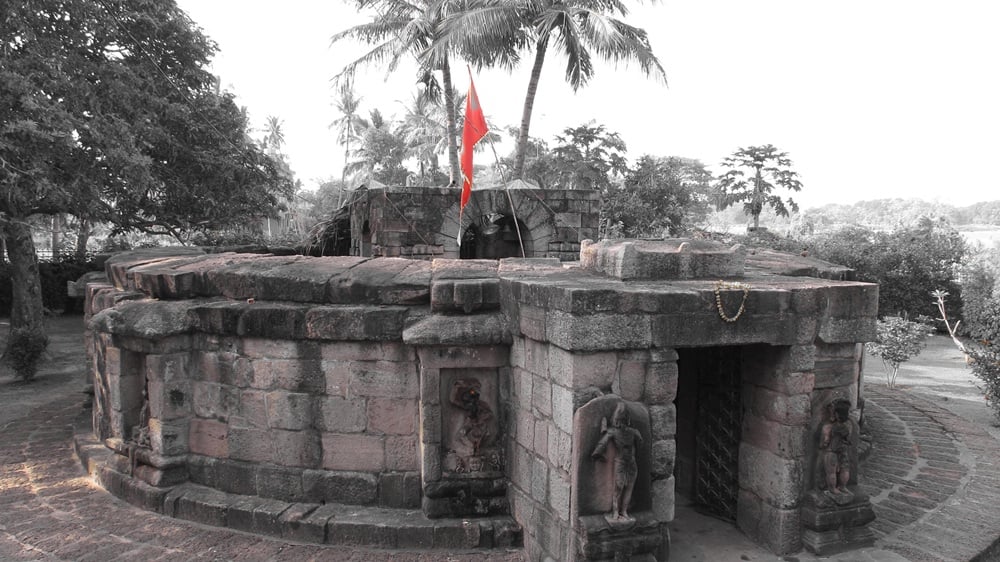 The tiny but striking Yogini Temple at Hirapur, Odisha. (Source: Arjun Kumar)
Built into niches in the circular inner wall are the Yoginis, carved from fine-grained grey chlorite. About two feet in height, each female figure is depicted with an extraordinarily beautiful body. Some have animal heads, others have a gentle smile on their visage. Ornaments and headgear, mounts and weapons have all been carved in stone, giving each figure a distinct identity. Despite damage to the idols, the refinement of the carvings is obvious. According to a count done by local historians, there are only sixty-three Yoginis, one being missing.
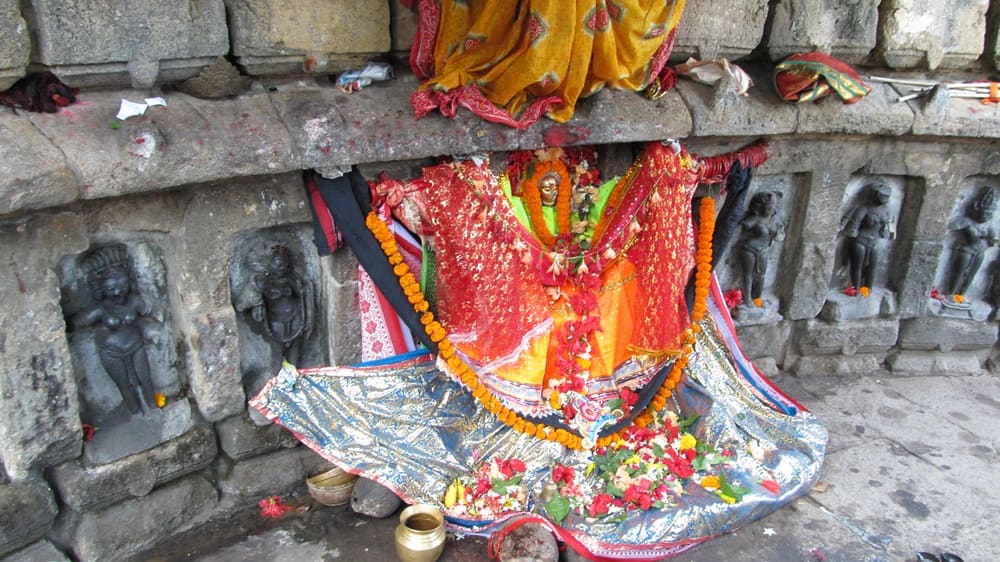 Yoginis with a central figure as primary deity in Hirapur's shrine. (Source: Arjun Kumar)
The ‘secret’ temple
In the middle of the circular structure is a small central pavilion, with sculpted depictions of Bhairava. Its inner shrine is empty, with the central icon of Shiva – perhaps in the form of a Linga – stolen decades ago. A Yogini is now in worship as the temple’s presiding deity. Incredibly, the temple was under a veil of secrecy for years, its existence coming to light only in 1953 when noted archaeologist Kedarnath Mohapatra came to know of the place.
The 9th century temple was in a state of disrepair when Mohapatra found it and he directed the restoration process. A larger Yogini shrine, with several idols in place, is in Bolangir’s Ranipur-Jharial village.
Yoginipuram to Delhi
It is believed that Delhi was once called Yoginipuram on account of the Yogini shrines here, but a relatively modern Yogini temple near Mehrauli is all that reminds one of the past. Varanasi’s narrow lanes contain a Chaunsathi Ghat with a temple, but one has to examine the blackened walls to find anything ancient here. But these are outliers, most Yogini temples were far from places of habitation and this isolation was deliberate.
The Tantric connection
Yogini worship was closely linked to Tantric rituals, in which spiritual power and liberation was sought through unconventional practices, often performed at night and in secluded spaces. The Yoginis were believed to be powerful female divinities—manifestations of Shakti, the cosmic feminine energy—who possessed supernatural abilities and were associated with transformation, protection, and occult knowledge.
In a strange acknowledgement of mystical feminine power, folks in nearby villages avoid these shrines after dark. Perhaps it was an element of that power that brought the Vrishanana Yogini home. And maybe the other lost Yoginis too will head back one day.
(Arjun Kumar is a heritage explorer by inclination with a penchant for seeking obscure sites. A brand consultant by profession, he tweets @HiddenHeritage.)
Views are personal, and do not represent the stand of this publication.
Discover the latest Business News, Sensex, and Nifty updates. Obtain Personal Finance insights, tax queries, and expert opinions on Moneycontrol or download the Moneycontrol App to stay updated!
Find the best of Al News in one place, specially curated for you every weekend.
Stay on top of the latest tech trends and biggest startup news.