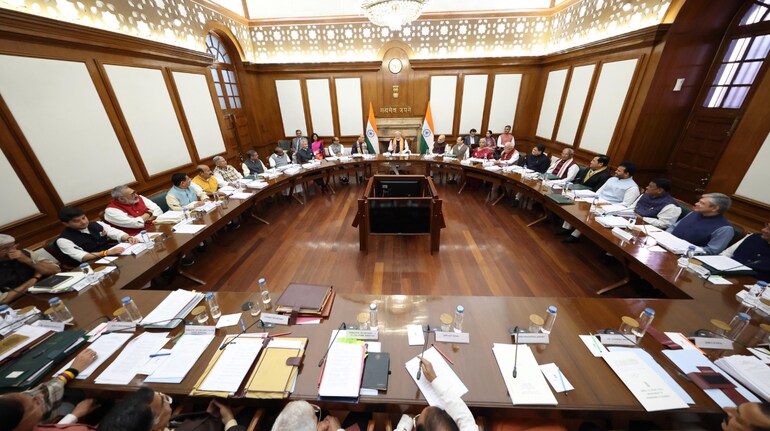

Since taking charge as Prime Minister in 2014, the Modi government has taken steady steps to move away from symbols of India’s colonial past and usher in a mindset shift. The inauguration marks a transformative milestone in India's administrative governance architecture, which has continued since the British era.
Seva Teerth houses the Prime Minister's Office, the National Security Council Secretariat, and the Cabinet Secretariat. Some of the major name changes are: South Block as Seva Teerth, Central Secretariat as Kartavya Bhavan, Rajpath as Kartavya Path, Race Course Road as Lok Kalyan Marg, and Raj Bhavans/Raj Niwas as Lok Bhavan/Lok Niwas.
For decades, several key government offices and ministries functioned from fragmented and ageing infrastructure spread across multiple locations in the Central Vista area.
The Modi government was aware of the fact that these dispersed offices led to operational inefficiencies, coordination challenges, and escalating maintenance costs. The new building complexes address these issues by consolidating administrative functions within modern, future-ready facilities.
Seva Teerth follows traditional Indian architecture and modern, future-ready politics.
The new buildings are clad in white and red sandstone, referencing material traditions found in historic Indian civic and institutional architecture.
This palette lends the structure a dignified, durable, and timeless quality while anchoring it within a recognisable cultural context.
Metal-clad domes, inspired by the Buddha Stupa, are introduced as contemporary accent elements, providing visual prominence while ensuring durability and ease of maintenance.
Jali screens are integrated along the façade to filter natural daylight into office spaces throughout the day. Beyond their environmental function, these screens reinterpret a traditional Indian architectural device that balances light, ventilation, and privacy, contributing both climatic performance and cultural continuity to the design.
The entrance portal draws inspiration from the stone screen-work of Chalukyan temples dating from the 11th to 13th centuries. The floral stone motif is derived from square-based geometric patterns traditionally found in temple panels.
The carved stone plinth band is inspired by the base mouldings of the 12th-century Chennakeshava Temple. The design features a continuous horizontal band of repetitive floral and geometric motifs, simplified and proportioned for contemporary application while retaining the essence of traditional stone craftsmanship.
PM Modi’s first decisions from Seva Teerth
The files that were first approved by Prime Minister Narendra Modi from Seva Teerth reflected a spirit of Seva and touched every section of society.
The PM signed important files relating to decisions for women, youth, and vulnerable citizens. In its very first set of decisions after shifting to Seva Teerth, the PM signed important files reflecting the spirit of Seva. These decisions touched every section of society: farmers, women, youth, and vulnerable citizens.
1. PM RAHAT Scheme: Life-Saving Protection for Every Citizen. The Prime Minister has approved the launch of the PM RAHAT scheme. Under this initiative, accident victims will receive cashless treatment of up to ₹1.5 lakh, ensuring that no life is lost due to a lack of immediate medical help.
2. Doubling of the target of Lakhpati Didis to 6 crore – The government has crossed the landmark of 3 crore Lakhpati Didis more than a year ahead of the original March 2027 timeline. The PM has now set a new, ambitious target of 6 crore Lakhpati Didis by March 2029, doubling both scale and aspiration.
3. Major Boost to Farmers: Agriculture Infrastructure Fund doubled to ₹2 lakh crore. In a move aimed at strengthening India’s entire agriculture value chain, the PM has approved doubling the outlay of the Agriculture Infrastructure Fund from ₹1 lakh crore to ₹2 lakh crore.
4. Startup India Fund of Funds 2.0 with a corpus of ₹10,000 crore: To power the next wave of innovation in India’s innovation ecosystem, especially in deep tech, early-stage ideas, advanced manufacturing, and breakthrough technologies, the PM has approved the Startup India FoF 2.0 with a corpus of ₹10,000 crore.
The historic South Block Prime Minister's Office also witnessed its last Cabinet meeting. Prime Minister Narendra Modi chaired the last Cabinet meeting held at this venue. As India, under PM Modi, moves away from the legacy of its colonial past, the South Block becomes a part of history from tonight.

Discover the latest Business News, Sensex, and Nifty updates. Obtain Personal Finance insights, tax queries, and expert opinions on Moneycontrol or download the Moneycontrol App to stay updated!
Find the best of Al News in one place, specially curated for you every weekend.
Stay on top of the latest tech trends and biggest startup news.