






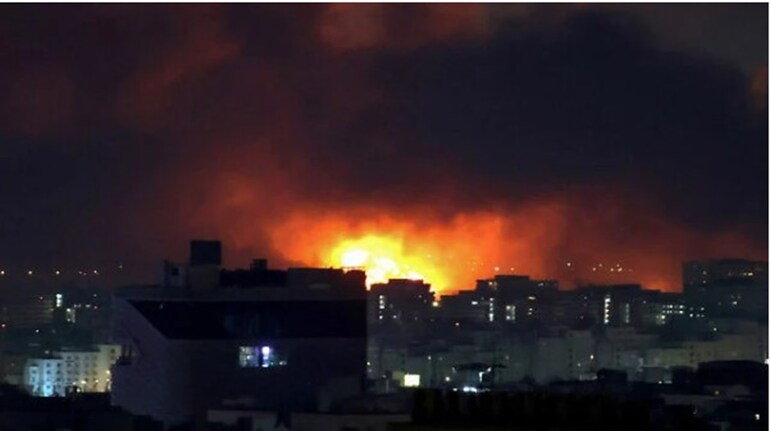
The war began with decapitation. The strikes that killed Supreme Leader Ayatollah Ali Khamenei, the chiefs of the Islamic Revolutionary Guards Corps (IRGC) and Iranian Army, and at least 40 other senior figures were the most consequential single act of military force in the region since 2003.
More than seven days later, as US-Israel pound Iran and Tehran retaliates with its missiles and drones, it is worth asking the question Washington has conspicuously avoided answering: to what end?
The military picture is clear. Iran's air force and navy have been severely degraded. Its underground “missile cities” — have been systematically targeted.
IRGC, Army, Basij headquarters struck, as also the police. The security architecture of the Islamic Republic is under sustained assault, to possibly weaken its ability to hold the country together.
Although the political objective has never been formally stated, regime change hovers over this conflict. On day one, Trump called on Iranians to rise and urged IRGC soldiers to lay down their arms, and called it 'a once in a generation opportunity.'
Israeli PM Benjamin Netanyahu echoed him saying they are going to create the conditions for people to take over. As recently as March 6, Trump has repeated the call — while his own officials refuse to list regime change among the stated objectives. If the goal is regime change, the campaign is insufficient: destroying missiles does not produce a replacement government. If it is only military degradation, the uprising rhetoric raises expectations that will likely not be met.
A ground war in Iran would be another misadventure for the US, far worse than the open desert of Iraq in 2003. The Zagros and Alborz ranges favour the defender, and Iran has said it is ready for a ground invasion.
This is the administration that ran on ending the forever wars. A ground element in Iran would be the largest American military commitment since Iraq, in harder terrain. There is no opposition in Iran which can be expected to fill the vacuum. The son of the former Shah of Iran is not a credible alternative.
What's more dangerous is the idea of propping Iranian Kurdish forces based in Iraq to seize territory in Iran's northwest. US-Israel have bombed the border defences in these areas so as to facilitate possible ingress for the Iranian Kurds. Reportedly, the CIA has been arming them.
Tehran has read this play sending IRGC reinforcements and has already struck Kurdish positions in Iraq in a pre-emptive warning. If the US goes ahead with this plan, it will lead to an insurgency which will have a cascading effect in Iraq, Syria and Turkey, which also have Kurdish populations with separatist movements.
The US has lost three F-15 Strike Eagles — reportedly in a friendly fire incident involving a Kuwaiti F/A-18 — and confirmed six soldiers killed, though Iran claims casualties in the hundreds. Each loss carries weight in a country where 60 percent oppose the war and only 26 percent approve.
The Senate voted 53 to 47 against curtailing war powers — a party-line margin, not a mandate. Satellite imagery suggests that Iran has destroyed $500 million radar of the THAAD missile defence system in Jordan. Similar losses have been seen in Saudi Arabia and UAE. Reportedly, Russia has been providing intelligence to Iran to help it target these systems.
Iran's losses are significant with over 1000 reported to have been killed. Its Air Force, made up of Shah-era US jets and Russian origin jets, has been degraded. Its navy has lost over 30 vessels damaged or sunk — including a warship torpedoed off the coast of Sri Lanka, extending this conflict far beyond the Gulf. But it's too soon to count Iran as a spent force. Which is why the US timeline estimates for the war keep stretching.
For Iran, time is on its side, so is its geography, and the interceptor-depletion problem may yet work in its favour.
Rubio explained that the US entered this war because Israel was going to strike regardless, and because Iran would eventually have struck at the US. It explains the trigger — though not convincingly. It does not articulate the political objectives. And it reveals that Israel's objectives are baked into this campaign in ways that may not align with American interests.
Washington, if it is thinking clearly, would want a post-conflict Iran weakened but coherent. It will not want a collapse or fragmentation of the country.
Israel may find a fragmented, destabilised Iran strategically preferable, indicated by its warning that it will eliminate whoever is the next Supreme Leader of Iran. These are incompatible visions, and the silence around that divergence is one of the most dangerous things in Washington right now.
Iran has struck every Gulf Arab state — targeting airports, hotels, oil facilities, along with US military installations. Its logic appears to be to raise costs, force the Arabs to put pressure on the US to end the conflict, and make the world feel the pain of the war through rising oil and gas prices and increasing risks to global trade.
However as a result of the US-Israeli frantically hunting and destroying Iranian launchers and missile storage, Iran's missile and drone attacks have fallen 86 percent since the opening days, as stated by CENTCOM — corroborated by the UAE and Qatar's defence ministry tallies of projectiles detected and intercepted. The barrages of day one and two, when Iran started its retaliation, especially in response to Khamenei’s killing, have sharply diminished since.
But the 86 percent figure contains a warning alongside its claim of success. Patriot batteries, THAAD, and Arrow interceptors are very expensive and not infinite. Gulf Arab states have requested replenishment and received no response, fuelling resentment as the US prioritises its own stocks and Israel's.
If Iran retains enough residual capacity to sustain even a reduced rate of fire over the coming weeks, the arithmetic of missile defence begins to shift. That is almost certainly part of Tehran's calculus.
Importantly, Iran's campaign has destroyed the détente it had achieved with Riyadh and Abu Dhabi. While the Arab states continue to deny their airspace to US offensive operations against Iran, and have exercised restraint in undertaking their own retaliation inside Iran, the détente is gone, despite Iran saying that it holds no grudges against its neighbours and is only defending itself against the US and Israel.
On March 7, Iranian president even apologised to its neighbours for the attacks and informed that his country will not target them anymore unless attacks on his country originate from them.
There is potential for trouble inside the regime itself over the succession of Ali Khamenei, with his son Mojtaba, backed by the IRGC, is projected to be the front runner. But his credentials that are required to hold the position are said to be thin as he does not command the senior jurisprudential standing.
Importantly, the dynastic dimension will undermine his legitimacy in a republic that was founded by overthrowing a monarchy.
If Mojtaba is installed, it will concentrate power around the IRGC, bringing uncertainty as to how that plays out within Iran and for the region.
(Yusuf T Unjhawala is an adjunct scholar at the Takshashila Institution. He tweets at @YusufDFI.)
Views are personal and do not represent the stand of this publication.
Discover the latest Business News, Sensex, and Nifty updates. Obtain Personal Finance insights, tax queries, and expert opinions on Moneycontrol or download the Moneycontrol App to stay updated!
Find the best of Al News in one place, specially curated for you every weekend.
Stay on top of the latest tech trends and biggest startup news.




