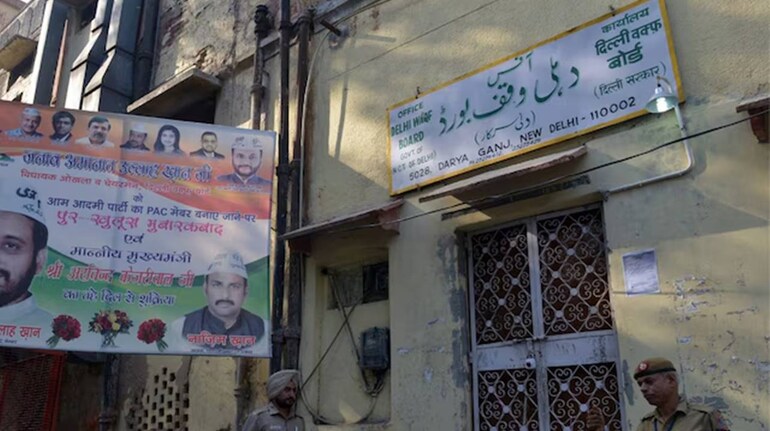
On August 8, 2024, two bills, the Waqf (Amendment) Bill, 2024, and the Mussalman Wakf (Repeal) Bill, 2024, were introduced in the Lok Sabha to streamline the Waqf Board's work and ensure the efficient management of Waqf properties. It was then referred to a Joint Parliamentary Committee (JPC) for scrutiny following objections from the Opposition.
Of the committee’s 21 Lok Sabha and 10 Rajya Sabha members, 13 were from Opposition parties – nine in the Lower House and four in the Upper House. Following 34 meetings spread across different cities, the JPC tabled its report on February 13 during the budget session.
The tabling of the JPC report caused much uproar in both houses of the Parliament as opposition members alleged that the JPC on the Waqf Bill is "biased" and “one-sided", a charge refuted by the government. According to a report published by The Hindu JPC accepted 32 amendments moved by BJP and its allies, however, all the amendments moved by the Opposition were rejected.
It leads to the question: Why haven’t politicians been able to find common ground?
The objective of Waqf (Amendment) Bill, 2024
According to an explainer published by the Ministry of Minority Affairs the objective of the Waqf (Amendment) Bill, 2024, is to amend the Waqf Act, 1995, to redress the issues and challenges in regulating and managing waqf properties.
There have been major points of disagreement on the Bill, but some of the most contentious has been on the issue of the inclusion of non-Muslims in the Board.
Inclusion of non-Muslims
Section 9 of the Waqf Act, 1995 specifies the constitution of the Central Waqf Council. According to the amendment bill, the composition is more or less the same except that now two non-Muslim members shall also be appointed on the Board.
As per Section 14 which specifies the Composition of the Waqf Board, the composition is more or less the same except only two members shall be women, and now two members shall be non-Muslim, “at least” one member each from Shia, Sunni and other backward classes among Muslim Communities and one member from Bohra and Aghakhani shall be nominated if they have functional auqaf in State.
According to a PRS analysis, "The Waqf Acts of 1913, 1923, 1954 and 1995 required waqf to be created according to Muslim law. The Muslim Personal Law (Shariat) Application Act, 1937 specifies that in all questions regarding waqf, the rule on decisions where the parties are Muslims shall be the Muslim Personal Law (Shariat). They are thus special laws for Muslims, in contrast with secular laws such as the Indian Trusts Act, 1882 and the Societies Registration Act, 1860, which also allow for the creation of institutions for charitable purposes. The Act required the bodies governing waqf to be exclusively constituted of Muslim members. The Bill amends this to require non-Muslim members in the bodies."
Also, as reported by The Hindu “Nearly all the dissent notes filed by the Opposition have criticised this provision”. According to the report, AIMIM’s Asaddudin Owaisi remarked, “Comparisons with analogous statutes governing the management of Hindu, Sikh, and other religious endowments highlight the discriminatory nature of this amendment.”
According to the report Owaisi cited the Tamil Nadu Hindu Religious and Charitable Endowments Act, 1959, and the Sikh Gurdwaras Act, 1925, which dictates that only members of the respective religious communities are eligible for the membership of governing bodies, to support his argument.
“Waqf by User
The Act allows waqf to be formed by: (i) declaration, (ii) recognition based on long-term use (waqf by user), or (iii) endowment when the line of succession ends (waqf-alal-aulad). However, the amendment bill states that only a person practising Islam for at least five years may declare a waqf. It clarifies that the person must own the property being declared.
It removes 'Waqf by User', where properties could be deemed as waqf based solely on prolonged use for religious purposes.
It also adds that waqf-alal-aulad must not result in the denial of inheritance rights to the donor’s heir including women heirs.
Issue of declaration of government property as Waqf.
As clarified in an explainer published by the Ministry of Minority Affairs, according to the amendment bill, any government property identified as waqf will cease to be so. The Collector of the area will determine ownership in case of uncertainty and submit a report to the state government. If deemed a government property, he will update the revenue records. It is also important to note that earlier, the Waqf Act empowered the Waqf Board to inquire and determine if a property is a waqf. The Bill removes this provision.
Among the other amendments adopted by the panel include the decision to do away with vesting any inquiry into disputes over a government property with the District Collector concerned. The amendment proposed by BJP MP Brij Lal said the “State government may by notification, designate an officer above the rank of collector” to carry out an inquiry, as per law.
This provision was also questioned by Muslim representatives who argued that the Collector being the head of the revenue records cannot be an impartial judge to such disputes. In the context of the survey of Waqf earlier, the Waqf Act provided for an appointment of a Survey Commissioner and additional commissioners to survey Waqf.
The Bill instead empowers Collectors to do the survey. Pending surveys will be conducted as per the state revenue laws. This has also been a point of contention as some of the opposition MPs, in their dissent note, have said that the issue should be considered as a civil dispute to be adjudicated in the courts.
Discover the latest Business News, Sensex, and Nifty updates. Obtain Personal Finance insights, tax queries, and expert opinions on Moneycontrol or download the Moneycontrol App to stay updated!





Find the best of Al News in one place, specially curated for you every weekend.
Stay on top of the latest tech trends and biggest startup news.