In the middle of the Delhi summer this year, President Droupadi Murmu invited students from across the country to introduce them to the future of technology for the society. Navachara, a new art gallery at the Rashtrapati Bhavan, was fed by Artificial Intelligence (AI), much to the amusement of the young visitors.
State-run galleries, like Navachara in the Rashtrapati Bhavan, are leading a technological innovation for the future of museums in the country. Developed by the President's estate with technical assistance from American technology giant Intel India, the AI-enabled gallery offers an immersive experience for visitors about the history of the heritage building housing the first citizen.
Among the visitors to the Rashtrapati Bhavan in July were some students, who were creators of the AI-enabled exhibits of the new Navachara gallery. According to Intel India, the gallery is aimed at promoting AI-driven innovation while improving digital literacy and creativity in the student community.
The new Rashtrapati Bhavan AI-enabled gallery, which reflects the country's status as a software superpower, arrives in a year that has been marked by many technological interventions in art, both in the public and private institutions.
The National Museum, which is governed by the Union Ministry of Culture, introduced Machine Learning, augmented reality (AR) and high-definition robotic cameras to help art enthusiasts enhance their museum viewing experience this year.
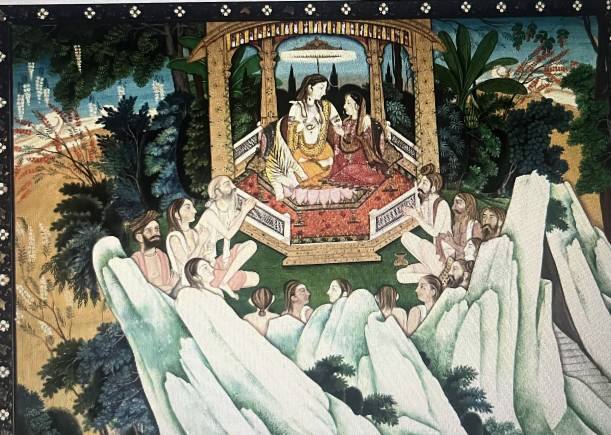 Artificial Intelligence-enabled viewing experience of miniature paintings at the National Museum, Delhi. (Image courtesy National Museum)
A dedicated technology-aided gallery, named Pocket Gallery by the National Museum in New Delhi, opened a virtual collection that allowed people to view AI and AR-aided art works, especially the museum's collection of miniature paintings, with the click of a button on their smartphones. Built in collaboration with Google Arts & Culture, a partnership of the American multinational company with cultural institutions across the world, National Museum's miniature paintings were made available on the online platform of Google Arts & Culture.
According to Google Arts & Culture, the Life in Miniature project, a virtual collection within a technology-enabled traditional Indian architecture, inaugurated by Union Minister of State for Culture and Tourism Prahlad Singh Patel, allows visitors to watch the works from a mammoth collection of miniature paintings, including on the Ramayana.
The year 2023, which witnessed the world's first sculpture created using Artificial Intelligence (AI) at the National Museum of Science and Technology in Stockholm, Sweden, has ushered in technological innovations in private art institutions too in the country. The Bengaluru-based Museum of Art & Photography (MAP) partnered with American software company Accenture to introduce an immersive viewing experience for visitors this year.
According to Abhishek Poddar, the founder of MAP, the collaboration with Accenture would help the museum engage with the new generation of museum-goers in the country. Among the new technologies used by the museum are face superimposition and speech synthesis based on deep learning and generative AI models.
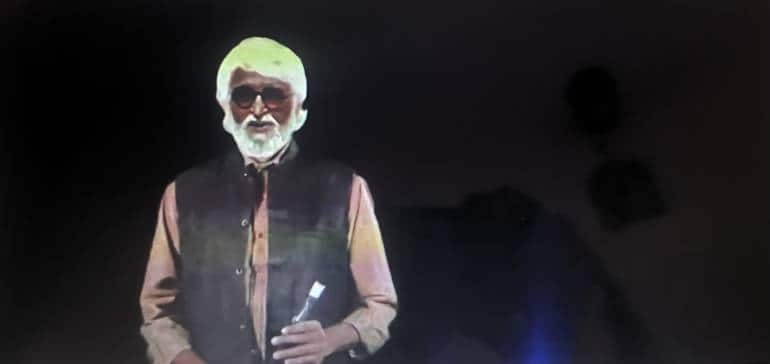 The ‘digital persona’ of MF Husain at the Museum of Art & Photography, Bengaluru. (Image courtesy MAP, Bengaluru)
The "conversational digital persona", as MAP describes the new AI-driven technology of museum viewing, is that of the late artist MF Husain. The digital persona of the famous artist is even able to respond to questions from visitors aided by speech synthesis software. The museum launched the "conversational digital persona" of Husain in February this year with a hologram.
The MAP Labs, as the digital initiative is called, is a technological collaboration of institutions, including technology companies, startups and universities working towards new opportunities offered by fast-paced progress in development of AI applications. For the "digital persona" of Husain, MAP Labs, which conducted extensive research on the artist's life and work, partnered with Accenture Labs.
The merger of art with algorithms, which began as a creative tool, like the AI artwork that was sold for 432,500 dollars in a Christie's auction five years ago, entered the area of museums and exhibitions in the country this year to transform the viewing experience. Last year, a photography biennale in Australia instituted an AI Award for works using technology.
Interwoven, another technology-driven project by MAP, this time with the American technology major Microsoft, helped build an online viewership for the museum during the coronavirus pandemic. Interwoven, an exhibition on the history of South Asian textiles, announced the arrival of digital museums in the country.
Indian museums are today spoken in the same breath as the Metropolitan Museum of Art, New York, the Victoria and Albert Museum, London, the Smithsonian in Washington, and Musée des Plans-Reliefs, Paris that are all regularly mounting AI-enabled exhibitions. Technology companies have enthusiastically joined the bandwagon, making massive investments, like Microsoft's AI for Cultural Heritage, launched four years ago.
“We’ve always wanted to be the museum for the future, experimenting and pushing the boundaries of what technology can do in the museum space as a meaningful tool for improving access and enhancing cultural experiences,” says MAP's Poddar, a prominent art collector.
Discover the latest Business News, Sensex, and Nifty updates. Obtain Personal Finance insights, tax queries, and expert opinions on Moneycontrol or download the Moneycontrol App to stay updated!
Find the best of Al News in one place, specially curated for you every weekend.
Stay on top of the latest tech trends and biggest startup news.