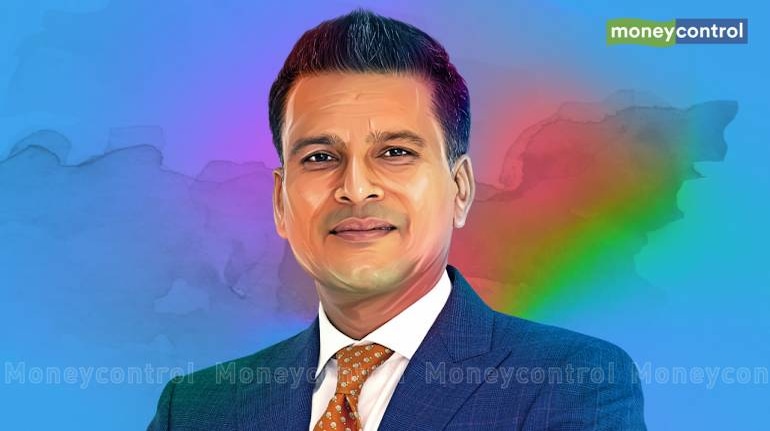
JSW Energy is looking at 6,000-7,000 MW (6-7 GW) of group captive renewable energy capacity within the Sajjan Jindal-led JSW Group, which, apart from energy, has a presence in cement, infrastructure, paints, and steel. In an interview with Moneycontrol, Prashant Jain, Joint Managing Director (Jt MD) and Chief Executive Officer (CEO) of JSW Energy Ltd, tells how 2025 will be a significant year for the company, as by then it would commission a solar module manufacturing factory, a green hydrogen production unit, and a battery energy storage system.
Edited excerpts of the interview:
JSW Energy’s year-on-year net profit and revenue have both declined, but EBITDA has increased 18 percent in the first quarter ending June 2023. Tell us the factors that led to such a performance.Our EBITDA was up 18 percent, but in reality, it is up by about 29 percent. Nearly Rs 30 crore-odd of EBITDA could not be consolidated, which is from our Mytrah asset, because refinancing for some of the SPVs took longer than expected, and on a pro-forma basis, Rs 30 crore of EBITDA has gone into the reserves of those companies. Otherwise, it would have gone up by Rs 30 crore. Another Rs 80 crore is from our hydro project and the Barmer thermal power asset. This is the EBITDA that will get recouped in the subsequent quarters during the current financial year because all these assets are on a two-part tariff PPA basis, where either we have to achieve the design energy or we have to achieve the minimum availability of the plant, which, historically, we have been achieving. So, that adds up to Rs 110 crore that has not come during Q1 FY24, which will be coming up in the subsequent quarters of the current financial year.
Coming to profit after tax (PAT), in Q1 FY23, there was a one-time recovery of Rs 120 crore. So, the PAT of Q1 last year was inflated by that amount as an exception.
Another reason was that we had a lower merchant contribution during the quarter because, in April and May, the power demand was either flat or negative due to unseasonal rains. But in June, the power demand rebounded, and it was up 4.5 percent. And now in July, at the peak of the monsoon, we are witnessing a 5.5 percent increase in power demand.
Now the merchant tariffs are also pretty good. They are about Rs 5.5. So, we are quite optimistic for the year as a whole. But overall, we are very happy with the performance in Q1 of FY24. If you look at the country as a whole, Q1 saw an increase in merchant volume by 14 percent and the power tariff was Rs 5.1 per unit.
What about fuel prices? Have they declined further?Coal prices in March were around $137-$140, and during the quarter they averaged out to be $114-$115. Now, as we speak, they have come down to double digits.
Beyond Ind-Barath, does JSW Energy have any plans to add more thermal capacity?As of now, no. But we are not averse (to it). In case, we find a good opportunity to grow our thermal business, we will look into it. But at this point in time, we are concentrating more on renewable assets. There is nothing in the pipeline (for thermal capacity) beyond Ind-Barath.
We are continuously engaging in the consolidation of opportunities in the market. There are a few good opportunities that we are looking at as well. But we always weigh the opportunity compared to whatever we are doing organically. Any time we see a great opportunity where the returns are better inorganically, we then move for acquisition. Otherwise, we continue to grow organically.
When you say organically, what are the various options the company is weighing?By organically I mean, like right now, we are building SECI projects as well as group captive projects. Going forward, JSW Group is also looking at decarbonisation. There is a potential to do close to 6,000-7,000 MW group captive projects in the next three to five years for the JSW Group alone. So, it is mostly going to be these two – SECI projects and within JSW Group.
The government has initiated the process of launching a domestic carbon trading market. Does JSW Energy have any plans on that front?All the RE projects that we are building will be registered under that segment, and we will be looking at the carbon credit market. We are already getting carbon credits, which we are trading overseas. These are being purchased by companies that are present in Europe, the US, and various other parts of the world. Eventually, when India deepens this market and Indian companies start buying it, we will also be trading there (in the upcoming domestic carbon trade market).
We are already an active participant in the international carbon credit market. Currently, we have close to 20-21 million accumulated carbon credits, which we trade overseas. Going forward, as our portfolio increases, we will generate more carbon credits, which we are excited to trade in India.
What happened to the plan to sell some stakes in JSW Neo, the RE arm of JSW Energy?We are looking for a value-unlocking opportunity. We are also seeing very active engagement by strategic investors and their keenness to participate in the Indian growth story through JSW Neo. I cannot comment any further on this, but in the near future, it is going to be a reality.
When is the company’s green hydrogen project scheduled for commissioning, and are there any logistical hurdles?The project will be completed by March 2025. We have already created our own microgrid for the electricity that we are harnessing from solar and wind farms. The renewable power is coming through a dedicated transmission line to the JSW Steel premises, where the electrolyser will be set up, and green hydrogen and green oxygen will be supplied to them. So, there is no transportation involved in the distribution of power or green hydrogen.
Give us an update on your energy storage projects – battery and pumped storage. Also, when will the solar module factory be ready?The battery energy storage project is expected to be commissioned by October 2025. We are in the process of finalising the contracts and other things. Engineering is complete.
As regards pumped storage, we are expecting the project to go into construction mode during the current financial year. And then, after that, it will take 36 months to commission that project.
As for the solar module manufacturing unit, we have finalised the location in the state of Rajasthan. Right now, engineering and the finalisation of contracts are going on. That project will also be completed by March 2025.
Discover the latest Business News, Sensex, and Nifty updates. Obtain Personal Finance insights, tax queries, and expert opinions on Moneycontrol or download the Moneycontrol App to stay updated!
Find the best of Al News in one place, specially curated for you every weekend.
Stay on top of the latest tech trends and biggest startup news.