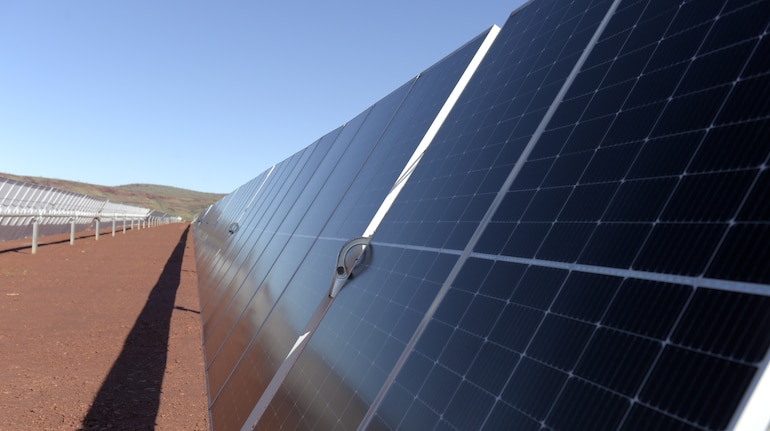
The Indian government is stepping up efforts to guard against the risk of rising retail electricity tariffs as renewable energy takes up a larger share of the country’s generation mix, senior officials told Moneycontrol, adding that NITI Aayog is preparing a white paper on the infrastructure needed to integrate renewables without burdening consumers.
The concern comes despite the fact that renewable power has become significantly cheaper to produce than fossil fuel-based electricity. About 91 percent of new utility-scale renewable power projects globally in 2024 were more cost-effective than the cheapest new fossil alternatives, according to the International Renewable Energy Agency (IRENA).
“India now has among the lowest renewable energy costs globally, with new solar-PV and wind already cheaper than new coal-based capacity,” a government official privy to the matter said. “The key is to manage the integration costs properly, or else consumers may face tariff shocks like those reported in parts of Europe and Australia.”
Integration Drives Tariffs
In several high-renewable economies, falling generation costs have not prevented retail tariffs from rising. An official from the Central Electricity Authority (CEA) stated that India’s rapid growth in renewable capacity — which pushed the country’s non-fossil share above 50 percent of installed capacity earlier this year — is straining transmission networks and increasing supply costs for distribution companies. “If the necessary grid investments do not catch up, these pressures can ultimately show up in consumer bills,” the official said.
Atanu Mukherjee, CEO Dastur Energy, Niti Aayog’s consulting partner, told Moneycontrol that India’s biggest challenge currently is not renewable capacity—it is renewable integration. “We can keep adding cheap solar and wind, but that does not mean electricity will automatically become cheaper for consumers. Solar may cost Rs 2 in Rajasthan, but delivering that same power reliably, round-the-clock, to a home in Delhi requires transmission lines that are often underutilized, storage systems, flexible thermal plants that can ramp sharply, grid-stability equipment, and a distribution network capable of handling variability. If we don’t build all these elements together, retail tariffs will rise, not fall,” he said.
Lessons from Other Countries
Officials and experts said that Germany, California, Denmark, the UK and Australia all saw retail power prices rise even as renewable-generation costs fell. In Germany, despite renewables exceeding 40 percent, demand-centres such as industries are far from the wind farms — forcing expensive HVDC lines which increased electricity bills to 40–45 cents per kWh.
California faces the classic “duck curve” - solar oversupply during the day, followed by a steep evening ramp that forces expensive gas plants and large battery systems to come online, thereby rising power tariffs.
In Denmark and the UK, system-balancing costs have soared as grids struggle to manage intermittent renewable output.
Australia has faced similar challenges, with most renewable capacity located far from major demand centres and transmission infrastructure lagging behind.
India will begin facing the same pressures when renewables reach about 20–25 percent of actual generation, which could happen within the next five to seven years, said Mukherjee.
“Our grid is strong but built on an older philosophy where generation was centrally controlled. With renewables, we lose control over where and when electricity is produced—sun and wind appear where nature allows. That means low utilisation of long-distance transmission, more need for stabilization systems, and greater dependence on backup power – issues that need to be tackled now,” he said.
India is targeting 500 GW of non-fossil power capacity by 2030. An official from the Ministry of Power said that careful planning of integration costs is being done to keep the clean-energy transition both sustainable and affordable.
Discover the latest Business News, Sensex, and Nifty updates. Obtain Personal Finance insights, tax queries, and expert opinions on Moneycontrol or download the Moneycontrol App to stay updated!
Find the best of Al News in one place, specially curated for you every weekend.
Stay on top of the latest tech trends and biggest startup news.