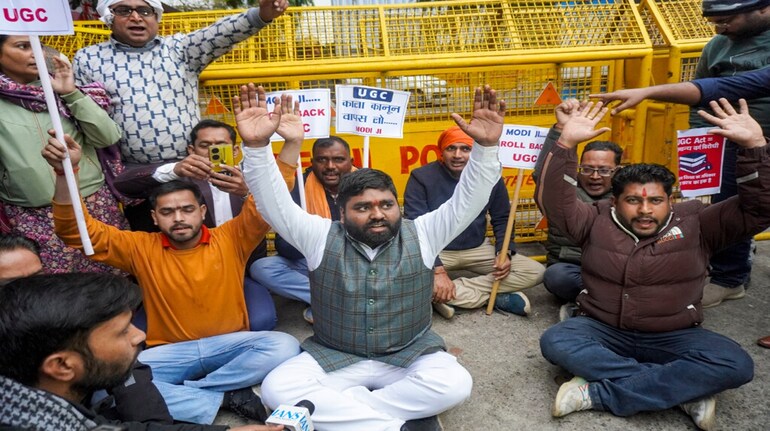

As anger simmers on campuses and in sections of academia over the UGC's 2026 equity regulations, the most striking feature of the controversy is not the protests or the petition in the Supreme Court but the calculated restraint of the Opposition.
From Congress to the Samajwadi Party and beyond, parties that have historically built their politics on social justice, or made a pivot to contain the damage from the BJP's rise by latching on to issues such as caste census and reservations, have conspicuously avoided leading the charge, revealing how the issue has boxed them into a corner.
The University Grants Commission (Promotion of Equity in Higher Education Institutions) Regulations, 2026 aim to mandate Equal Opportunity Centres, equity committees and stricter institutional accountability to address discrimination in higher education. While upper caste groups, seen as a loyal vote base of the ruling BJP, argue the rules centralise power and open the door to misuse, the political optics appear to have equally cornered Opposition parties that have spent the last two years pitching themselves as champions of OBC, Dalit and minority empowerment.
For the Congress, which has made the caste census the centrepiece of its post-2024 revival strategy, opposing an "equity framework" would directly contradict its own political messaging. Rahul Gandhi's repeated calls for "jitni abadi, utna haq" have locked the party into a pro-reservation posture -- a departure from the party's long-held stance on the issue -- and left it little room to criticise regulations framed around inclusion, even if concerns exist about process and federalism.
A senior Congress leader privately admitted, "If we oppose this openly, BJP will brand us anti-Dalit and anti-OBC in one day. We are not going to give them that weapon."
For parties like the Samajwadi Party, RJD and JD(U), the dilemma is deeper. Their political identity is rooted in the Mandal movement, and any resistance to equity-linked regulations risks alienating their core social base.
SP chief Akhilesh Yadav has so far limited his response to general remarks on "consultation" rather than attacking the rules themselves. "Social justice cannot be weakened, but policies must be framed with dialogue," he said at a recent event, carefully avoiding a direct confrontation with the Centre.
RJD leader Tejashwi Yadav echoed a similar line, saying, "The intention must always be to strengthen representation, not dilute it. The government must clarify doubts," stopping short of demanding a rollback.
The message is clear that none of these parties can afford to be seen standing on the same side as upper-caste student groups opposing the rules, even if administrative concerns exist.
This political restraint is also one reason that has left the protests largely leaderless and fragmented, driven by student groups and faculty bodies rather than parties. Even where state leaders have spoken up, the tone has been cautious. In Haryana, Congress leader Rao Narendra Singh criticised the Centre for undermining state autonomy, but avoided questioning the equity principle itself. In Uttar Pradesh, Azad Samaj Party leader Chandra Shekhar Aazad defended the idea of equity while attacking the BJP for "selective justice".
This selective criticism explains why national Opposition leaders have not hit the streets. A Congress strategist summed it up bluntly: "This is not a farmers' protest. There is no clean political upside."
The legal challenge to the rules in the Supreme Court has also provided political cover. By letting the judiciary examine constitutional validity, Opposition parties can outsource confrontation without owning it. "The matter is sub judice, and we respect the court," has become a convenient holding line.
The Centre's assurances that safeguards will be built in, and that the UGC will issue clarifications to prevent misuse, may have further diluted the Opposition's appetite to escalate. With the government framing the rules as a continuation of the 2012 anti-discrimination framework, outright opposition risks appearing obstructionist rather than reformist.
For now, the Opposition's silence is less confusion and more political compulsion. And until the courts intervene or the Centre amends the rules substantially, the Opposition appears content to let the controversy burn without stepping into the fire.
Discover the latest Business News, Sensex, and Nifty updates. Obtain Personal Finance insights, tax queries, and expert opinions on Moneycontrol or download the Moneycontrol App to stay updated!
Find the best of Al News in one place, specially curated for you every weekend.
Stay on top of the latest tech trends and biggest startup news.