
The Enforcement Directorate's raids at premises linked to the Indian Political Action Committee (I-PAC) in West Bengal's Kolkata on Thursday has triggered a political firestorm in the poll-bound state.
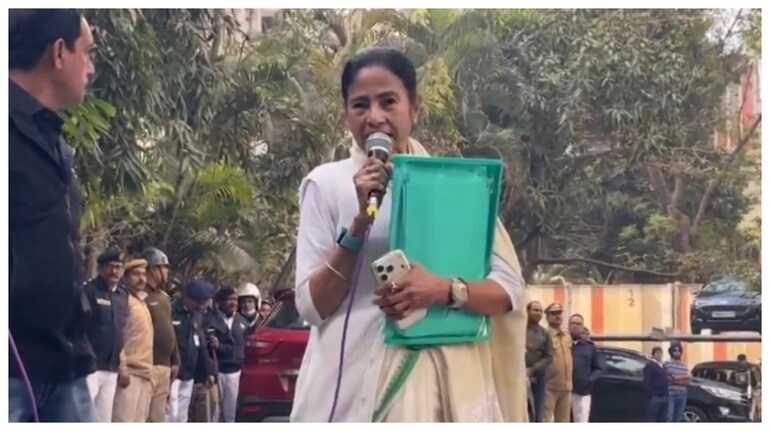
As the raids continued, Mamata made a stunning dash to I-PAC chief Pratik Jain's residence and alleged that the ED wanted to seize sensitive documents of the Trinamool Congress, including its candidate lists for the upcoming polls, at the behest of Union Home Minister Amit Shah.
The agency shot back saying that its raids were not political but were linked to a coal scam and that there were specific allegations against the I-PAC chief linking him to hawala transactions and cash deals connected to the multi-crore swindle. The ED has also approached the Calcutta HC in the matter alleging obstruction of searches by the Chief Minister. The agency also accused Mamata of walking away with crucial documents linked to the scam. The matter is expected to be taken up by the High Court on Friday.
The optics of a sitting Chief Minister confronting the central agency pointed to a deeper reality. The I-PAC was no longer a backstage consultant in West Bengal, but had evolved into a critical cog in the Trinamool Congress' electoral machinery.
Officially, the ED has said the searches were linked to a money-laundering probe related to the coal pilferage case. The TMC, however, has framed the action as an attack on its campaign infrastructure. Mamata Banerjee alleged that agencies were being used to destabilise her party ahead of the 2026 Assembly elections, a charge the BJP has rejected.
Beyond the optics, there is a key takeaway from the entire drama that continues to unfold in Bengal's political epicenter -- of I-PAC's proximity to the TMC's core decision-making. Party insiders have often acknowledged that the consultancy has been deeply involved in surveys, booth-level feedback, voter profiling and campaign messaging since the run-up to the 2021 Assembly elections — a role that has only expanded since.
Founded by Prashant Kishor after the BJP's 2014 Lok Sabha campaign, I-PAC initially functioned as an extension of Kishor's personal political brand. That changed after Kishor formally exited day-to-day political consulting and stepped away from the organization to launch Jan Suraj, his own political outfit.
In West Bengal, however, I-PAC's association with the Trinamool Congress only strengthened. The consultancy played a significant role in the 2021 Assembly campaign, when the TMC defeated a high-decibel BJP challenge to return to power with a resounding mandate of 213 of 294 seats. It later continued to support the party through the 2023 panchayat elections and the 2024 Lok Sabha polls, where the TMC won 29 of the state's 42 seats.
While Kishor is no longer formally associated with I-PAC, senior political observers and party functionaries say his strategic imprint remains visible in the firm's methods of data-driven messaging, hyper-local feedback loops and constant course correction based on voter sentiment.
According to multiple accounts, I-PAC conducts extensive ground surveys across constituencies, feeding real-time inputs to the TMC leadership. Its recommendations have reportedly influenced candidate selection and their "winnability" assessments, messaging around welfare schemes and women voters, and counter-narratives to BJP campaigns on nationalism, religion and corruption.
In strong indications of the trust the party places in the consultancy's assessments, a senior I-PAC functionary told The Print earlier that its survey-based inputs are "rarely ignored" by the TMC's top leadership. There have also been reports of how the I-PAC's suggestions prevailed despite internal discord within the party.
Mamata Banerjee's sharp response to the ED raids, thus, needs to be seen in the same context and as a signal of how integral the consultancy has become to the party's electoral readiness. With the BJP intensifying its Bengal push and the 2026 elections just months away, any disruption to campaign planning is seen as politically costly.
For the BJP, the controversy serves a dual purpose of keeping the spotlight on alleged irregularities while questioning the legitimacy of outsourced political strategy. For the TMC, the raids reinforce its long-standing narrative of federal overreach and political vendetta.
I-PAC's rise within Bengal and beyond also mirrors a broader boom in India's political consulting industry, which has grown rapidly since 2014. What was once an ad-hoc ecosystem of campaign volunteers has turned into a professionalised industry involving data analysts, communication specialists, social media teams and field researchers.
"By the time of the 2014 national election, the industry was reported to be worth $40-$47 million. Between 2014 and 2018, industry specialists approximated that the number of firms in this market had at least doubled," Anuradha Sajjanhar wrote in her 2021 paper titled 'The Emergence of Political Consulting' for The Economic and Political Weekly.
For parties like the TMC, who are fighting a resource-rich and centrally powered BJP, such professional support has become a strategic equaliser. The success of these models has also raised questions about transparency, funding and the political influence of private consultancies, especially when they become deeply embedded in party structures.
I-PAC's trajectory also illustrates how political consulting has moved from the margins to the centre of Indian electoral politics. The ED raids have not just triggered a legal probe but also turned a campaign consultancy into a political symbol that sits squarely at the intersection of power, strategy and state-Centre conflict.
Discover the latest Business News, Sensex, and Nifty updates. Obtain Personal Finance insights, tax queries, and expert opinions on Moneycontrol or download the Moneycontrol App to stay updated!
Find the best of Al News in one place, specially curated for you every weekend.
Stay on top of the latest tech trends and biggest startup news.