






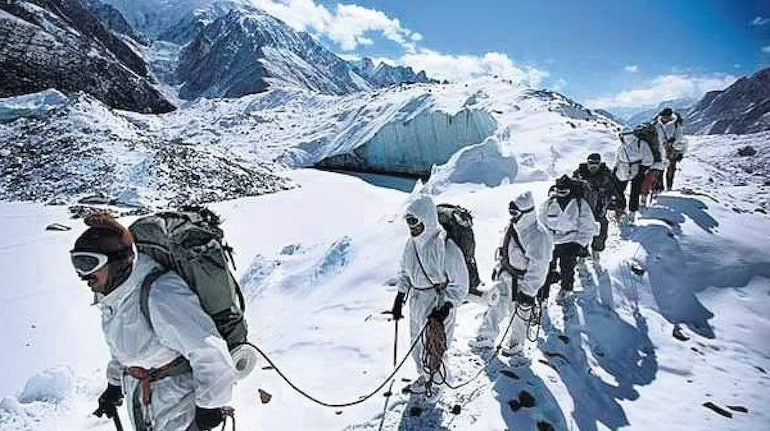
When Indian troops were first heli-lifted onto the Saltoro Ridge in April 1984, there was no sense that the deployment would turn into the world’s highest, longest-running military confrontation.
The operation, later named Operation Meghdoot, was conceived as a pre-emptive move to block Pakistani advances into the un-demarcated reaches north of NJ9842. What followed instead was the slow construction of a permanent war, fought above 18,000 feet, where frostbite, avalanches and altitude sickness would kill far more soldiers than bullets.
The early years of Siachen were not defined by battles in the conventional sense. They were defined by survival, by men learning, often fatally, how little margin for error exists at extreme altitude, and by an army discovering that logistics, not tactics, would decide whether a post could be held for a winter.
Why Siachen mattered
The origins of the conflict lie in cartography as much as strategy. The 1949 Karachi Agreement and the 1972 Simla Agreement left the Line of Control demarcated only up to NJ9842, beyond which it ran “thence north to the glaciers.” Through the 1970s, Pakistani maps increasingly depicted the line angling northeast toward the Karakoram Pass, implicitly claiming the Saltoro Ridge and the Siachen Glacier.
Indian intelligence assessments in the early 1980s suggested that Pakistan was planning to occupy key passes on Saltoro. According to later reporting in The Hindu, this prompted New Delhi to act before the onset of the 1984 climbing season, when foreign expeditions, many with military links, were expected in the region.
April 1984: Getting there first
The first Indian deployments were improvised and risky. Helicopters flying from lower bases pushed men and supplies into an environment few had trained for. Troops from Ladakh Scouts and infantry units climbed onto icy ridgelines where even standing still required effort.
The Indian Express, in later anniversary accounts, described how early posts were held with minimal shelter, limited oxygen, and clothing never designed for prolonged exposure at minus 40 degrees Celsius. Soldiers slept in snow caves and makeshift tents, often losing weight rapidly as their bodies struggled to adapt.
The initial tactical success, occupying the dominating heights, came at an immediate human cost.
The first casualties: Not from enemy fire
Within weeks of the first deployments, the Indian Army recorded its earliest Siachen fatalities. These were not combat deaths. Soldiers fell into crevasses, succumbed to pulmonary oedema, or froze during blizzards that arrived without warning.
One of the first widely reported tragedies was an avalanche that buried an Indian post in 1984, killing several soldiers outright. The Hindu later noted that such incidents forced the army to confront a brutal reality: at those altitudes, nature was the primary adversary.
By the end of the first year, casualties from cold injuries and altitude-related illnesses were already shaping operational planning. Posts had to be held, but at what cost?
Building a logistics chain in the sky
What turned Siachen from a tactical operation into a permanent deployment was logistics.
Supplying men at 18,000 to 22,000 feet required a continuous air bridge. Every sack of rice, every kerosene can, every oxygen cylinder had to be flown in.
Indian Air Force helicopters, particularly the Cheetah and later the Mi-17, became lifelines. Pilots flew at the edge of performance envelopes, landing on narrow ice platforms with little room for error. The Tribune has carried multiple first-person accounts from pilots describing how downdrafts and whiteouts could turn routine sorties lethal.
These flights were not occasional. They were daily, year after year. The cost was enormous. Defence correspondents writing in The Indian Express through the late 1980s and 1990s repeatedly noted that Siachen consumed disproportionate resources for a front where neither side could realistically launch large-scale offensives.
Pakistan responds, the conflict freezes
Pakistan responded to India’s occupation of Saltoro by establishing its own positions on lower ridges and attempting, unsuccessfully, to dislodge Indian posts. Skirmishes occurred, artillery was occasionally used, but soon both sides realised that movement itself was the enemy.
By the late 1980s, the conflict had settled into a grim equilibrium. Indian troops held the heights. Pakistani troops occupied lower valleys. Neither side could push the other out without unacceptable losses.
This stalemate, however, did not reduce casualties. Avalanches, ice collapses and exposure continued to claim lives almost every year. Reuters reports in the 2000s repeatedly highlighted that weather-related deaths far outnumbered combat fatalities on the glacier.
The human cost of permanence
What made Siachen unique was not just altitude, but duration. Soldiers were not fighting a campaign; they were living inside an environment that punished small mistakes relentlessly.
Letters and interviews published over the years in The Hindu and The Indian Express reveal the psychological toll. Isolation was extreme. Rotations were short, but even a few months at those heights altered bodies and minds. Sleep was poor. Appetite disappeared. Fingers and toes were lost to frostbite even among experienced troops.
Families back home often learned of deaths through brief telegrams or official visits, with little public understanding of where or how their sons had died. Siachen, for decades, remained remote not just geographically but emotionally.
Learning to survive the glacier
Over time, the Indian Army adapted. Specialized high-altitude training, improved clothing, better shelters and medical protocols reduced, though never eliminated, casualties. The creation of the Siachen Battle School institutionalised hard-earned lessons about acclimatisation, movement and survival.
Yet even as systems improved, the fundamental reality remained unchanged. Holding Siachen meant accepting a steady attrition from non-combat causes. As one senior officer told The Indian Express years later, “You don’t conquer Siachen. You endure it.”
Why the war never ended
Calls to demilitarise Siachen have surfaced repeatedly since the 1990s. Track-II talks, military-to-military discussions and political initiatives have all explored withdrawal. But trust remains the missing ingredient.
Indian negotiators have consistently argued, in interviews reported by The Hindu, that any pullback without authentication of current positions risks a repeat of 1984 in reverse. Pakistan, for its part, has been reluctant to formally acknowledge Indian control of the Saltoro Ridge.
As a result, the glacier remains militarised, not because it offers tactical dividends, but because neither side believes the other will stay away if it leaves.
A war shaped by ice, not ideology
The early years of Siachen set the pattern for everything that followed. First deployments driven by maps and intelligence hardened into permanent occupation because withdrawal felt riskier than endurance. The first casualties, claimed by cold and altitude, foreshadowed decades in which the glacier would kill silently and regularly.
Siachen is often described as a symbol of resolve. It is also a reminder of the limits of human ambition. In its early years, soldiers learned that survival itself was an act of courage, and that in some wars, the fiercest enemy never fires a shot.
Discover the latest Business News, Sensex, and Nifty updates. Obtain Personal Finance insights, tax queries, and expert opinions on Moneycontrol or download the Moneycontrol App to stay updated!
Find the best of Al News in one place, specially curated for you every weekend.
Stay on top of the latest tech trends and biggest startup news.




