






A senior political observer offers a telling analogy to describe Karnataka Chief Minister Siddaramaiah’s political temperament.
“He is like a toddler clutching a toy. If you try to snatch it away or provoke him, he will only resist. It takes patience and calm engagement for him to part with it voluntarily.”
The metaphor neatly captures the Congress’ dilemma in Karnataka, where the party has spent much of 2025, navigating a prolonged power tussle between Siddaramaiah (77) and his principal challenger, deputy CM DK Shivakumar, over the chief minister’s post.
Also read: Rewind 2025: Bengaluru’s infra takes baby steps but is citizen activism losing its voice?
Two mass leaders, one chair
Widely regarded as the architect of AHINDA - the social coalition of minorities, backward classes and Dalits - Siddaramaiah continues to dominate Karnataka’s political landscape. On January 7, he is set to surpass D Devaraj Urs as the state’s longest-serving chief minister, a symbolic milestone for a leader who draws ideological inspiration from Urs, the original architect of AHINDA.
On the other hand, Karnataka Pradesh Congress Committee (KPCC) president Shivakumar, a formidable organiser with a strong Vokkaliga base, is seen within Congress ranks as an organisational strongman - a fundraiser, crisis manager and trusted loyalist of the Gandhi family.
“The Congress and the BJP face very different challenges in Karnataka. The Congress has many leaders, but it is not a cadre-based party, like the BJP. The BJP, meanwhile, has a well-oiled organisational machinery backed by the RSS, but lacks strong mass leaders in Karnataka beyond BS Yediyurappa,” another political observer said.
For the Congress, which governs only a handful of states, losing Karnataka - its most politically and electorally significant bastion - is not an option, especially at a time when it faces a sharp resource disadvantage vis-à-vis BJP.
Siddaramaiah’s long political arc
Siddaramaiah’s political resilience has been tested before. After the fractured verdict of 2018 assembly elections, the Congress stitched together a coalition with Janata Dal (Secular), despite emerging as the single-largest party. HD Kumaraswamy became chief minister, while Siddaramaiah - who had earlier quit the JD(S), calling it a “family-run party” - was appointed head of the coalition’s coordination committee.
The government, however, steadily unravelled. In 2019, 17 MLAs defected, bringing down the Congress-JD(S) coalition. A majority of them were believed to be loyal to Siddaramaiah. The BJP returned to power, while Siddaramaiah slipped seamlessly into the role of Leader of the Opposition, once again emerging as the Congress’ most powerful voice in the state.
Three years later, he completed a full political arc, leading the party to a landslide victory in 2023 assembly elections with 136 seats and reclaiming the CM’s post.
Power restored, authority constrained
Siddaramaiah 2.0, however, has unfolded very differently from his earlier tenure between 2013 and 2018, when he was the undisputed power centre. One reason his first term was relatively smooth - despite being seen as an ‘outsider’ - was the defeat of then KPCC president and CM aspirant G Parameshwara in the 2013 assembly elections from Koratagere in Tumakuru district.
Despite a comfortable majority and no immediate threat to the government’s survival, Siddaramaiah’s second term has been overshadowed by persistent speculation over his tenure and an unresolved leadership tussle with Shivakumar.
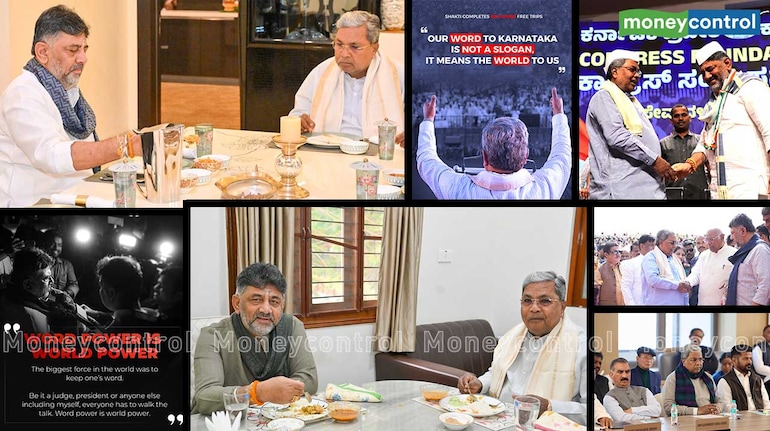
Both leaders insist publicly that they are on the same page and that the Congress high command will take the final call. Yet, competing claims have repeatedly surfaced through cryptic social media posts. In one instance, Shivakumar wrote, “Word power is world power,” urging leaders to “walk the talk” - widely interpreted as a pointed reminder about power-sharing promises. Siddaramaiah responded with a carefully worded message: “Our word to Karnataka is not a slogan. It means the world to us.”
Also read: From A-Z, Karnataka sees a series of price hikes
The exchange followed Shivakumar’s disclosure of a purported post-election power-sharing understanding involving several senior leaders - widely seen as a reminder to the high command of an informal agreement for a rotational chief ministership after two-and-a-half years.
Soon after, the two leaders held conciliatory breakfast meetings at each other’s residences, ahead of the Belagavi legislature session on December 8, reportedly at the party leadership’s behest.
Governance under strain
As the leadership suspense drags on, governance pressures have mounted. The
Siddaramaiah government has faced criticism over a series of price hikes, corruption allegations by contractors, its handling of the RCB IPL victory celebrations and stampede that killed 11 fans, protests by sugarcane farmers, delays in filling vacancies across government departments, and poor implementation of welfare schemes, such as the Rs 2,000 Gruha Lakshmi guarantee.
“Whenever there are multiple power centres, governance inevitably takes a hit. With the CM focused on safeguarding his chair, meeting MLAs and making frequent visits to Delhi, administrative control weakens,” a senior bureaucrat said. “This is also his last tenure, so the emphasis is largely on welfare delivery.”
The official pointed to the recent economic data showing Tamil Nadu’s GSDP growth of around 16 percent, outpacing Karnataka’s 10.2 percent in 2024-25, widening the gap despite Karnataka’s technological strengths. Bengaluru’s persistent infrastructure woes and growing influence of Congress high command are also cited as visible governance challenges.
A widening financial crunch has further unsettled legislators. In Bengaluru, public anger over the lack of visible development has grown, even as several high-profile projects pushed by the deputy CM remain largely on paper. Local body elections, meanwhile, are long overdue.
Also read: Of guarantees & hikes: Karnataka govt walks a tightrope amid calls to limit benefits
Siddaramaiah, who has presented a record 16 budgets, will table his 17th in 2026, amidst a mounting funds crunch. Rising costs of guarantee schemes and infrastructure projects have pushed up borrowings, with the CM blaming the Centre for inadequate GST compensation, non-devolution of cesses and lower tax devolution under the 15th Finance Commission.
Shivakumar’s waiting game
For Shivakumar, the stakes are both personal and political. His stewardship of the KPCC is widely credited with rebuilding the Congress’s grassroots organisation across districts - something the party had lacked for decades in Karnataka.
He has repeatedly hinted that his loyalty, sacrifices - including a stint in jail - and role in the party’s revival should weigh heavily in leadership decisions. At the same time, he appears aware that welfare guarantees alone may not secure the party’s future. Andhra Pradesh offers a cautionary tale, where YS Jagan Mohan Reddy suffered a crushing defeat despite rolling out expansive welfare schemes.
High command’s dilemma
For now, the Congress leadership has opted for continuity. Shivakumar continues as both KPCC president and sole deputy CM, while no formal announcement has been made on rotational chief ministership. The party is treading cautiously.
Karnataka is one of the only three states - along with Telangana and Himachal Pradesh - where the Congress is in power, and it has projected the “Karnataka model” nationally. After losing governments in several states, it can ill-afford another setback, particularly in the home state of AICC president Mallikarjun Kharge.
Also, read: All you need to know about Siddaramaiah who is set to become Karnataka CM for the second time
Even within the Gandhi family, views are believed to be divided - with Rahul Gandhi seen as backing Siddaramaiah, while Priyanka Gandhi is perceived to favour Shivakumar. Much may hinge on Sonia Gandhi’s stand, especially given Shivakumar’s long-standing loyalty and her personal visit to him in Tihar Jail after his arrest by the Enforcement Directorate.
For now, a divided BJP poses little immediate threat. Yet, as 2025 draws to a close, Karnataka enters the new year with a familiar question unresolved - not whether the Congress-led government will survive, but how long it can keep its most powerful leaders in uneasy equilibrium.
In fact, talk of rotational chief ministership in Chhattisgarh between TS Singh Deo and Bhupesh Baghel never materialised.
In Madhya Pradesh, intense speculation surrounded the CM’s post after the Congress returned to power in 2018. At the time, Rahul Gandhi posted a photograph with Kamal Nath and Jyotiraditya Scindia, accompaned by a cryptic Leo Tolstoy quote: “The two most powerful warriors are patience and time.” Just over a year later, Scindia quit the Congress for the BJP, triggering the collapse of the Kamal Nath-led government.
Whether DK Shivakumar will have the patience to wait - or whether 2026 will see a new chief minister in Karnataka - remains an open question.
Also, read: 'Brand Bengaluru' caught between DK Shivakumar’s vanity projects and city's crumbling infra

Discover the latest Business News, Sensex, and Nifty updates. Obtain Personal Finance insights, tax queries, and expert opinions on Moneycontrol or download the Moneycontrol App to stay updated!
Find the best of Al News in one place, specially curated for you every weekend.
Stay on top of the latest tech trends and biggest startup news.




