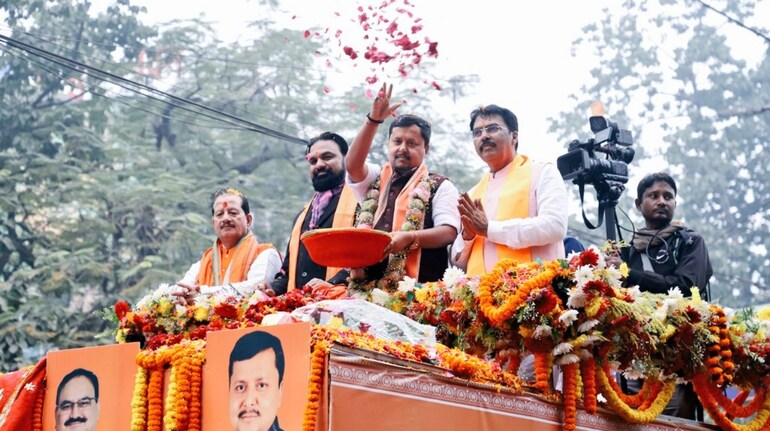

The Bharatiya Janata Party is set for a major organisational transition, with its national Working President Nitin Nabin scheduled to file his nomination for the post of BJP national President on January 19, reported CNN-News18 citing sources.
Prime Minister Narendra Modi is expected to act as the proposer during the nomination process, a gesture being seen within the party as a strong endorsement of Nabin’s leadership and a signal of continuity at the top.
The nomination is part of the BJP’s internal organisational framework for electing its national President and is likely to be attended by several senior leaders, central office-bearers and members of the party’s core leadership.
The formal announcement of the new BJP President is scheduled for January 20, which is expected to offer clarity on the party’s leadership structure as it prepares for a packed electoral calendar over the next four years.
Why was the transition delayed?
Nitin Nabin, a five-time MLA from Bihar, was appointed BJP Working President on December 14. His formal takeover as party president, however, was delayed due to kharmas, the inauspicious period in the Hindu calendar, which ended on January 14.
Since his appointment, Nabin has been touring various states, holding meetings with party leaders and cadres, and familiarising himself with organisational challenges across regions.
Challenges ahead
As Nabin prepares to take charge from outgoing BJP President J P Nadda, he faces a series of immediate political and organisational challenges, particularly in regions where the party has struggled to expand its footprint.
The recently concluded Bihar Assembly elections highlighted vulnerabilities for the BJP, even as the party looks ahead to Assembly elections in West Bengal, Assam, Tamil Nadu, Kerala and Puducherry in 2026.
Eastern India remains a complex terrain for the BJP, where its influence is significantly weaker compared to its dominance in northern and western states. In West Bengal, entrenched regional politics and identity-driven narratives have consistently resisted the BJP’s expansion, while Tamil Nadu and Kerala continue to pose ideological and organisational hurdles rooted in strong regional movements.
A crowded election calendar through 2029
Nabin’s tenure will coincide with an unusually dense election cycle. In 2027, Assembly elections are due in Uttar Pradesh, Gujarat, Goa, Uttarakhand, Punjab, Himachal Pradesh and Manipur, several of which are currently ruled by the BJP.
In 2028, Chhattisgarh goes to the polls, a state where Nabin previously served as the party’s main in-charge during both the 2022 Assembly elections and the 2024 Lok Sabha polls. Assembly elections in Rajasthan and Madhya Pradesh, both BJP-ruled states, along with Karnataka and Telangana, currently governed by the Congress, are scheduled for 2029.
Elections in Nagaland, Mizoram, Tripura and Meghalaya are also due that year, culminating in the 2029 Lok Sabha elections, all of which will fall squarely within Nabin’s tenure as BJP President.
Balancing continuity with renewal
Nabin’s biggest challenge will be to consolidate the party’s traditional support base while recalibrating strategies to appeal to younger voters and regional aspirations. His task will involve strengthening grassroots organisation, managing factional equations, and tailoring political messaging to vastly different electoral landscapes.
Known for his soft-spoken style and organisational experience, Nabin will be expected to bring both stability and innovation to the BJP’s national strategy, as the party navigates a series of high-stakes elections that could shape its political trajectory over the next decade.
Discover the latest Business News, Sensex, and Nifty updates. Obtain Personal Finance insights, tax queries, and expert opinions on Moneycontrol or download the Moneycontrol App to stay updated!
Find the best of Al News in one place, specially curated for you every weekend.
Stay on top of the latest tech trends and biggest startup news.