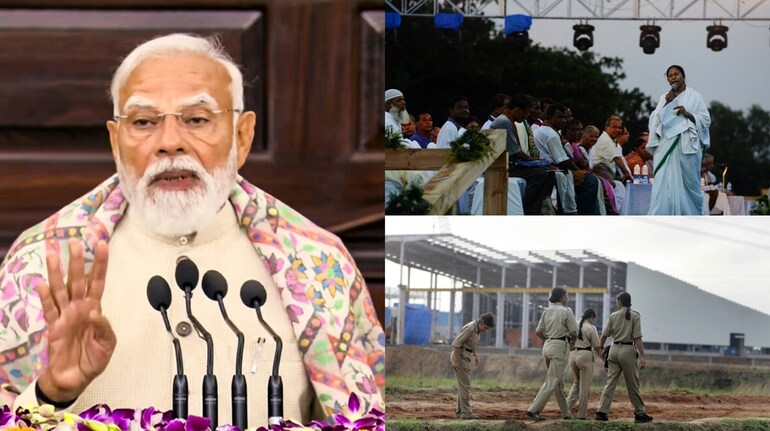

Nearly 18 years after Singur altered West Bengal’s political and industrial trajectory, the Hooghly district village is once again at the centre of a high-stakes political narrative. Prime Minister Narendra Modi is scheduled to address a rally on Sunday at the very site where the Tata Nano factory was once planned.
PM Modi's visit, believes the BJP, will help revive the debate around industrialisation, land, and missed economic opportunity in the state.
Singur occupies a singular place in Bengal’s political history.
Singur: A lookback at the moment that changed Bengal's political discourse
In 2006, the Left Front government acquired nearly 1,000 acres of multi-crop farmland to set up Tata Motors’ Nano car factory. The move triggered a prolonged agitation led by the then Opposition leader Mamata Banerjee, who framed the acquisition as forcible and anti-farmer. The protests quickly spiralled into violence, arrests, and hunger strikes, eventually pushing Tata Motors to pull out of the project in October 2008 and relocate it to Sanand in Gujarat.
Announcing the exit, then Tata Group chairman Ratan Tata had spoken of an “adverse business environment” and memorably remarked that “a gun was put to my head and the trigger was pulled,” a statement that would come to symbolise Bengal’s fraught relationship with big industry.
The episode significantly reshaped the state’s politics.
Four years later, riding on the twin movements of Singur and Nandigram, Mamata Banerjee ended 34 years of Left rule in 2011. Years later, the Supreme Court ordered the return of land to unwilling farmers. The Trinamool Congress (TMC) continues to cite the verdict as moral and legal vindication.
Ironically, nearly two decades on, the Singur land remains largely unused.
What farmers say now
Nearly two decades later, a ground report by News18 from Singur reveals a deep sense of stagnation and disillusionment among farmers, both willing and unwilling land donors, many of whom say the land returned to them is no longer cultivable.
Kaushik Bag, a farmer in his 60s who had willingly given six bighas of land and even underwent training in the hope of a factory job, told News18 that nothing materialised. “The land was returned, but there is concrete under the soil. Farming is impossible,” he said, adding that he now hopes the Prime Minister’s visit will lead to a concrete development plan.
Shyamapado Das, an unwilling land donor who gave up three bighas, said he believed farming would resume once the agitation succeeded. “Today, wild animals roam the fields. Singur became a political battleground, and farmers were left behind,” he said.
Others express regret over the movement itself. Swapan Mitra, whose family surrendered one bigha, said political assurances at the time proved hollow. “We were drawn into politics. Maybe the factory was the better option,” he told News18.
Manik Ghosh, once active in the agitation, now drives a Toto for a living. “We thought the movement was for farmers. Now it feels like politics won and we lost,” he said.
Similar sentiments were echoed in Gopalnagar, the village where the Singur protest began. Farmers there told News18 that while Singur became synonymous with ‘Paribartan’, their lives saw little change. “Those who became leaders never came back to see us,” an elderly farmer said.
BJP’s political pitch
Against this backdrop, the BJP is seeking to reframe Singur not as a victory for farmers’ rights, but as the starting point of Bengal’s industrial decline. The party has deliberately chosen the abandoned Nano site, locally known as "Tata’r Math", for PM Modi’s rally, projecting it as a symbol of “lost opportunity”.
BJP leaders say that Singur scared away big-ticket investors and cemented Bengal’s anti-industry image.
“Industrialisation left Bengal the day Tata was forced to leave,” BJP leader Sukanta Majumdar has said, promising that Tata would return if the party comes to power. He also blamed “tolabazi” and political interference for deterring investors.
State BJP president Samik Bhattacharya told PTI that reviving agriculture on the Singur plot is no longer practical. “The character of the land has changed from agricultural to industrial,” he said, calling for a comprehensive land policy that makes farmers stakeholders in industry rather than adversaries.
The party has framed PM Modi’s rally as the opening salvo of its 2026 Assembly election campaign, hoping to contrast its industrial vision with what it calls the TMC’s “politics of obstruction”.
The ruling TMC has dismissed the BJP’s renewed Singur focus as selective amnesia.
Party spokesperson Kunal Ghosh pointed out that senior BJP leaders had supported the Singur agitation at the time. “They are now trying to rewrite history,” he said. State minister Chandrima Bhattacharya reiterated that the Supreme Court had declared the land acquisition illegal. “Where were these leaders when farmers were beaten and land was forcibly taken?” she asked.
The CPI(M) has also questioned the BJP’s credibility, while conceding that Bengal’s fragmented land holdings make industrialisation complex.
Singur remains a powerful political metaphor in Bengal, a place where industry, land, and power collided with lasting consequences. While it delivered political change, it also left behind barren fields, broken livelihoods, and unresolved questions about development.
Discover the latest Business News, Sensex, and Nifty updates. Obtain Personal Finance insights, tax queries, and expert opinions on Moneycontrol or download the Moneycontrol App to stay updated!
Find the best of Al News in one place, specially curated for you every weekend.
Stay on top of the latest tech trends and biggest startup news.