
The Karnataka Budget presented amidst mounting debt concerns saw the budget outlay approaching Rs 4.5 lakh crore for the financial year FY 26-27, growing by 9.4 percent over the previous budget.
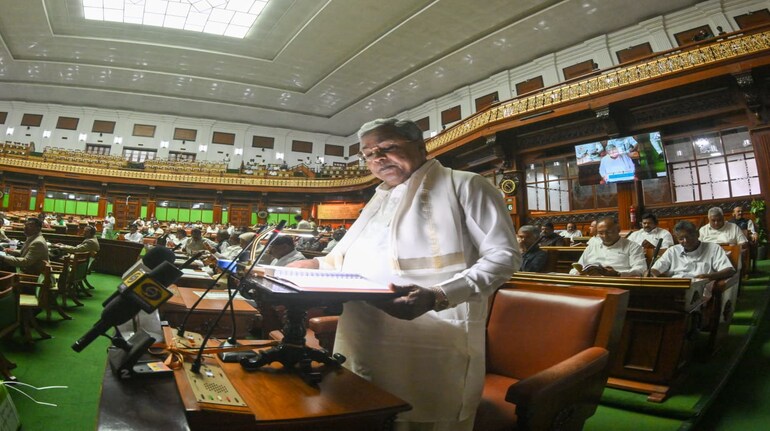
Presented by the Karnataka Chief Minister Siddaramaiah, who is also the finance minister, the public debt accounts for 30 percent of the revenue expenditure of Rs 4,48,000 crore.
The State economy recorded a strong real GSDP (Gross State Domestic Product) growth of 8.1 percent at constant prices in 2025–26, surpassing the national growth rate of 7.4 percent for the same period.
The state government’s revenue receipts stood at Rs 3,15,000 crore, while Rs 1,32,000 crore will come from public borrowing. The government has so far spent Rs 1.22 lakh crore for welfare programmes.
Debt is 25 percent of the state's GDP
The state government’s increasing financial stress owing to multiple welfare programmes has seen public debt financing going up by 14 percent. The government is likely to spend Rs 35,300 crore in debt repayments during FY 27.
The revenue deficit for 2026-27 budget is estimated at Rs 23,000 crore while the fiscal deficit is estimated at Rs 97,500 crore, which is 2.95 percent of GSDP.
The total outstanding liabilities or debt of the state is estimated to reach Rs 8,24,390 crore at the end of 2026-25, which is almost 25 percent of GSDP.
Out of the total expenditure, only Rs 75,000 crore is going to create new assets in the form of net capital expenditure. Revenue expenditure accounted for Rs 3,38,000 crore.
Flags revenue hit from GST rate changes
Siddaramaiah has also flagged the unanticipated GST rate rationalisation impact for the Karnataka state finances by around Rs 10,000 crore during the current fiscal whereas it is expected to cause Rs 15,000 crore lose in FY 27.
“It had an adverse impact on revenue mobilisation. Prior to rationalisation, the State’s average monthly GST collections in 2025–26 were registering a growth of around 10 per cent. However, following the implementation of rate restructuring, the average monthly growth has moderated sharply to about 4 per cent,” the Chief Minister said.
He also said that Karnataka’s share in tax devolution under the 15th Finance Commission (FC) has seen a sharp decline to 3.65 percent from 4.71 percent under the 14th FC, a decline of 23 percent.
“To ensure fair devolution to all states, we had urged the 16th FC to adopt a more balanced and fair tax devolution formula that recognises both equity and efficiency,” Siddaramaiah said.
However, the 16th Finance Commission has recommended a tax devolution share of 4.13 percent for Karnataka, which is an increase of 13 percent over the share recommended by 15th FC and is a partial redressal of the injustice caused to the State, he added.
“Karnataka, a large contributor to the central budget”
“We are one of the major states that contributes the highest to the tax revenue of the country. The cow that yields abundant milk requires proper care. It is Bheeshma’s philosophy that if it becomes weak, the entire cowherd suffers. Recognising this principle, we urge the Union Government to respond sensitively to the needs of the State,” said Siddaramaiah, who was presenting his 17th budget as the state’s Finance Minister.
He added that a diverse country like India can achieve progress only through a truly cooperative federal system. The various state governments, especially the southern states, have been complaining that by giving more grants to the poorer northern states, the central government is punishing the states that contribute more to the central exchequer.
State’s collection target
The state’s agriculture sector recorded a robust growth of 9.1 percent, supported by improved monsoon conditions, while growth in the industrial sector strengthened to 6.7 percent. The services sector has registered a growth of 8.1 percent.
The state's revenue receipts include tax revenue, non-tax revenue, central grants, and tax devolution. The commercial tax revenue target for 2026-27 is Rs. 1,25,000 crore, while that of the Excise department is Rs 45,000 crore. The Stamp and Registration duty is expected to net Rs 29,000 crore, and the Motor Vehicle department is expected to collect over Rs 15,000 crore.
The government is spending Rs 10, 578 crore for the electricity subsidy scheme called Gruha Jyothi. Rs 5,300 crore was allocated last year for the free public bus travel for women.
Discover the latest Business News, Sensex, and Nifty updates. Obtain Personal Finance insights, tax queries, and expert opinions on Moneycontrol or download the Moneycontrol App to stay updated!
Find the best of Al News in one place, specially curated for you every weekend.
Stay on top of the latest tech trends and biggest startup news.