






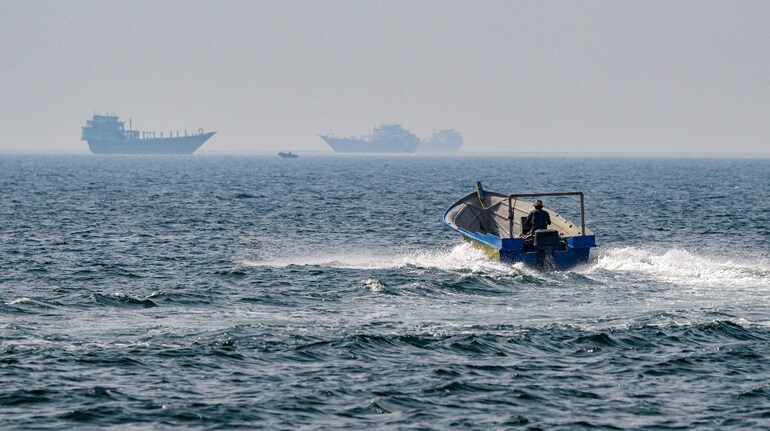

Two days after joint Israeli-United States airstrikes on Iran triggered a major escalation in West Asia, the Strait of Hormuz has emerged as the centre of a severe global crisis.
According to reports, Iran reportedly targeted an oil tanker transiting the Strait of Hormuz near Oman’s coastline, escalating its response to what it describes as retaliation for US and Israel’s killing of Supreme Leader Ayatollah Ali Khamenei.
The Palau-flagged tanker was hit off Oman’s Musandam Peninsula, in an incident that came after drone strikes on the country’s Duqm port. Oman’s Maritime Security Centre (MSC) said at least four people were injured in the attack.
What is Strait of Hormuz?
Hormuz is a narrow but strategically crucial waterway in the Middle East, acting as the sole maritime gateway from the Persian Gulf to the open sea.
The strait connects the Persian Gulf in the west to the Gulf of Oman and, further southeast, the Arabian Sea.
Its northern shore is bordered by Iran, while the Musandam Peninsula—an Omani exclave that also includes parts of the United Arab Emirates—lies along the southern side of the waterway.
The strait measures only about 21–33 miles (33–54 km) across, and because of this constricted width, vessels must follow designated shipping lanes—each around 2 miles (3 km) wide and separated by a buffer zone—to avoid collisions.
Several major islands lie within or near the strait, including Qeshm, Hormuz, Larak and Hengam, most of which are under Iranian control.
Why is it important?
The Strait of Hormuz is the world’s most critical oil chokepoint. Chokepoints are narrow channels along widely used global sea routes that are utilised for transporting oil through sea. If a chokepoint is closed, even if for a temporary period, it can translate to potential delays in supply, reduction in traffic and rise in shipping and insurance costs.
Global importance
The strait facilitates roughly 20% of global oil consumption — about 20 million barrels per day — and between 20% and 25% of the world’s liquefied natural gas (LNG), much of it exported from Qatar. More than 80% of the oil transported through this route is bound for Asia, with China, India, Japan and South Korea among the biggest importers.
Alternative export routes exist but are insufficient to offset a complete shutdown of the strait.
Saudi Arabia can reroute up to 5 million barrels per day through its East-West Pipeline to ports on the Red Sea. The UAE’s Habshan-Fujairah pipeline has the capacity to transport around 1.5 million barrels per day directly to the Gulf of Oman, bypassing the strait. Iraq also operates a pipeline through Turkey, though it mainly carries crude from its northern oilfields and cannot fully replace southern export flows.
What is Iran threatening?
According to Reuters, Iran’s Islamic Revolutionary Guard Corps (IRGC) Navy has announced via VHF radio that no vessels are permitted to cross the Strait of Hormuz.
According to The Hindu, analysts at S&P Global Commodities at Sea (CAS) said traffic through the Strait of Hormuz had dropped by roughly 40–50% as of 7:30 p.m. UTC on February 28, noting that many vessels appeared to be exiting the area amid rising tensions.
Fatih Birol, Executive Director of the International Energy Agency (IEA), said on social media that the agency was closely tracking developments in the Middle East and assessing their potential impact on global oil and gas markets as well as trade flows.
What does it mean for India?
Aditi Nayar, Chief Economist at ratings agency ICRA, told The Hindu that the escalation in West Asia “would have a bearing on India’s macros, including things like the impact of fuel prices on inflation and the twin deficits, as well remittances”.
As the world’s third-largest oil consumer, India is particularly exposed. According to experts, New Delhi's reliance on this route has grown further in early 2026.
Nearly 50% of India’s crude oil imports — roughly 2.6 million barrels per day — move through the strait, largely sourced from Iraq, Saudi Arabia, the UAE and Kuwait.
The vulnerability is even greater when it comes to LPG (cooking gas), with almost the entire volume of India’s imports passing through this chokepoint.
Any prolonged disruption could directly affect domestic supplies, including the Pradhan Mantri Ujjwala Yojana and household energy access.
Around 60% of India’s liquefied natural gas (LNG) imports, mainly from Qatar and the UAE, also transit the strait. Analysts told News18 that every $1 increase in crude oil prices raises India’s annual import bill by about $2 billion, underscoring the potential economic impact of sustained volatility.
Discover the latest Business News, Sensex, and Nifty updates. Obtain Personal Finance insights, tax queries, and expert opinions on Moneycontrol or download the Moneycontrol App to stay updated!
Find the best of Al News in one place, specially curated for you every weekend.
Stay on top of the latest tech trends and biggest startup news.





