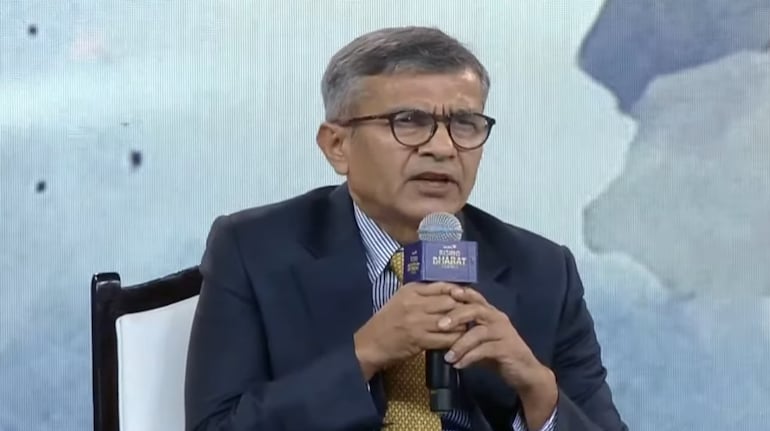

India will continue to balance its strategic partnerships and protect its economic and security interests as geopolitical tensions escalate in West Asia, Defence Secretary Rajesh Kumar Singh said on February 28 at News18 Rising Bharat Summit, noting that global conflicts are evolving rapidly even as India remains relatively insulated.
“Events are moving pretty fast… we are in an oasis in a world facing geopolitical conflicts,” Singh said, referring to the ongoing tensions involving Iran and Israel.
He added that India’s stakes in the Middle East, including energy security and a large diaspora, require sustained engagement and partnerships.
India will also work to preserve its interests in Iran’s Chabahar port, which New Delhi views as critical for connectivity to Central Asia and Afghanistan.
“We will have to negotiate our way so that our interests in Chabahar are sustained,” Singh said.
Highlighting India’s foreign policy approach, Singh said the country’s “ability to strike, align and engage” with multiple partners simultaneously reflects its strategic autonomy, citing recent multilateral engagements where rival nations participated together.
On defence preparedness, Singh said lessons from recent conflict (Operation Sindoor) underscored the growing importance of air power, stand-off weapons and unmanned systems.
The government has raised the modernisation budget by 24 percent for FY27 and signed defence contracts worth a record Rs 2.9 lakh crore to provide long-term visibility to industry.
Singh dismissed concerns on US-India deal hindering India’s strategic autonomy, noting that India will continue to rely on Russia to fulfil its defence requirements.
Russia despite a decline in its share of India’s defence imports still accounts for over a third of India’s total imports.
Domestic push for Rafale
India plans to expand fighter capabilities through the multi-role fighter aircraft (MRFA) programme, with Rafale jets expected to see greater domestic manufacturing and higher local content. The indigenous fifth-generation Advanced Medium Combat Aircraft (AMCA) programme will remain central to future air power strategy, while decisions on competing foreign offers are yet to be finalised.
Singh reiterated that India will continue defence procurement from multiple partners — including Russia, France and the United States — while doubling down on indigenisation. The government aims to ensure that 75 percent of defence spending remains within the country.
He also emphasised deeper industrial collaboration with Israel, particularly in niche technologies such as air defence systems, alongside expanded joint ventures and co-production arrangements.
Discover the latest Business News, Sensex, and Nifty updates. Obtain Personal Finance insights, tax queries, and expert opinions on Moneycontrol or download the Moneycontrol App to stay updated!
Find the best of Al News in one place, specially curated for you every weekend.
Stay on top of the latest tech trends and biggest startup news.