




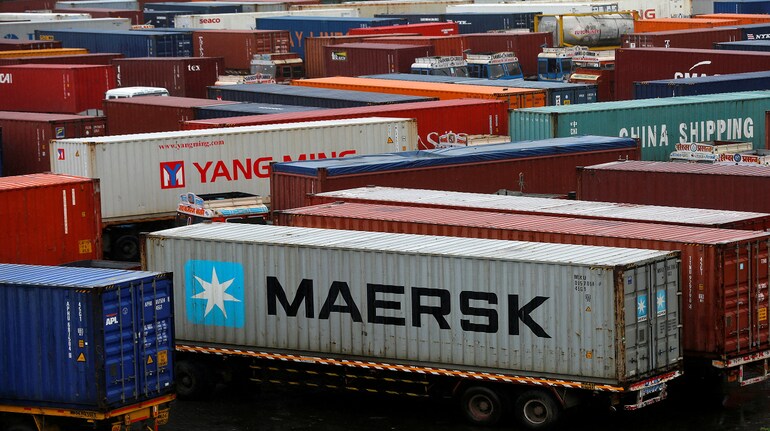
India imposed port restrictions on the import of select goods from Bangladesh, including readymade garments and processed food items.
The Directorate General of Foreign Trade (DGFT), under the Commerce Ministry, has issued a notification on Saturday in this regard.The notification imposes ”port restrictions on the import of certain goods such as readymade garments, processed food items etc., from Bangladesh to India,” the ministry said.
However, such port restrictions will not apply to Bangladeshi goods transiting through India but destined for Nepal and Bhutan, it added.
The order said that readymade garments imports from Bangladesh will not be allowed from any land port. However, it is allowed only through Nhava Sheva and Kolkata seaports. For fruits; fruit flavoured and carbonated drinks; processed food items (baked goods, snacks, chips and confectionary); cotton and cotton yarn waste; plastic and PVC finished goods, dyes, plasticisers and granules; and wooden furniture, the notification said the inbound shipments from the neighbouring country shall not be allowed through any LCSs (Land Customs Stations) and ICPs (Integrated Check Posts) in Assam, Meghalaya, Tripura and Mizoram; and LCS Changrabandha and Fulbari, in West Bengal.
It added that these port restrictions do not apply to the import of Fish, LPG, Edible Oil, and Crushed stone from Bangladesh.To make these changes, a new paragraph is introduced in the country’s import policy regulating the imports of these goods from Bangladesh to India, ”with immediate effect,” it said. On April 9, India withdrew the transhipment facility it had granted to Bangladesh for exporting various items to the Middle East, Europe and various other countries except Nepal and Bhutan.
The announcement came in the wake of a controversial statement made by Muhammad Yunus, head of Bangladesh’s interim government, during a recent visit to China. Yunus had said that India’s seven northeastern states, which share nearly a 1,600 km border with Bangladesh, are landlocked and can only access the ocean through Bangladesh. Speaking at a business event, he also claimed that Bangladesh is the “only guardian” of the Indian Ocean in the region and invited China to use Bangladesh as a route to ship goods globally.
The comments were not well received in New Delhi and sparked sharp criticism from Indian political leaders across party lines. The transshipment facility—granted by India to Bangladesh in June 2020—had allowed Bangladesh to use several Indian ports and airports, including Delhi airport, to export goods to the Middle East, Europe, and other global destinations, ensuring smooth trade flows.
Indian exporters, mainly from the apparel sector, had also earlier urged the government to withdraw this facility to the neighbouring country.India-Bangladesh relations have nosedived dramatically after Yunus failed to contain attacks on minorities, especially Hindus, in that country.Bangladesh is a big competitor of India in the textile sector. The India-Bangladesh trade stood at USD 12.9 billion in 2023-24.
The new restrictions will force Bangladesh to reroute exports -- including Ready-Made garments (RMG), plastics, melamine, furniture, juices, carbonated drinks, bakery items, confectionery, and processed foods -- through Kolkata port in West Bengal or Nhava Sheva port in Maharashtra, sharply increasing logistics costs.
With 93 per cent of Bangladesh's exports to India previously moving through these land routes, the impact on its RMG sector -- which exports nearly USD 740 million worth of garments to India annually -- could be severe.
Indian officials defended the move as a step toward ensuring "fair trade," highlighting that Bangladesh enjoys unrestricted access to India's northeastern markets while imposing barriers on Indian exports.
They also noted that Bangladesh charges Indian goods 1.8 taka per tonne per kilometre, more than double its domestic rate of 0.8 taka.
"Bangladesh cannot assume market accesswithout reciprocity. For years, India extended concessions without equal returns. This decision restores balance," an India curbs Bangladeshi exports via land ports after 'landlocked' remarks of Yunus Indian official told ANI.
According to sources, Bangladesh continues to impose port restrictions on Indian exports, particularly at ICP's bordering North Eastern states. Industrial growth in the Northeastern States suffers a triple jeopardy due to imposition of unreasonably high and economically unviable transit charges by Bangladesh, denying in practice access for the Northeast to the Indian hinterland.
*With Agency Inputs
Discover the latest Business News, Sensex, and Nifty updates. Obtain Personal Finance insights, tax queries, and expert opinions on Moneycontrol or download the Moneycontrol App to stay updated!

Find the best of Al News in one place, specially curated for you every weekend.
Stay on top of the latest tech trends and biggest startup news.




