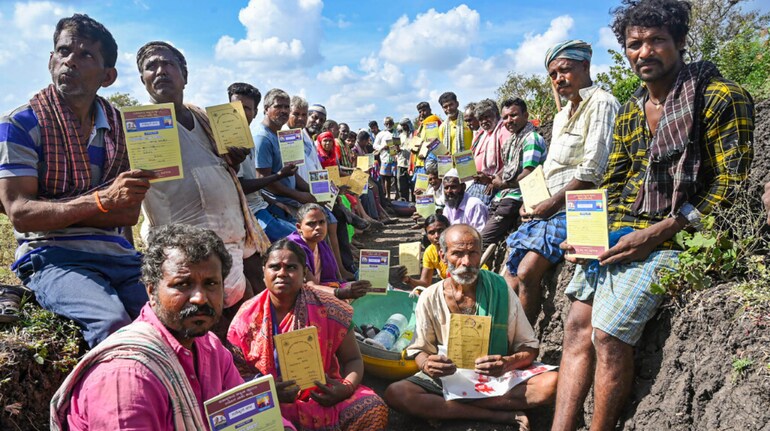
The Central government’s decision to revamp its flagship rural employment guarantee scheme was due to its structure of being 'demand driven', meaning the annual outlay of the scheme was not a fixed amount but dependent on the amount of work requested by the rural workers.
According to a senior government official, this structure was the reason why many states, particularly in Southern India, with far lesser population got more-than-expected annual allocation from the Centre. "States like Tamil Nadu, Kerala, Karnataka receive higher-than-expected allocation each year," the official said.
The Centre has renamed the Mahatma Gandhi National Rural Employment Guarantee Act (MGNREGA) to Viksit Bharat - Guarantee for Rozgar and Ajeevika Mission (Gramin) Bill, 2025 (VB: G-RAM-G). The new Bill has made scheme 'supply-driven', that is, annual allocation from the Central government for this scheme will be fixed, and any extra expenditure will be completely borne by the states. The Bill was passed in Lok Sabha on December 18 amid massive protests by the Opposition parties.
The official explained that in February-March, two months before the start of new financial year, each state presents its estimate of MGNREGA to the ministry of rural development. "But it was being witnessed, that these states exceeded the amount that was being presented by them."
The official, however, didn’t share what estimates were presented by the states, and by how much amount did the final allocation exceed.
Crucially, in March 2025, minister of state for rural development Chandra Sekhar Pemmasani had said in the Lok Sabha that "Tamil Nadu has been given more funds under MGNREGA than Uttar Pradesh in one fiscal year (didn’t specify the year), even though its population is seven crore as against the latter’s 20 crore."
In 2024-25, Tamil Nadu received Rs 9,843 crore from the Central government for the scheme, according to official MGNREGA dashboard. This included expenditure on unskilled wages, material, and on administration of the scheme. While, UP received Rs 9,147 crore.
The total expenditure incurred on all states by the Centre was Rs 85,435 crore in FY25, and Tamil Nadu had received the highest allocation. UP received the second highest, and Andhra Pradesh, the third highest – Rs 7,315 crore.
The top five states, which received the maximum allocation under MGNREGA, in FY25, were: Tamil Nadu, UP, Andhra Pradesh, Rajasthan (Rs 6,763 crore), and Bihar (Rs 6,221 crore). Karnataka was at the seventh spot, with allocation amounting to Rs 5,638 crore in FY25, and Kerala was at 11th spot (Rs 3,491 crore).
In the current financial year, till December 18, the Centre’s overall expenditure for MGNREGA stands at Rs 48,396 crore. And this year so far, UP has received the highest amount – Rs 4,863 crore. Andhra Pradesh has received Rs 4,818 crore, Bihar – Rs 4,244 crore, Madhya Pradesh – Rs 3,837 crore, and Tamil Nadu – Rs 3,740 crore.
This year, Karnataka has received Rs 2,507 crore so far (ninth highest), and Kerala has received Rs 2,136 crore (11th highest).
The official quoted above explained that, due to the scheme being demand-driven, and largely funded by the Centre, the Union government found itself helpless in regulating the money-flow.
"Hence, the changes were made, where a fixed allocation will be released annually."
Under MGNREGA, Centre pays 100 percent of unskilled wages and 75 percent of material costs. States pay only 25 percent material costs. In the VB: G-RAM-G Bill, costs related to wages and materials will be shared between the Centre and States in the ratio of 60:40. It will be in the ratio of 90:10 for North-eastern and Himalayan States.
And in case, the outlay exceeds what the Centre has budgeted, states will bear the additional costs, as per the new Bill.
The NREGA Sangharsh Morcha, in a statement, criticised the new provision and said that the 60:40 cost-sharing ratio ends the Centre’s responsibility for full payment of wages and puts states under severe financial strain. "Poorer, cash constrained states would be disproportionately affected, leading to lower employment generation and distress migration," it said.
An official spokesperson of the organisation told Moneycontrol: "There is no scam behind Tamil Nadu receiving higher funds. To receive the wages by workers, attendance has to be registered digitally, and the Tamil Nadu government ensures the process is followed, which is why the fund allocated to the state is high."
Discover the latest Business News, Sensex, and Nifty updates. Obtain Personal Finance insights, tax queries, and expert opinions on Moneycontrol or download the Moneycontrol App to stay updated!
Find the best of Al News in one place, specially curated for you every weekend.
Stay on top of the latest tech trends and biggest startup news.