








Bengaluru’s Kempegowda International Airport is positioning itself to move beyond a regional gateway into a global transit hub, supported by steady transfer traffic growth, infrastructure upgrades, and airline collaborations.
“A major focus for us is improving transfer experience across all formats: Domestic-to-Domestic, Domestic-to-International, International-to-Domestic, and International-to-International,” Girish Nair, Chief Operating Officer of Bangalore International Airport Limited (BIAL), which operates KIA, told Moneycontrol.
Also, read: Bengaluru International Airport Ltd appoints Girish Nair as COO
“Transfers are no longer a back-end function. They are a strategic enabler of network growth and passenger choice. We want travellers to see Bengaluru not just as an origin or destination, but as an easy, reliable, and attractive place to connect,” he added.
Traffic trends
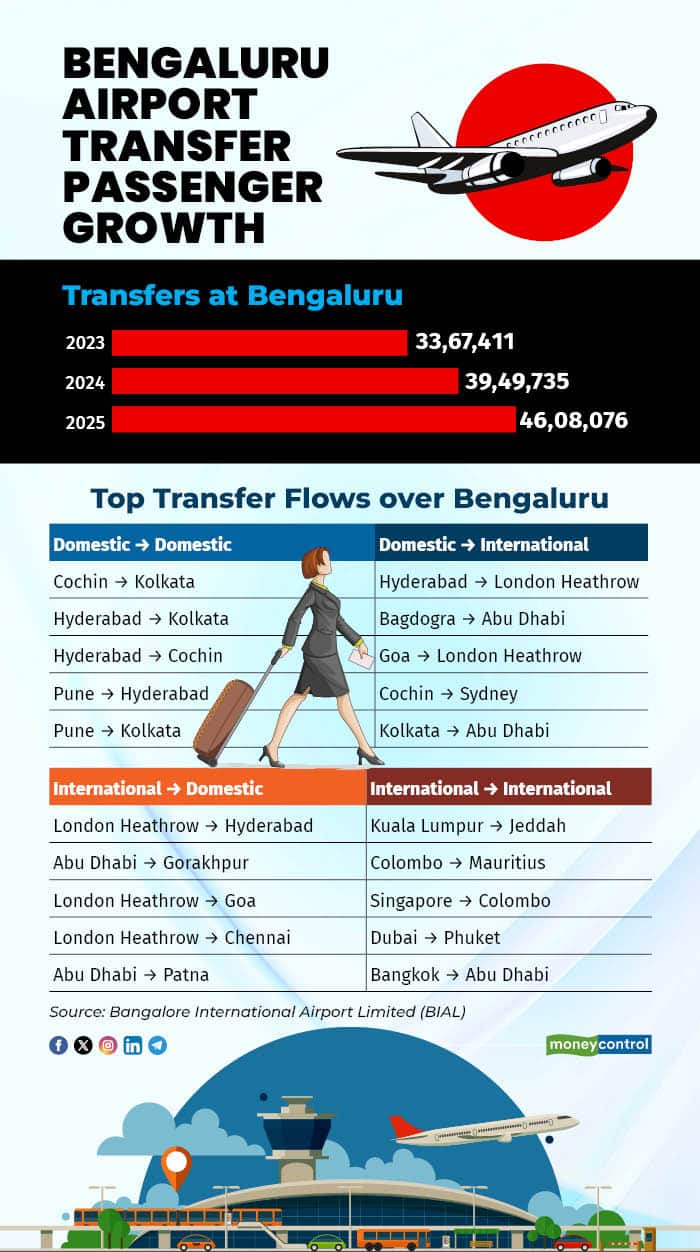
KIA’s transfer traffic is growing about 17 percent year-on-year, with Domestic-to-Domestic flows leading. Transfers now make up roughly 15 percent of total traffic.
“Our goal is to reach 20 percent transfer share. Domestic-to-Domestic is the most mature segment due to strong domestic connectivity, ranking among India’s top two airports and growing at 5 percent annually. Domestic-to-International and International-to-Domestic flows are growing over 30 percent, and our focus now is on expanding International-to-International transfers, which are still at a low base but have high potential,” Nair said.
Also, read: Bengaluru airport surpasses 41 million passengers, 5 lakh MT cargo in FY25
City-pair opportunities and airline collaboration
Major city-pair flows with strong potential include Australia-Europe (Sydney-London Heathrow), Japan-Sri Lanka (Tokyo Narita–Colombo), Asia-Middle East, Kuala Lumpur-Jeddah, and Denpasar/Bali or Bangkok-Abu Dhabi. The airport is engaging Indian and international carriers, global alliances, tourism boards, and the travel trade to improve connectivity and ensure seamless transfers.
“We are working with airline partners to identify connecting markets and support network expansion to enhance transfer traffic,” Nair said. BIAL also promotes hub development through joint marketing campaigns and route development initiatives to strengthen its hub proposition.
Positioning Bengaluru as India’s gateway
Bengaluru’s domestic connectivity makes it an attractive entry point for international carriers. “Traditionally, other metropolitan cities were the gateways, but today Bengaluru is the growth centre. Domestic migration is shifting here from cities like Mumbai which increases the importance of domestic connections,” Nair said.
He added that initiatives such as Air India and IndiGo’s MRO facilities signal the city’s potential as a regional hub. “Our focus is on building a robust network covering southern India and beyond,” he added.
Infrastructure Upgrades
Terminal 1 refurbishment is underway. “The eastern-side baggage handling system has been completed, and the western side is being upgraded. Terminal 1 now handles 25-26.5 million passengers, with 22 million reached by January 2025. The target is to expand capacity to 35 million. Curbside areas are being re-engineered to improve passenger flow” he said.
For Terminal 2 Phase 2, Engineering, Procurement, and Construction contract is being finalised, with construction expected to be completed by 2029.
Also, read: Criticism mounts over Bengaluru airport’s new pick-up rule; BIAL in no mood to relent

Discover the latest Business News, Sensex, and Nifty updates. Obtain Personal Finance insights, tax queries, and expert opinions on Moneycontrol or download the Moneycontrol App to stay updated!
Find the best of Al News in one place, specially curated for you every weekend.
Stay on top of the latest tech trends and biggest startup news.





