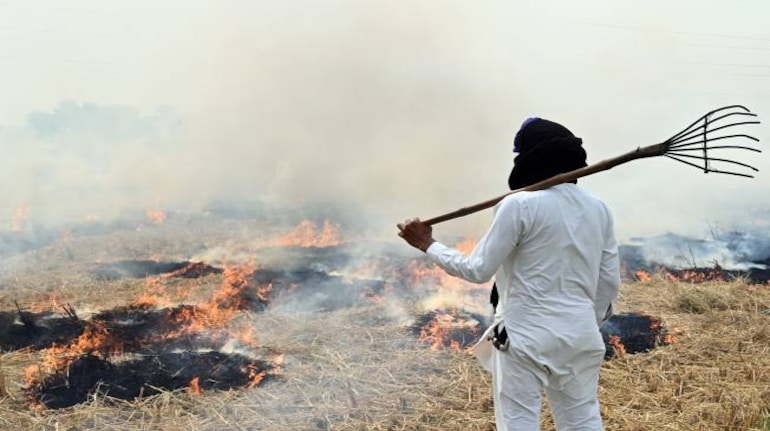
As large swathes of Delhi gasp for breaths under a thick blanket of haze and smog, with no breather in sight from the severely toxic air, technology comes to fore as a potential solution. The persistent problem of air pollution calls for an end to stubble burning in the National Capital Region and in adjoining states of Punjab, Haryana, Uttar Pradesh, and Rajasthan.
Stubble burning, an age-old practice of setting crop lands on fire by farmers to pave way for fresh sowing, has remained largely uncontrolled despite the perpetual problem of air pollution in the Capital at the onset of winter every year. The Supreme Court has directed the state governments to stop the practice immediately but that would add to the woes of the impoverished farmers. While the apex court order was hailed by many, over the longer run, organic corrective measures would be needed to battle the underlying problem.
Mahindra Group Chairman Anand Mahindra took to microblogging site X on November 7, suggesting the application of alternative sustainable agricultural practices to resolve the crisis. "To heal Delhi’s pollution, regenerative agriculture must be given a chance. It provides a remunerative alternative to stubble burning while simultaneously increasing soil productivity," he wrote.
Through this explainer, Moneycontrol tries to explore deep into regenerative agriculture, its potential as a sustainable alternative to stubble burning and its impact on the food ecosystem.
What is Regenerative Agriculture?Regenerative agriculture or regenerative farming is seen as a sustainable alternative for a multitude of reasons. With the threats of climate change looming close, global leaders and multinationals are now keen on adopting this sustainable agriculture practice to build a more resilient food chain and curb the impact on the already-deteriorating ecosystem.
Regenerative agriculture is chiefly an outcome-based practice aimed at nurturing and restoring soil health, curbing the impact of agriculture on climate and water resources, and biodiversity, while also boosting farm productivity and profitability.
Also Read | Stubble Burning: How regenerative farming, biochar and generous financing can solve many problems in one go
How regenerative agriculture helps fight stubble burning menace?Farmers in the chiefly agrarian states of Punjab, Haryana, Rajasthan and Uttar Pradesh, remove paddy crop residues from their fields to sow the next crop between mid-September and November. This method, called stubble burning, is one of the key reasons, apart from vehicular emissions, for the deteriorating air quality index in northern India.
Due to the short time window between rice harvesting and wheat sowing, farmers have largely taken to this practice. However, this highly unsustainable method causes air pollution as well as erodes soil fertility.
Also Read | What is the planetary health diet, and how can it save the world and your life
Farmers practising regenerative agriculture plant a new crop immediately after harvest and keep alternating between cash and cover crops. The crop rotation at regular intervals helps control pest infestations as well as conserves moisture content in the soil.
It also provides a more diverse diet to nourish the beneficial microbes in the soil. The practice of crop rotation between nitrogen-fixing crops and nitrogen-hungry crops also reduces farmers' reliance on fertilisers, another key farming component responsible for causing soil and water pollution.
Also Read | This Punjab farmer earned Rs 16 lakh last year by trying to curb stubble burning
Relay planting: An alternative to stubble burningAnother important method of regenerative farming is relay planting where the seeds of the next crop are sown while the current harvest is in the reproductive stage. Relay planting helps farmers avoid the risks of missing out on crop sowing timelines, and thus reducing the instances of stubble burning.
Other benefits of relay plantation or relay cropping include enhanced crop productivity, net economic returns, land use efficiency, increased soil fertility, efficient nutrient cycling, and organic pest control.
Soil Health: A necessary component in agricultureSustainable practices that balance between maiximising carbon input to soils through the plantation of cover crops, and minimising carbon losses from soils through no-tilling will help cut down on carbon amount in soil significantly on an annual basis.
It also helps cut down on the carbon footprint through carbon sequestration - a process in which trap carbon is trapped and conserved inside the soil from the atmosphere and into plant roots.
Thus, regenerative agriculture can potentially transform agriculture from a source of greenhouse gases to a net carbon cutdown.
According to the Intergovernmental Panel on Climate Change (IPCC), roughly 22 percent of anthropogenic greenhouse gas emissions come from agriculture, forestry, and other land uses.
Also Read | Punjab seeks to phase out paddy cultivation to stop crop burning
Impact of regenerative agriculture on food ecosystemOne of the primary side-effects of the climate crisis is the imminent food crisis, which has chiefly persisted in developing or underdeveloped nations. Regenerative agriculture helped tackle this food crisis in nations like Kenya, Ethiopia, Malawi, Tanzania, Uganda, Sudan, and Zambia.
Also Read | MC Explains: Why Maharashtra pollution authority is sending notices to cement cos
Global impactIt should be noted that multinationals across the world are now eyeing to adopt sustainable practices in operational and production stages to meet their net-zero goals. Global behemoths like Apple, Unilever, Salesforce, PepsiCo and Microsoft have been pressing on driving their businesses through organic measures and establishing a sustainable value chain system.
Discover the latest Business News, Sensex, and Nifty updates. Obtain Personal Finance insights, tax queries, and expert opinions on Moneycontrol or download the Moneycontrol App to stay updated!
Find the best of Al News in one place, specially curated for you every weekend.
Stay on top of the latest tech trends and biggest startup news.