






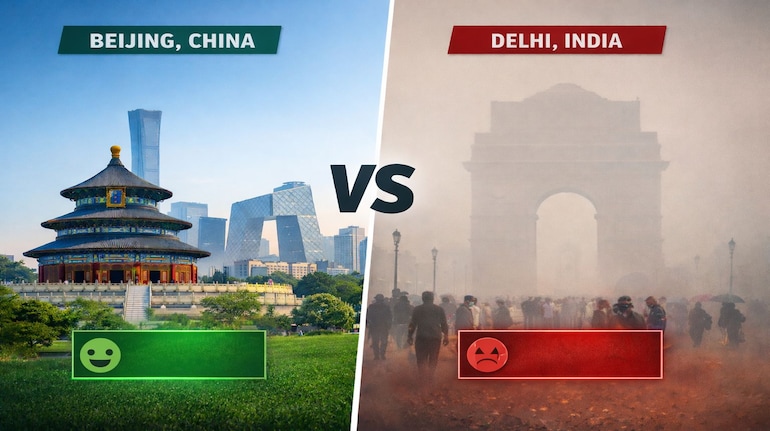
As Delhi and the National Capital Region (NCR) continue to reel under dangerously high pollution levels, China has drawn attention to what it called a “shared struggle” with India on air pollution, while presenting itself as an example of how severe air quality problems can be reduced over time with sustained effort.
Yu Jing, spokesperson for the Chinese embassy in India, posted on X and compared the air quality levels of Beijing and New Delhi, sharing images that showed Beijing’s Air Quality Index (AQI) at 68, considered “satisfactory,” while Delhi’s AQI stood at 447, a level categorised as “severe” by India’s Central Pollution Control Board (CPCB).
“Both China and India know the struggle with air pollution amid rapid urbanization,” Yu wrote. She added that although the challenge remains complex, China’s consistent policies over the past decade have led to clear improvements in air quality.
Both China and India know the struggle with air pollution amid rapid urbanization 🌫️📊.🌫️➡️🌤️ While the challenge remains complex, China’s sustained efforts over the past decade have delivered noticeable improvements. 📌 In the coming days, we’ll share a bite-sized series… pic.twitter.com/0ZG4Rl8ISD — Yu Jing (@ChinaSpox_India) December 15, 2025
Yu also announced that the Chinese embassy would share a bite-sized series exploring how China tackled air pollution, step by step. “In the coming days, we’ll share a bite-sized series exploring how China tackled air pollution — step by step,” she said.
Delhi’s pollution crisis deepens
The Chinese spokesperson’s remarks come at a time when Delhi’s air quality has once again dropped to alarming levels. On Monday, pollution across Delhi-NCR remained in the “severe” category, leading the authorities to enforce Stage 4 of the Graded Response Action Plan (GRAP), the strictest level under the emergency framework.
These measures include a ban on construction and demolition activities, restrictions on the movement of polluting vehicles and other steps aimed at cutting emissions immediately.
Delhi’s winter pollution crisis is not new. Every year, falling temperatures and calm wind conditions trap pollutants close to the ground. Emissions from vehicles, construction dust, industrial activity and power plants combine with smoke from crop burning in neighbouring states, creating a thick layer of smog that often lasts for weeks.
Meanwhile, the Supreme Court has said that one of the main reasons Delhi-NCR continues to suffer from severe air pollution every winter is the reluctance of the rich and affluent to change their lifestyles. The court observed that despite several orders and strict protocols issued over the years, air quality in the national capital region remains dangerously poor.
How Beijing cleaned up its air
China has also struggled with severe air pollution for years, especially in major cities such as Beijing. Thick smog, reduced visibility and health concerns were once common during winter. However, over the past decade, Beijing has managed to significantly improve its air quality through strict and sustained measures.
The turning point came in 2013, when China launched the Air Pollution Prevention and Control Action Plan. This plan laid out a comprehensive strategy to reduce emissions from energy production, transport and industry.
According to a UN-Habitat report, Beijing recorded a 50–60% reduction in PM2.5 levels, fine particles that are among the most harmful air pollutants.
One of the most important steps was a sharp reduction in coal use. Beijing’s coal consumption fell from about 21.8 million tonnes in 2012 to less than one million tonnes in later years. The city shut down coal-fired power plants and shifted aggressively towards cleaner energy sources.
Vehicle pollution was another major focus. Authorities enforced tougher emission standards, removed more than two million old and highly polluting vehicles from the roads and tightened checks on industries.
Regional coordination also played a key role. Beijing worked closely with neighbouring regions such as Tianjin and Hebei to ensure joint enforcement and shared pollution reduction targets.
As a result, Beijing recorded 290 days of good air quality last year, the highest since monitoring began and a stark contrast to the smog-filled winters of the past.
Why Delhi faces bigger challenges
Delhi cannot easily replicate China’s model. One key difference lies in governance. Beijing benefits from a highly centralised system that allows swift decision-making and strict enforcement. Delhi, on the other hand, faces fragmented responsibilities across multiple agencies and state governments within the NCR.
Interstate coordination remains a major challenge, particularly when it comes to issues like crop burning and industrial pollution. Enforcement also tends to be uneven across different regions.
Financing is another major gap. China invested billions of dollars over several years in clean energy, pollution monitoring systems, industrial upgrades and enforcement mechanisms. In comparison, Delhi’s funding for air pollution control remains limited and spread across different programmes.
The Delhi government has sought Rs 1,000 crore from the Centre to expand pollution-control technologies, but matching Beijing’s scale of investment would require several thousand crores over multiple years, alongside far more integrated regional planning.
Discover the latest Business News, Sensex, and Nifty updates. Obtain Personal Finance insights, tax queries, and expert opinions on Moneycontrol or download the Moneycontrol App to stay updated!
Find the best of Al News in one place, specially curated for you every weekend.
Stay on top of the latest tech trends and biggest startup news.




