Legendary Australian pace bowler Glenn McGrath feels that Jasprit Bumrah faces a big challenge ahead of him as he will be returning to the Indian team after being out of action for nearly a year. Bumrah, who underwent lower back surgery earlier this year, will make his international comeback in the form of T20Is as captain against Ireland later this month.
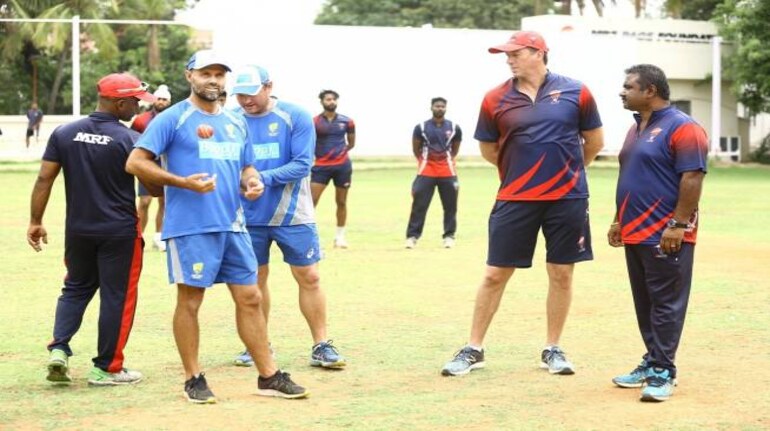
The 53-year-old McGrath, who is currently in Chennai as the Director of Coaching at the MRF Pace Foundation, took time off his training session with the young Indian bowlers to talk exclusively to moneycontrol.com on Bumrah’s comeback, the Indian fast bowling stock, his World Cup semi-finalists and the just-concluded Ashes, among other subjects.
Excerpts:
Firstly, congratulations on Australia retaining the Ashes. But the result was not 5-0 Australia as you had predicted before the series. England bounced back from 0-2 down to level 2-2. Do you think it is a fair result?(Laughs) I think it is probably a fair result on the series. That first Test, England should have won but somehow Australia hung in there and got the victory. The second Test, Australia won. The third one was really close. That could have gone either way. Obviously, the Manchester Test (fourth) was rain-affected and England were all over Australia. Then that last Test, Australia just couldn’t quite get there. I think it was one of the most entertaining, gripping and closely-fought series that we have had for a long long time. Two-all was fitting. I always say 5-0. But as cricketers, you have got to be adaptable. When Australia lost that third Test, I had to adapt to 4-1 but in the end it was 2-2. That’s how it goes. You have always got to be positive.
Comparisons were made to the 2005 Ashes that England won. Was it a fair comparison? How was the latest Ashes compared to the earlier Ashes, some of which you were a part of?The Ashes still means a lot to both countries, no doubt about that. They showed it again this time. Obviously, there is a lot of talk about Bazball, a little bit more aggressive form of the game. I don’t think Bazball was new. It is about backing yourself and playing without fear. The teams that I was lucky enough to play throughout my career, that’s the way we played. You look at the West Indies of the 1970s and 80s, Don Bradman’s 1948 Australians and a lot of other teams over different eras. But the difference obviously is that they (England) are looking to score at six-seven runs an over which has never been done at the Test level before. This series was different because of the way England played and then Australia played nearly the opposite. We had two types of Test cricket on show which has never been done before and that made it even more entertaining.
How have you seen Pat Cummins as a Test captain? A fast bowler becoming Australian Test captain is not common, is it?He has done okay. Probably his first tough series that he has played in and being a fast bowler and captain, obviously there are a lot more challenges, a lot more pressure. When you are bowling, you can’t stand at fine leg and switch off mentally. And, during that fourth Test at Old Trafford, I thought he was mentally tired. That’s the issue with fast bowlers being captain, mentally you get a lot more fatigued because there is no time to have a rest when you are bowling. You need to focus 100 percent on your bowling and normally get to fine leg to switch off and recharge. That’s the problem that he had and it came out in the series. All in all, he has done a good job but obviously there’s a different challenge for fast bowlers being captain over a batsman being captain.
Talking about fast bowlers and captains, Jasprit Bumrah has been made captain for the short T20I series against Ireland. Bumrah is on his comeback after almost a year due to injury. Do you think it is fair to burden Bumrah with extra responsibility on his comeback trail?Obviously, it is up to Jasprit. It is a nice honour to be captain. But, yes, coming back from injuries, he is looking to get into the match and get bowling in those conditions. On top of that, he is captain. It is interesting and an extra challenge. I guess if he didn’t think he is up to it, he would not have accepted it. Only he can say that. But, sometimes, it is nice just to come back and focus on your bowling, getting back into the rhythm and switching on because he is such a big part of the Indian bowling attack when he is fully fit. It is a big challenge for him. Though it is against Ireland, they are not one of the big teams but they can be competitive. That’s going to be interesting to see how it all comes together, how he copes and how he gets back to his bowling.
How do you look at Bumrah’s comeback? Will he be guarded against a few things related to bowling?I think when you come back after a long layoff, you have got to give yourself time. You cannot expect to pick up from where you left off. Even if you haven’t had injury, you just want to bowl in the good areas, get a little bit of bowling and not worry about being back to where you want to be. You’ve to build it over time. There’s still a little bit of time. Obviously, there are matches against Ireland, there’s the Asia Cup, the ODI series against Australia before the World Cup. There’s enough cricket and he has to give himself enough time to peak. Otherwise, if you want to get there too quickly, sometimes that can confuse you mentally.
I think the four teams for me are Australia, India, England and Pakistan. I think those to me are the picks. Obviously I’d like to see an Australia-India final. But I think England are a very good one-day unit. They are going to be tough to beat. India in home conditions are tough to beat. Pakistan have been playing some good cricket. You can never write Australia off. They are the teams I think will do well in this World Cup.
What role do you see for pacers in the World Cup? Or, will it be a spin-dominated World Cup as it is being held in India?It depends on what the conditions are and what the pitches are. Fast bowlers still have a big part to play. But, you’d always expect the tracks to turn a little bit in India. So, again, I’ll be watching keenly what the wickets are doing and what wickets are produced for the World Cup.
Suddenly, the Indian pace bowling seems to be depleted without Bumrah and the absence of a few others due to injuries. Not long ago, India’s pace bowling stock was over-flowing. Do you feel the same way?Not really. The Indian fast bowling stock has been better than it has ever been. When you have got someone like Jasprit Bumrah playing for a little while, it leaves a bit of a hole because he is such a class bowler and such a big part of the team. But, Mohammad Shami is a quality bowler, no doubt about that. Mohammed Siraj has done well since he has come in and looks the part as well. Obviously, Bumrah coming back fills that gap there. You have got quite a few of the guys. Avesh Khan has got a little bit of opportunity. There are enough guys coming through. But when you take one of your best seam bowlers, swing or fast bowlers out of your attack, it always makes it look a little bit bare than what it is. I think India have more fast bowling options now than they ever had. We expect them to perform straight away when they come in and when you have Bumrah missing, it can make the attack quite a little bit different.
Siraj has efficiently taken the leadership role among fast bowlers in the absence of Bumrah and Shami. How have you seen Siraj’s progress and what should he be doing to get better and stay injury-free?It’s up to him. He looks like he can perform at that level. He likes the challenge, he is competitive and has everything you need to be a fast bowler. He bowls good areas and gets a bit of the movement. But, a fast bowler also needs an off-season because running and bowling are two things that completes a fast bowler’s strength. So, they need a break every now and then to put that strength back in. I always say that it is like driving a car. You fill it up at the start of a journey and if you don’t fill it up again sooner or later, it is going to run out of fuel. You need a little break to fill it up. If you keep bowling, keep bowling without a break year after year, you are going to break down sooner or later. As long as he has enough time to get strong again, I think he has got the ability to be there for a long time.
Talking of pace bowling, we have Umran Malik, who is very fast but also expensive at the same time. Is it fair to bowl that express quick and give runs while taking wickets? Or should there be a balance between pace and picking wickets?Express pace is unique. It is rare. You can’t teach someone who bowls 130kmph to bowl 150-155kmph. I don’t like to see bowlers slowing down to get control. I like to see them work harder and get control. You can’t be going along at 6-7 runs an over. You like to see these bowlers running in and bowling quick but they have to also be in the business, they have to be taking wickets and building pressure. They have to get the batsmen jumping around. If it is a bit too easy, it is not effective. He needs to work on his control. I don’t like to see bowlers slowing down. I like to see them bowl at top pace, working hard in the nets to get the control he needs and he will be fine.
You mean someone like Brett Lee, who came as a fiery pacer but later on had the control to be one of the most successful fast bowlers of Australia, don’t you?Exactly right. The other name that comes to mind is Mitchell Johnson. Mitchell Johnson had good pace but the control wasn’t quite there sometimes. He worked hard at it, and that series against England in Australia (2013-14, he took 37 wickets), he got control and all of a sudden, he went from a dangerous bowler to a lethal bowler, nearly unplayable. That’s the perfect scenario for someone who can bowl at express pace and with a little bit of control or a little bit of better control, that’d be a massive bonus for the team.
Speaking of pace bowlers and injuries, we have England’s James Anderson at 41, still desirous of playing for England while Stuart Broad, at 37, has retired. How do you see Anderson in the England set-up from now?It’s interesting to me. Jimmy Anderson being 41, still has got the desire, keen to put his body through that every day, it’s an amazing sort of mental strength. Obviously, he is motivated, he is still a legend of the game, his longevity in the game, the amount of wickets he has taken, the way he swings the ball is just an art form. Jimmy didn’t have the best of Ashes, only five wickets in four Tests. And, you had Stuart Broad, who has been bowling as well as he ever has, unbelievable as well. The partnership they formed is incredible. Hanging up his boots is an individual thing. Anderson is close to 700 wickets (690 Test wickets). I’d like to see him get it. And then see what he does from there. You have to be motivated but you still have to be performing out in the middle to warrant selection as well. I think England will stick with him but you still have got to be taking wickets.
It has been 11 years since you took over as the Director of Coaching at the MRF Pace Foundation from Dennis Lillee. Could you achieve what you set out to achieve or do you feel there is still some more work to be done to unearth the pace bowling talent in India?Eleven years have gone by quite quickly. I have enjoyed it. I like to think that I have passed on some of the things to the boys coming through. My strength was more of the mental side of the game, core processes, how you bowl to the batsmen, bowling with control. I think the boys have improved in those areas, which is great. I have learnt a lot about the technical side, you can always keep learning. The boys are all improving, bowling well. You always look at new ways to add things to improve and give the young bowlers more opportunities to play, come up against different scenarios when they play the Ranji Trophy and for India.
Cricket Australia, in its media release on Monday, said eight batsmen will train at the MRF PF. So, MRF PF is not just about developing Indian bowlers but also helping overseas batsmen to play in the sub-continent conditions, isn’t it?(Laughs) It has always been fast bowlers and will always be fast bowlers. The agreement with Cricket Australia has been in place since 1992 and I came over in the first group. It is predominantly fast bowlers most of the time. Now and then, batsmen and spinners come over and play with the MRF team and the conditions. It is an agreement we are proud of. We send a couple of boys each year to Australia to train and have a look at the bio-mechanics. It is an agreement that has been going on for a long time. Predominantly, it is about fast bowlers but it is also about relationships between different countries and different players. It is a good challenge for the young Indian bowlers to bowl to batsmen from other countries because they go about it differently. It will prepare them if they go on to play for India, coming up against some of these Australian players, they will be in a far better position.
We have a good relationship with the Board of Control for Cricket in India. Ultimately, we are trying to produce the best bowlers that we can so they can go on to represent India and become successful. We have got common goals. We have a working partnership with the states. Each year we go to one or two states and work with their bowlers. We just got back from Kerala. We are trying to offer whatever we can to Indian cricket and help the young cricketers come through the system.
Discover the latest Business News, Sensex, and Nifty updates. Obtain Personal Finance insights, tax queries, and expert opinions on Moneycontrol or download the Moneycontrol App to stay updated!
Find the best of Al News in one place, specially curated for you every weekend.
Stay on top of the latest tech trends and biggest startup news.