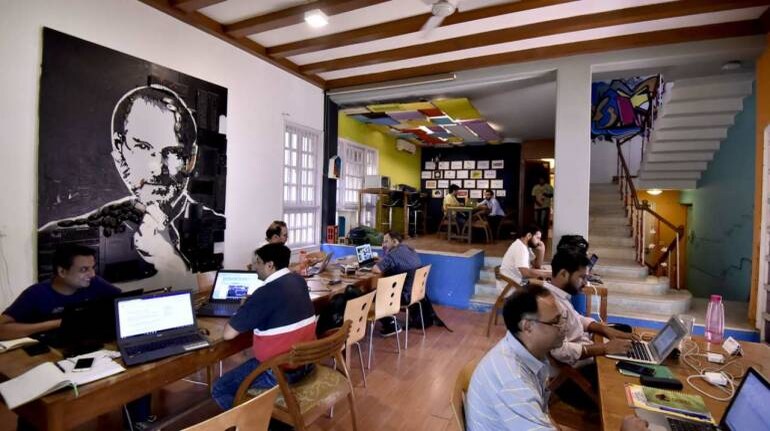
Remote working by employees in small to mid-size tech firms is probably here to stay as companies look to downsize real estate and pause their expansion plans in co-working spaces.
This will impact the co-working industry in the country, which has been growing at a fast pace in the last couple of years.
Manav Garg, founder, EKA Software, a software-as-a-service (SaaS), said work from home (WFH) will become a permanent feature for the company. “We will reduce dependence on real estate and capacity in co-working spaces,” he said.
Another entrepreneur Pallav Nadhani, who recently sold his firm FushionCharts and is already on to his next venture, said the company is pausing its expansion plans in the co-working spaces. The company reduced its capacity after its contract ended in a co-working space.
Many other startups and firms are likely to follow suit as companies see a drop in business volumes and are looking to cut costs. Real estate experts told Moneycontrol the sector is likely to see an impact in the short-term.
Vikas Lakhani, part of Indian Workspace Association, said co-working spaces are seeing a 10-15 percent drop in business for existing clients. Lakhani explained that many firms are re-negotiating contracts and reducing capacities. Though there are more queries coming in, Lakhani said uncertainty is still weighing on the sector.
Co-working in India Co-working had begun to take root in India recently driven by startups and growing gig economy for freelance programmers in the country. Flexibility around scaling up and downsizing of your space was also attractive.
According to a report by JLL India, a real estate consultancy firm, co-working share in office space leasing increased to 12 percent in first quarter of 2019 among the top seven cities from 5 percent in 2017. Some reports pegged this number could touch 25 percent in coming years.
How will co-working fare post COVID-19? The pandemic will reduce office absorption significantly in 2020. According to a report by Savills, office space absorption in India could witness a degrowth of 6 percent during the crisis in 2020 from a growth of 22 percent prior to the crisis. The report estimates 10-15 percent growth in 2021. This will affect co-working spaces too.
However, experts see a silver lining.
While there is a slump, the sector is likely to pick up. For one, post COVID-19, people would want more flexibility in terms of workspaces, more than ever, in the long-term, a real estate expert pointed out. In addition, having a co-working space eliminates the need to have multiple office space since it can be accessed from other cities as well, Lakhani added.
However, the extent of recovery is still unclear as companies are looking at various options to engage their workforce and more models could emerge.
Other models might emerge Nadhani said one could probably see society complexes renting out apartments for those within the society, say for 10-20 people working in different companies. This could be a quasi-office and it would be important for someone who wants clear demarcation between their professional and personal space, he added.
The executive said the company is looking at having four days of working from home and one day in office for idea sharing and just socialising. In this case, there is no need for a seat for its entire workforce.
Garg explained that the company is studying internal behavioural changes and are taking steps to ensure employee well-being.
Since lockdown and remote working started, employees are working longer hours and weekends and weekdays are blurring. Garg said the company is looking at giving them a digital holiday, where they can sign off from emails and other digital communication tools for a day.
Discover the latest Business News, Sensex, and Nifty updates. Obtain Personal Finance insights, tax queries, and expert opinions on Moneycontrol or download the Moneycontrol App to stay updated!
Find the best of Al News in one place, specially curated for you every weekend.
Stay on top of the latest tech trends and biggest startup news.