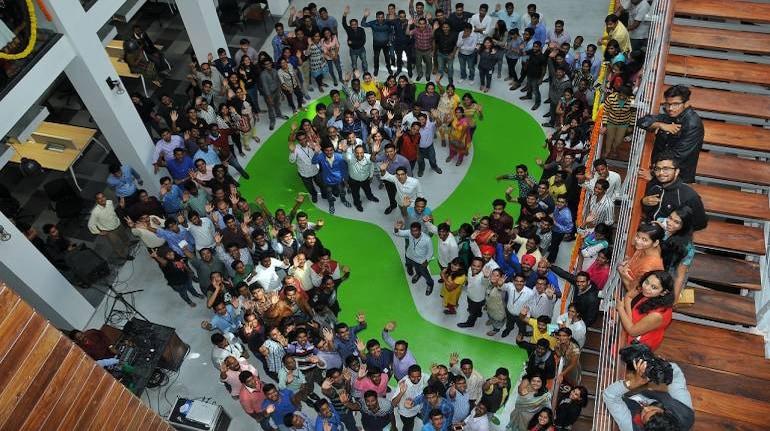
Standing in front of a gigantic iron gate, it's hard to imagine that there is a sprawling campus of a multi-million dollar startup behind it adorned with lush green trees and dew drop laden grass.
We are at the headquarters of one of India's homegrown unicorns, Quikr in Bangalore.
Needless to say, this is one of the most unconventional offices compared to other Indian unicorns which are mostly stationed amidst glass high-rises or amidst crowded central business districts.
Quikr that shifted its headquarters from Mumbai to Bangalore in 2015 had almost lost hope of finding an unconventional location for its office till someone told Pranay Chulet, the 43-year old founder and chief executive about a textile factory that was being shut down.
The location -- behind the buzzing Manyata Tech Park was perfect and the space it possessed was a luxury, by Bangalore standards.
There were no second thoughts.
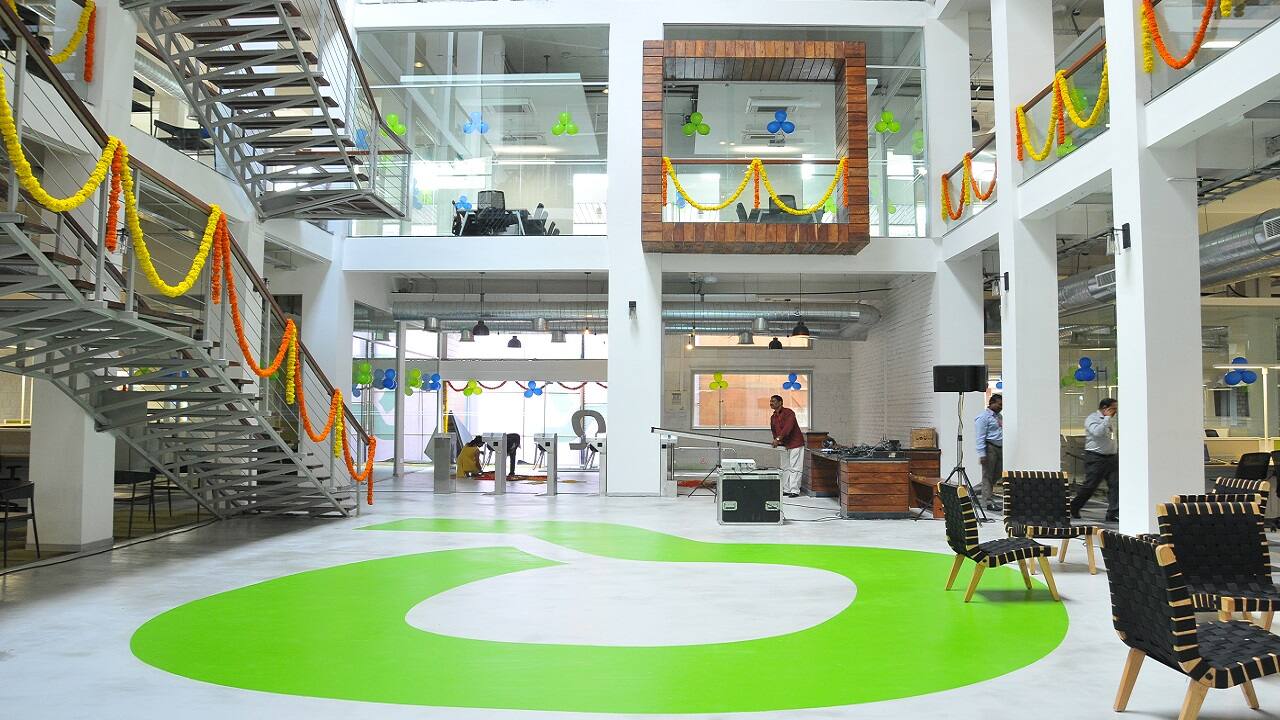
"Now we don't need to be cramped (unlike the previous expensive offices of Mumbai). We have a lot of open space. If we were to really try to optimize it fully, we could easily house about 3000 people here," Chulet says while sitting in a large glass cubicle painted in white with smoothened brick feel.

A fitness freak, Chulet is dressed in a polo T-shirt and is sipping soya milk instead of a regular tea or coffee.
Chulet tells me that space has been frugally decorated and ruins of the textile factory structure still make up a large part of the tech startup. Because of the glass walls, there's plenty of natural light pouring into the office.
Like a transition from an old textile compound to housing a tech startup, Quikr's history also has remnants of its past.
"When we started in 2008, Quikr was a little company and so was the internet market. Indian internet users were also just beginning to get familiar with the medium. There was little mobile broadband and internet speed was nowhere near to what it is today," says Chulet.
"The market has become a lot bigger, speed has improved, something called the mobile internet is proven and people's expectations from this medium have become a lot more sophisticated," he adds explaining the change is last nine years of the company.
Magic of VerticalizationOnline classifieds portal Quikr was founded in 2008 as a horizontal classifieds platform. After seven years, in 2015, it started verticalizing its businesses.
"We have transitioned from what was a simple one size fits classic horizontal platform where you could come buy and sell anything from goods to jobs to homes to cars and so on. Today we are a collection of five verticals. So we have not really changed anything from what we started in the sense of changing pressure... we have just gone deeper in things that we started by building more category specific markets," he adds.
Quikr has built its business around five key segments -- automobile, real estate, jobs, services and customer to customer sales with an aim to expand its revenue.
"So we have this magic word in the office since three years called verticalization where what was initially a horizontal platform is now gone deeper and created deeper solutions," Chulet says.
Services, goods and bikes followed by jobs and homes are the largest categories in terms of transactions. However, the order almost reverses when talked about in terms of the value of transactions.
"My firm view is that the market is so competitive that if you start a single category company, you will just keep fighting between your categories. There is a lot of benefit to a cross-category brand if it starts going deeper," he says adding that with multi-category, the company's revenue base is now much broader against any of the vertical players.
He stresses that in India if a company wants to scale up a business, having a strong brand and investing in that brand is super important.
"Somehow our population still associates certain level of credibility when the brand is seen on television. If I was just a cars classifieds company or just a real estate (listings) company or just a goods company, by definition, our revenue pool would have been smaller. I wouldn't have been able to invest more than a certain amount on building that brand," he says.
"That is a big benefit because stronger the brand, more the premium you can command in revenue generation," he adds.
He also claims that even on the customer acquisition side, the company's costs are lower, because it is able to find customers for one vertical in another vertical.
"This is about how can you generate more revenue out of the same offering because our consumer pool is much larger. We know who is in the market for a movers and packers because they are moving their house or who is looking for a blue collared job. So that is in some ways the most powerful lever," he says.
What sort of competition the does company see coming from its biggest rival Olx?
"We see Olx more of as goods focused player so if you asked us this question about 3-4 years prior, they were our only competitor. Now we have several competitors. They are just one of our many competitors," he says adding that while Olx focuses on the customer to customer business, Quikr is comparatively broad-based.
While Quikr reported net sales of Rs 41 crore during the year ended March 2016, its loss widened to Rs 534 crore from Rs 450 crore during the like period of the previous financial year.
Greener PasturesThe company, however, claims that its net losses are narrowing and it targets to achieve profitability in the next seven quarters.
"Losses have been reducing substantially and I don't mean by just 10-20 percent. The reason for that is two-fold -- our revenue is increasing fast. Second is the reduction in heavy lifting. When you are building a brand initially you have to spend a lot more," he explains.
Quikr last month launched a category focused ad campaign for old smartphones. It is now known for its catchy and quirky television commercials.
"Of course you should continue to invest in the business but you may not always need to invest in the same level where you needed to when you started," Chulet says adding that the monthly cash burn has reduced significantly. He, however, declined to share numbers.
The company that has over 2500 employees across the country says there will be a gradual increase in the employee base.
"Employee base will grow more as the revenue grows. Some of the employees get linked to revenues....sales force or operations in the company, they get linked to how many paid customers we have," he says.
We head to meet other key executives of the company and come across conference rooms with interesting names such as Raftaar, Jaldi, Daud...all words related to the verb "speed" in Hindi.
Indeed the word speed resonates with rapid acquisitions of smaller startups by Quikr in the last 18 months. These include names such as Babajob, Commonfloor, Grabhouse, Stayglad, Zapluk, Salosa and Zimmber, among others.
Quikr is also in talks with Housing Development Finance Corp. Ltd to acquire its brokerage business. Chulet declined to comment on that development.
Vineet Sehgal, the chief marketing officer of Quikr explains me the company's ad strategy.
"If the services are limited to 12-15 cities there is no point doing television," he tells me while sitting inside Raftaar.
He adds that while for some verticals, TV ads work better. "However in a lot of other categories like services or hyperlocal a lot of digital initiatives work better," he explains.
We are soon joined by Prasun Mandal, the analytics and product monetization head of the company.
According to him, the company is using a lot of artificial intelligence to send relevant push notifications to customers. "Audiences who are coming in to rent a home, will need to paint and clean it," says Mandal.
Clearly, the company wants to capture the imagination of Indian masses when it comes to searching any kind of classifieds online. And it wants to do it Quikr....


Discover the latest Business News, Sensex, and Nifty updates. Obtain Personal Finance insights, tax queries, and expert opinions on Moneycontrol or download the Moneycontrol App to stay updated!
Find the best of Al News in one place, specially curated for you every weekend.
Stay on top of the latest tech trends and biggest startup news.