The world’s biggest venture capital (VC) firm and the hottest start-up space: you would think it is a perfect match. Sequoia Capital makes headlines for many reasons, most recently for a new business model. It is now being spoken in Indian startup circles about an investment it hasn’t yet made in what’s perhaps the country’s hottest start-up space.
Sequoia India has so far steered clear of investing in aggregator companies that sell their products on e-commerce platforms in India, a concept popularized by Thrasio Holdings, an aggregator of sellers on Amazon.com. Inc.. Three-year-old Thrasio was valued at $10 billion recently, and having the name Thrasio in your pitch deck is enough to raise a few million dollars, at the least. Business models can come later it seems.
These models, wherein companies acquire top-rated sellers on e-commerce platforms and scale them up, have been all the rage. Nearly a billion dollars could be invested into Indian Thrasio models by the end of 2021, a new level of aggression even considering the record amounts of money pumped into start-ups in 2021.
Top venture funds, including Accel Partners, Lightspeed Venture Partners, Tiger Global Management and SoftBank have already bet on this model, with some of them already seeing big returns on paper as well. For example Accel and Lightspeed invested in Mensa Brands and GlobalBees about six months ago. Both companies are already raising funding rounds valuing them at a billion dollars each.
Investors seem to be falling over each other to fund these companies, which themselves are on an acquisition spree- to buy revenue and show that revenue as their own in order to raise more money at higher valuations.
And yet, Sequoia, which manages over $5 billion in assets in India- more than twice any other early-stage investor --has not done so yet. Analysing why Sequoia hasn’t bet on any of these companies offers a peek into the storied Silicon Valley firm’s thinking and strategy in India.
Moneycontrol spoke to people familiar with the investor’s thought process, including people who share governing boards with Sequoia, entrepreneurs the VC firm has spoken to, competitors and others. They spoke on the condition of anonymity.
Sequoia declined to comment on a query from Moneycontrol.
Because of its sheer size, it is rare to see Sequoia India not invest in a particular space. From e-commerce to fintech, from cryptocurrency to enterprise software, Sequoia is everywhere. Even more so with its three funds--seed, venture and growth, and its conservative tagline- From idea to IPO and beyond.
Rival investors often contend that Sequoia follows a “spray and pray” strategy- that it invests in multiple companies in every sector due to which some of them are bound to succeed by sheer virtue of size, akin to buying more lottery tickets to increase your chances of winning.
People close to the firm contest this, though, saying that because Sequoia invests across sectors and stages, in about 30-40 companies a year from its accelerator program Surge alone, some conflicts, wherein more mature portfolio companies do something similar, or companies pivot to one another’s business models, is inevitable.
Spray and pray or not, Sequoia hasn’t invested in this space partly because it is not convinced of its potential yet, people said.
“Digital consumer brands are not new. But they are not sure whether the India online retail market is big enough to justify these many Thrasio-plays and this much money being invested in the space. Betting on the future is fine but in this space, the present is looking really shaky,” said one person.
India has about 160 million ecommerce users who have shopped for around $50 billion in Gross Merchandise Value (GMV) in 2021 so far, a Redseer report says. This is estimated to be $140 billion and account for 11% of all retail commerce by 2030. But growth estimates can change, pricing is still a challenge and more competition is imminent. Further, unlike the US, India has far fewer branded categories and less awareness of brands in many categories, retailers say.
“Do stray businesses become valuable only by aggregating them? And whether Indian Thrasio’s can be bought at prices similar to the US is unclear. Their valuation does not justify the current business model or traction,” this person said.
That statement could be made of most sectors, including many of Sequoia’s own investments, more so during a funding boom, but people say these reasons have kept Sequoia away from investing in these companies
The core model of Thrasio start-ups, which entails investing in fast-growing consumer brands and turbocharging their growth, with multiple brands using their individual identities to appeal to a consumer, mirrors what offline giants such as Unilever Plc. and Procter and Gamble Inc. have done for decades. Internet start-ups have been replicating that strategy for online brands in recent years.
Many of them are already in Sequoia’s portfolio, another reason why the fund has not moved fast to fund the Thrasio model yet.
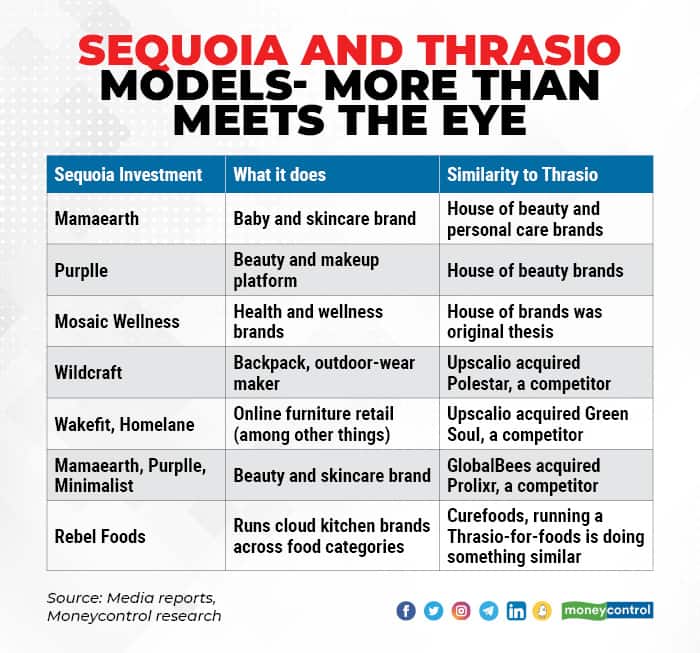
At least three Sequoia-funded start-ups- babycare brand Mamaearth, beauty care brand Purplle and health and wellness start-up Mosaic Wellness -- are looking to build a house of digital-first brands.
“If you look at it from the point of view of not Thrasio models, but being invested in consumer brands, Sequoia has enough and more. And all of them are looking for acquisitions, so in some sense they already have exposure to the Thrasio play without investing directly,” said a person tracking the firm.
People businessInvestment firms, more than many other business spaces, are driven by people. Investors, particularly early stage investors, back a company not because of its financials or track record, but because of the founder’s previous background, an evolving industry ripe for disruption, and decisions driven by instinct and gut feeling. Sequoia is no different.
Consumer brand investments are generally led at Sequoia by GV Ravishankar, a veteran at the firm, and Sakshi Chopra, who became a partner earlier this year. This isn’t a hard and fast rule though. For instance, Sequoia’s investment in Mamearth, a maker of natural skin care products, was led by Ishaan Mittal, but it indicates where expertise lies in the firm.. Ravishankar and Chopra’s combined consumer portfolio includes mattress-maker Wakefit, Purplle, outdoor clothing and gear brand Wildcraft and Rebel Foods. which is also creating a house of food brands..
People familiar with Ravishankar and Chopra’s thinking said that they aren’t usually inclined to fund developing business models at sky-high valuations, a bet that others at Sequoia, as well as other VCs in general may be willing to take.
“GV and Sakshi are really sensible investors. They are not going to do the ‘hot’ deals, just because it is hot or because they will get a mark-up (on valuation) soon,” said a person who knows the two well.
“If you’re investing in Thrasio models, you are taking a very long- term view, where the future is rosy but today is messy,” this person added.
Never too lateSequoia’s investment strategies reveal not only the firm’s thinking but also serve as a barometer of where the venture industry stands, which is why the decision to sit out of Thrasio-models so far is curious. And yet it isn’t, because Sequoia India has enough capital and clout to enter deals at any stage, even at a valuation of $1 billion or more if they find the company really appealing.
Sequoia runs three funds in India (and Southeast Asia), and if it gets tapped out from those, it also has a global growth fund, an $8 billion investment vehicle meant to compete with hedge funds and even SoftBank.
Such a structure also rectifies previous errors. In the early days of e-commerce from 2009-10, Sequoia was not an investor in any of the leading e-commerce companies--Flipkart, Snapdeal, ShopClues. Today even if Sequoia misses any promising company early on, it has ample opportunities to back them later on, and still make returns.
Investors argue that when a market is growing and a start-up has a shot at dominating that market, entry valuations for the first few rounds make little difference, because in the end stage. assumption plays out--of a decacorn (a start-up worth $10 billion) or bigger. Everyone makes benchmark-beating returns, no matter what valuation they came in at.

For example, Sequoia led a $55 million round in software firm Freshdesk in 2016, along with existing investor Accel. At a valuation of $600 million, it was one of the most expensive deals Sequoia had done at the time.
“It looked like classic FOMO (fear of missing out) investing. They sorely regretted missing Freshdesk at seed and came in at a really expensive price,” a rival SaaS (founder quipped. SaaS is short for Software As A Service.
Freshworks, as it is known today, listed last month on NASDAQ. With an unexpected and eye-popping valuation of $14 billion, Sequoia’s 12% stake in Freshworks is worth over $ 1 billion, and despite coming in later than Accel and Tiger Global, will reap nearly 10 times what it invested if it sells shares today.
Sequoia’s reticence to bet on India’s hottest space indicates both its own strategy as well as the risks and overlaps in a red-hot business model.


Discover the latest Business News, Sensex, and Nifty updates. Obtain Personal Finance insights, tax queries, and expert opinions on Moneycontrol or download the Moneycontrol App to stay updated!
Find the best of Al News in one place, specially curated for you every weekend.
Stay on top of the latest tech trends and biggest startup news.