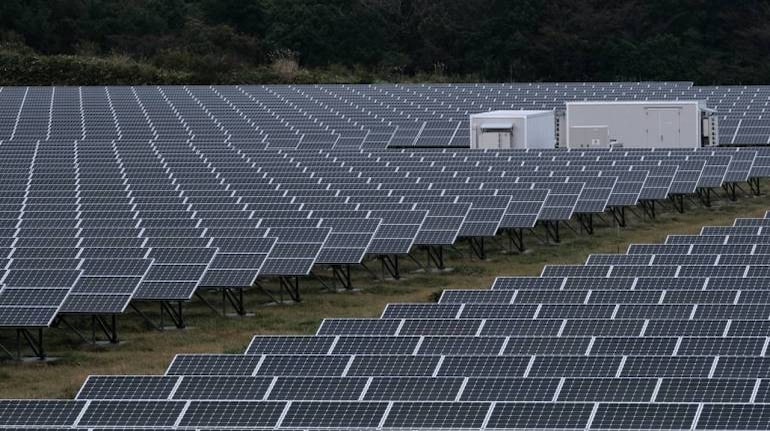
India's pure renewable energy capacity will increase to about 170 gigawatts (GW) by March 2025 from that of 132 GW as on October, 2023, research agency ICRA said on December 7.
To be sure, the 170 GW stated by ICRA does not include large hydropower projects. It constitutes only pure RE capacities such as solar, wind, hybrid and so on. According to government data, as on October 31, 2023, India's installed renewable capacity was 178.98 GW, but this includes large hydropower capacities (around 47 GW) as well.
It further stated that the rise in the renewable energy (RE) capacity over the next six years is estimated to increase the share of RE plus large hydropower in all-India electricity generation from 23 percent in FY2023 to around 40 percent in FY2030.
Also read: Exclusive | ALMM for solar panels may be implemented from April 2024, say govt officials.
The report also stated that RE capacity addition is likely to be supported by significant improvement in tendering activity in the current fiscal with over 16 GW projects bid out so far and another 17 GW bids underway by the Central nodal agencies. This is in line with the 50 GW annual bidding trajectory announced by the Government of India in March 2023.
“The sharp decline in solar PV cell and module prices, abeyance of the Approved List of Models and Manufacturers (ALMM) order till March 2024, and the timeline extension approved for solar and hybrid projects, is expected to lead to an improvement in RE capacity addition to 20 GW in FY2024 from 15 GW in FY2023," said Vikram V, Vice President and Sector Head - Corporate Ratings, ICRA.
This, along with the growing project pipeline, is likely to support the scale-up in capacity addition to 25 GW in FY2025, mainly driven by the solar power segment, he said.
However, challenges remain on the execution front with respect to delays in land acquisition and transmission connectivity, which could hamper the capacity addition prospects, the agency stated.
ICRA found that the sharp decline in solar photovoltaic (PV) cell and module prices by 65 percent and 50 percent, respectively, over the past 12 months is leading to a healthy improvement in debt coverage metrics for the upcoming solar power projects.
"Benefitting from this, for a solar power project with a bid tariff of Rs. 2.5 per unit and sourcing modules from domestic OEMs using imported PV cells, the average debt service coverage ratio (DSCR) has improved by over 35 bps. While this is positive in the near term, the developers would remain exposed to movement in imported solar PV cell and wafer prices, till the development of fully integrated module manufacturing units in India," Vikram said.
Given the intermittency associated with RE generation, the availability of round-the-clock supply from RE sources remains important. This can be made possible through the use of wind and solar power projects complemented with energy storage systems.
Talking about RE-round-the-clock (RTC) projects, Vikram, said, “The tariffs discovered in the RE-RTC tenders so far remain highly competitive against the conventional sources, with recent bid tariffs in the range of Rs 4.0-4.5 per unit, well below the Rs 5.2 per unit discovered in the recent medium-term bid for supply from coal-based projects."
The share of RE-based RTC projects is expected to rise in the upcoming bids as already seen from the tenders issued by the Solar Energy Corporation of India Limited (SECI) in the current fiscal. "The returns for the winning developer under the RTC bids remain linked with the cost of the storage component, apart from the cost associated with the wind and solar components," he said.
Further, based on the prevailing capital cost of battery energy storage systems (BESS) and pumped hydro storage projects (PSP) projects, the viability of the RTC projects remains relatively better with the use of PSP capacity, he added.
ICRA also highlighted that the state distribution utilities (discoms) have shown an improved discipline in making payments to power generators, including RE independent power producers (IPPs), following the implementation of the late payment surcharge (LPS) rules in June 2022.
Discoms in most key states are clearing dues within three months from the billing date to RE IPPs over the past 15 months. Moreover, the past dues are being cleared through installments under the LPS scheme. The sustainability of this trend would depend on the improvement in the financial profile of the discoms, which in turn is linked to the implementation of reform measures by the states.
Discover the latest Business News, Sensex, and Nifty updates. Obtain Personal Finance insights, tax queries, and expert opinions on Moneycontrol or download the Moneycontrol App to stay updated!
Find the best of Al News in one place, specially curated for you every weekend.
Stay on top of the latest tech trends and biggest startup news.