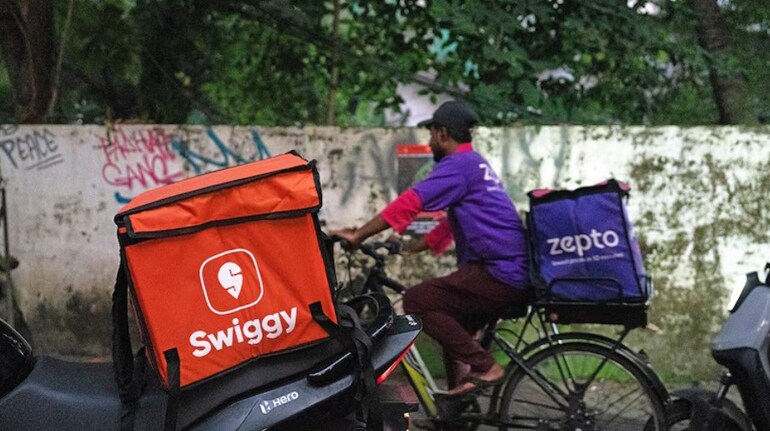
India’s quick-commerce sector is entering a more measured phase, with leading players pulling back from the rapid dark-store expansion seen in recent quarters. Companies are increasingly prioritising order density, store-level utilisation, and operating leverage, as many locations remain well below the required number of daily orders.
Order density refers to how many orders a dark store gets in a day, and higher density makes each store cheaper to run because the same staff and riders handle more orders.
Industry analysts say a dark store in a metro city needs around 2,200 orders each day to make good margins. But both Swiggy Instamart and Blinkit are currently averaging between 1,000–1,400 orders per day.
Swiggy has slowed down its dark-store expansion drastically after a large build-out last year. Bernstein Research said in a report dated November 3 that Instamart added 498 dark stores in FY25, but the pace has dropped sharply in FY26, with only about 161 expected for the full year.
Amitesh Jha, CEO of Instamart, told analysts during the Q1 FY26 earnings call: “We believe that we have reached a state that allows us to be very comfortable with the kind of service that we are giving to the customer and the growth headroom that we have created. We believe that our next network expansion will be based on the need, based on these geographies, and it will not necessarily be for expansion into the white spaces.”
He added that the current footprint was sufficient to sustain strong growth without continued heavy rollout: “The overall network expansion is such that it will allow us to grow at 100% without the addition of a lot of stores, essentially square feet.”
Selective Expansion
Swiggy stressed that the focus now is on using existing assets well, instead of adding more capacity. Instamart’s stores are much larger than Blinkit’s, averaging 4,200 sq ft compared to Blinkit’s 3,200 sq ft. This makes high utilisation even more important for strong profits, according to Bernstein.
The company’s Q2 FY26 numbers show this change clearly, as Instamart added only 40 new dark stores in the quarter. Management called these additions “selective,” saying expansion now depends on utilisation and customer-acquisition-cost efficiency, not just filling new areas.
Blinkit store expansion pace to peak in FY26
Eternal’s Blinkit is also expected to slow its rollout after a peaking in FY26 and follow a more sedate path from FY27. According to Bernstein, Blinkit added 775 dark stores in FY25 and is expected to add 1,000 in FY26, 700 in FY27, 500 in FY28, 300 in FY29, and 200 in FY30.
The report says Blinkit now has more than 1,700 dark stores and expects the pace of new store openings to reduce sharply over the next few quarters.
Eternal’s own guidance supports this. Blinkit grew its network from 1,301 stores at the end of FY25 to 1,816 by H1 FY26. Blinkit expects to cross 2100 stores by December 2025. But the company expects to reach only 3,000 stores by the end of FY27, showing that FY26 is the peak investment year before a moderation in new store additions.
“...there are multiple dynamics at play, in terms of choosing the pace of expansion. And I would say because of that, we've been slightly conservative right now in our guidance in terms of timeline of getting to 3,000 so that we have some room to actually make changes to how we want to grow if we have to,” said Akshant Goyal, Chief Financial Officer, Eternal Limited in the company’s Q2 FY26 earnings call.
Further, IPO-bound Zepto, which now operates roughly 900–1,000 dark stores, is also expected to take a more cautious expansion path as it aims to curb cash burn and strengthen store-level profitability before accelerating growth.
Why the Slowdown?
For both companies, analysts highlight the same reason that many existing stores are under-used, and larger new stores, especially for Instamart, need time to build up order levels.
Bernstein said Instamart’s current throughput is 1,000 orders per store per day, which is lower than Blinkit’s 1,500. This gap explains why Instamart is slowing its rollout, as many stores still have room to take more orders before it makes sense to open new ones. Further, even Blinkit’s stores can handle 2,200–2,300 orders per day when they reach maturity.
Motilal Oswal notes a similar trend in Q2 FY26, saying that “dark-store expansion intensity is lower for all players compared to Q2FY25–Q4FY25.” Most new dark stores have already crossed the 4–6-month breakeven stage, and the next improvement in margins now depends more on higher throughput than on building more stores.
The firm also says that better throughput will help margins grow and reduce fixed costs per order in the coming quarters.
Industry models now show a naturally slower expansion cycle. Bernstein’s supply-side analysis suggests India can support a total of 8,500 dark stores across 3,800 eligible pincodes. This means the fast “land-grab” period is ending as companies reach closer to saturation in large metros and Tier-1 cities.
Fundraising may revive ‘land-grab’ pressure
To be sure, while dark store expansion seems to be moderating currently, analysts believe that with quick-commerce players' latest fundraising plans, competitive intensity in the industry may see a revival in the coming quarters.
“Swiggy, armed with a potential INR100b in fresh funds, Zepto’s recent fundraise, and Eternal’s strong balance sheet could set off another land-grab phase in quick commerce,” Motilal Oswal noted in its report.
Discover the latest Business News, Sensex, and Nifty updates. Obtain Personal Finance insights, tax queries, and expert opinions on Moneycontrol or download the Moneycontrol App to stay updated!
Find the best of Al News in one place, specially curated for you every weekend.
Stay on top of the latest tech trends and biggest startup news.