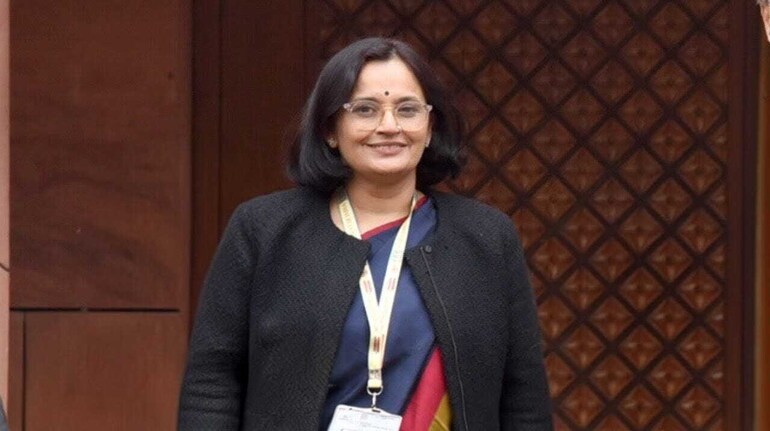

Private investment in India is beginning to respond to sustained public capital expenditure, with “crowding-in” effect visible in sectors such as electronics, automobiles, cement and steel, department of economic affairs secretary Anuradha Thakur told Moneycontrol in an post-Budget interview.
The government is confident of meeting its capital expenditure target for FY27, supported by diversification across sectors and higher infrastructure loans to states, said Thakur, who plays a key role in preparing and implementing the Budget, including framing fiscal targets.
The target for the Centre's capital expenditure has been set at Rs 12.2 lakh crore for FY27 and the allocation for interest-free capex loans to states increased to Rs 2 lakh crore.
Edited excerpts of the interview:
What's the breakup for the nominal GDP figure of 10 percent, as in the deflator and real GDP growth?
We have fixed real GDP growth at more than 7 percent. Core inflation is now stabilising and with that stabilisation, we may see its impact as well. All of this has been taken into account before arriving at the plus-7 figure. I look forward to inflation staying benign, though there are two views. One being what is the appropriate amount of inflation for growth. At the same time, low inflation is good for the poor, as they have more income left. I expect inflation to remain moderate, though whether it will remain exactly where it is remains to be seen.
How do you assess the role of public capital expenditure in reviving private investment, particularly among MSMEs? Are there signs of crowding-in?
Typically, when we used to talk about public capex, it was meant to crowd in private investment, which did not happen for a long time even as we continued raising capex. Then the narrative changed to the government doing the heavy lifting. However, I do see signs of private sector investment getting bolstered. It is said to be not uniform, present in certain sectors and not others. Among those sectors, some are linked to areas where the government has introduced schemes, such as the electronics sector, but thankfully it is also visible in some other sectors.
In that context, if you look at the 'Champion SMEs' scheme, it is not just about bringing scale to small and medium enterprises. Small and medium enterprises find it hard to access capital and they are directly part of the supply chains of large manufacturing companies. If we can help them achieve scale, investments will increase and they will also get the liquidity they need. As a result, the turnaround starts improving.
We are, therefore, hopeful that the cycle will turn around very quickly for medium and small MSMEs, leading to a further uptick in private investment. Big corporates have already started moving on private investments but if we can get around Rs 5 lakh crore worth of small and medium enterprises to grow, we can boost investments further.
Private investment in the last year has actually picked up, so the crowding-in effect is happening in sectors such as electronics, automobiles, smaller capital goods, cement and steel. This is why we have given a strong push to infrastructure.
Will the target for capex be met given the issues around absorption capacity?
Yes, because of diversification. We have also increased capex loans to states and there is a lot of appetite among state governments as well.
What is the remit of the FEMA Committee proposed in the Budget?
The FEM–NDI (foreign exchange management non-debt instruments) Rules were notified in 2019, bringing together a number of separate items. Since their notification, there have been several amendments from time to time. We keep receiving representations and we realise that very fine aspects need to be either clarified or amended. That is probably not the best way to do it. The finance minister guided us to review the rules holistically, undertake consultations and include this intent in the Budget speech to reflect a certain openness.
We will carry out consultations, and even if, after six months, amendments are still required, we will proceed with them. At least we will have the satisfaction that we consulted as many stakeholders as possible. That is the time we will take for consultation, and beyond that we will try to move quickly. The remit is ease of doing business as well as addressing sectoral issues, so that we can weave them together and ensure there are no contradictions in the regulations. Accordingly, we will also look into the definition of FDI in the NDI Rules.
Are changes to Press Note 3 on cards? What stage are the discussions at?
It is truly at the discussion stage and it was put in place with a lot of thought. How it will shape up, whether there will be different buckets, these are only initial discussions. It has to be calibrated very carefully.
Do you expect interest rates to be cut, as inflation continues to be low?
For both inflation and interest rates, there is an optimal level that supports growth. After the initial round of consecutive cuts, the RBI is holding steady and I do not hear the private sector complaining. For now, there is a modicum of stability and I would not be surprised if it remains like this for some time.
What steps will the government take to boost FDI inflows?
We are actually getting an analysis done by a specialist organisation on this and the results should be available in about a month. By specialist, I mean that we have set up a small group of officers from the department of economic affairs (DEA) and the department for promotion of industry and internal trade (DPIIT), and they have further commissioned more detailed statistical analysis from other bodies.
So far, what we can see from the data is that the trend is largely on account of outward direct investment (ODI), which is a relatively new phenomenon in this country. This has led to net foreign direct investment (FDI) either remaining flat or declining, sometimes only marginally. FDI flows per se have been quite robust. Would we like them to be higher? Most certainly. We believe there is potential for higher FDI, which is why we are attempting to identify specific sectors where we can proactively push growth through targeted grants under government schemes so that FDI can flow in.
In particular, sectors such as pharmaceuticals are areas where we believe not only domestic industry but also foreign investment could pick up, possibly as early as the coming financial year. The impact on net FDI is mainly due to ODI, and that is not something we can really quarrel with, as it reflects a regulatory framework that permits Indian companies to invest overseas.
Coming to the big announcement, does the trade deal between India and US remove a big macro-economic headwind?
It does relieve us of the uncertainty in this space. It was also mentioned in the Budget speech that there was uncertainty in the trade space. To that extent, it is definitely a positive development. Going forward, once the detailed contours of the agreement are shared with us, which will probably happen after the technical processes are complete, as discussions have been taking place at the technical team level, we will be able to assess the impact in a more granular manner.
Do you think this will have a positive impact on FPI flows, which remain a concern?
FPIs, by their very nature, are highly cyclical and we have been seeing the impact. The financial market is also largely driven by sentiment, so I would certainly say we expect a turn in sentiment on account of the certainty that this brings. To that extent, it will have an impact on the FPIs as well.
Does the government have any estimate of the impact the US-India trade deal will have on the GDP?
We do not immediately have estimates for the impact on GDP growth, as the trade deal has just been agreed. Given the domestic situation and our GDP being driven a lot by domestic factors, we had arrived at a number, which we felt back then was a realistic number. Personally, I felt there were reasons for more buoyancy in the economy, probably the receipts will be higher and growth number will be higher. Now, with this uncertainty gone, I don’t have a number immediately, but it will have a positive impact.
What will be the impact on the rupee?
The rupee has gone up today (February 3), flows are coming back on the FPI side. Capital flows change in any manner the rupee behaves in a different manner then. I think once the trade deal gets operationalised, it will have an impact. But let's wait a little bit. Maybe just another 15 days or a month, it will give us a clear indication, we will have more details. But it will definitely have an impact.
Returning to the Budget, given the debt-to-GDP ratio aim of 49-51 percent by 2031, do we need a fiscal deficit target of 3 or 3.5 percent?
The jury is out on whether we require it, whether we should state it. In the previous Budget, we had said that fiscal deficit is the operational way to arrive at the debt—to-GDP ratio. They are co-related. I think the investor world and ratings agencies look at the fiscal deficit number. We would like to mention that as well though that is not the metric for us now. We have put a glide path to the debt-to-GDP ratio, which we have to keep on declining, sometimes faster, sometimes slower, but we want to reach that commitment. Along with that, we will put out the fiscal deficit number.
But is a fiscal deficit aim of 3-3.5 percent history now?
This the FRBM target and perhaps, we have reached it only twice since it was enacted. It has been like a beacon to follow. Now that we are following the debt-to-GDP ratio as a target, it is something that people globally are also moving towards. But given that we are front-facing investors and investors do draw comfort from the fiscal deficit number, we will continue to put that out.
In fact, during our stakeholder consultations, some suggested that we should not reduce the fiscal deficit below 4.4 percent, so that growth is not affected. However, we decided that since we have committed to a glide path, whether gradual or steep, we must remain directionally correct.
Have we opted for a slower pace of fiscal consolidation for FY27 to prioritise growth and is this a trend-setter?
There is also more momentum in the economy, so it is not necessary that the pace of our fiscal consolidation will remain gradual in the financial year after next.
Your gross market borrowings are higher than market estimates due to repayments. Are you concerned about yields? Would the government and RBI ensure the borrowing gets through, and are OMOs an option?
From what I have understood of the borrowing programme, there are a couple of things that are kosher. A strong central bank is kosher, because it is in everyone’s interest that the central bank remains solid. The central bank manages our borrowings and is responsible to both the government and the economy to ensure that we get the best rates possible at any given point.
The instruments we have to manage borrowings are what they are, such as OMOs, switches and buybacks. We have this manoeuvrability. At the same time, the market also wants us to keep capital expenditure high. The market, as well as we, have an idea of which year has large repayments. This year, we have had large repayments and over the next couple of years we will also have a good amount of repayments. So, market borrowings may stay elevated. I have to repay from whom I borrow.
However, we do not want to borrow at expensive rates. We will manage using those tools, OMOs, switches and buybacks, closer to repayment dates and closer to the borrowing calendar. When it comes to the yield on the 10-year bond we would love see delightfully placid numbers, but we know the reality is that this is a heavy borrowing calendar due to repayments of Rs 5.5 lakh crore. Therefore, we do have a larger T-bill borrowing this time, and we have put that out immediately and transparently. We will use the other mechanisms to the extent we can because we do not want any turbulence. Per se, in net terms, the borrowing has been kept within range.
Discover the latest Business News, Sensex, and Nifty updates. Obtain Personal Finance insights, tax queries, and expert opinions on Moneycontrol or download the Moneycontrol App to stay updated!
Find the best of Al News in one place, specially curated for you every weekend.
Stay on top of the latest tech trends and biggest startup news.