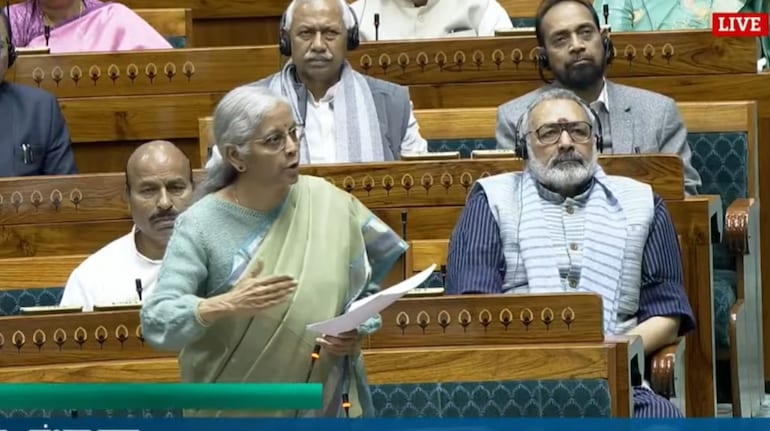

The fiscal deficit for the current financial year will remain within the budget target of 4.4 percent of GDP despite additional expenditure, finance minister Nirmala Sitharaman said in the Lok Sabha on March 13.
“The commitment inclusive of the second supplementary will be within the fiscal deficit presented on February 1,” the minister said in a reply on February 13.
The government has sought Parliament’s approval for gross additional expenditure of over Rs 2.81 lakh crore in the current financial year through the supplementary demand.
Sitharaman said India’s macroeconomic framework has strengthened in recent years, enabling the country to absorb global economic shocks while continuing on the fiscal consolidation path.
“We have strengthened the overall macroeconomic framework. This has enabled us to absorb economic shocks of various nature without deviating from fiscal consolidation,” she said.
Supplementary demands allow the government to seek Parliament’s nod for additional expenditure during a financial year when initial Budget allocations prove insufficient or when new requirements arise.
Economic Stabilisation Fund to prepare for global disruptions
The Economic Stabilisation Fund (ESF) will provide fiscal space for the government to respond quickly to unexpected global disruptions such as geopolitical crises and supply chain shocks, Sitharaman said during the debate.
“The proposed Economic Stabilisation Fund will provide fiscal space to allow India to respond to global impairments such as the recent crisis and unanticipated supply chain disruptions. The government is preparing to face any unexpected events,” she said.
Around Rs 59,000 crore is being sought for the fund under the supplementary demands. The total outlay for the ESF has been set at Rs 1 lakh crore, with Rs 42,618 crore to be added through savings from other ministries and departments.
Adequate fertiliser stock for kharif season
India has fertiliser stock of about 163 lakh metric tonnes, adequate for the upcoming kharif season, Sitharaman said, adding that additional allocations are being made now to prepare for fertiliser demand during the rabi season of December 2026–January 2027.
“Current fertiliser stocks are about 163 lakh metric tonnes, and we have sufficient fertiliser availability for the kharif season. We are making provisions now to meet fertiliser demand for the Rabi season of December 2026 - January 2027,” she said.
Sitharaman also highlighted the government’s efforts to expand domestic fertiliser production capacity.
“Six new urea units have been set up with an installed capacity of 12.7 lakh metric tonnes each, taking the combined capacity to 76.2 lakh metric tonnes. An additional 25.4 lakh metric tonnes of capacity will be added with two new units in Odisha,” she said.
According to the supplementary demands, additional net cash outgo approvals have been sought for fertiliser and food subsidies amounting to Rs 15,000 crore and Rs 23,640 crore, respectively.
There have fears of fertiliser shortage as the Iran war has hot supplies of fuel, including gas, the primary raw material for making nitrogen-based fertilisers, specifically urea.

Discover the latest Business News, Sensex, and Nifty updates. Obtain Personal Finance insights, tax queries, and expert opinions on Moneycontrol or download the Moneycontrol App to stay updated!
Find the best of Al News in one place, specially curated for you every weekend.
Stay on top of the latest tech trends and biggest startup news.