








In a move seen to expand the National Pension Scheme (NPS) coverage across corporate, retail and gig-economy segments, the PFRDA has announced a revision of the investment management fee (IMF) structure for pension funds.
The IMF is an annual fee levied by the pension funds for managing subscriber investments in NPS.
The rate, which will be effective from April 1, 2026, is aligned with the international pension fund benchmarks as well as safeguard subscriber interests, the Pension Fund Regulatory and Development Authority (PFRDA) said in a statement issued on December 31, 2025.
“The revised slab-based IMF introduces differentiated rates for government and non-government sector subscribers and shall also apply to schemes under the Multiple Scheme Framework (MSF), with MSF corpus being counted separately,” the statement read.
While the IMF for government sector employees under the composite scheme or those opting for Auto Choices and Active Choice G 100s remain the same, the following rates shall be applicable for the non-government sector subscribers (NGS).
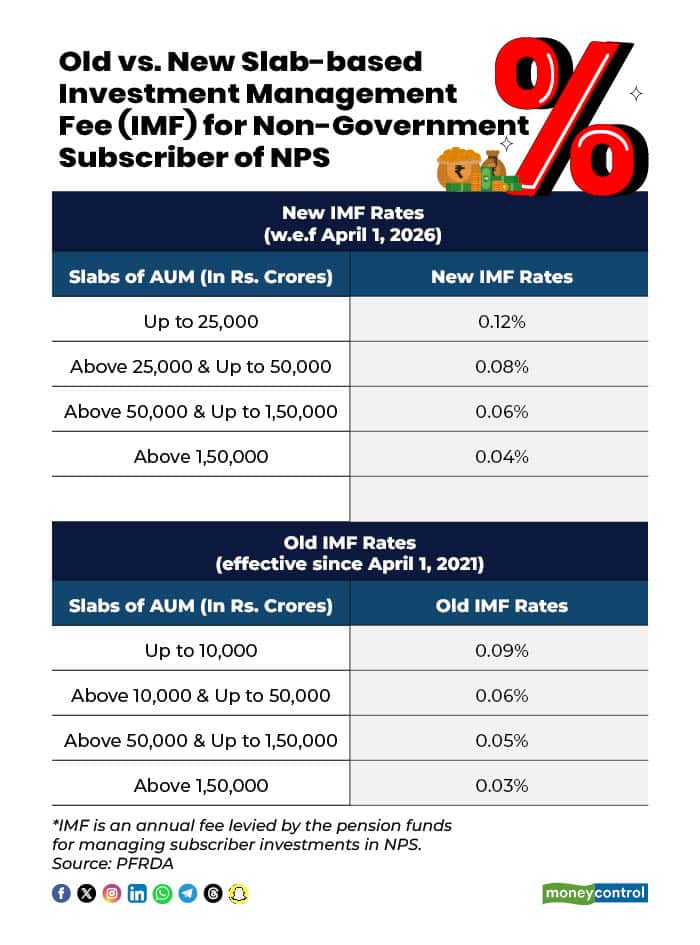
While the new IMF rates will benefit smaller pension funds in retaining a higher margin in early growth stages, the PFRDA has ensured that large pension funds do not earn excessive fees merely due to their size.
According to experts, larger pension funds will benefit from economies of scale, while smaller pension funds will retain higher margins in early growth stages.
“The revised slab-based IMF structure introduced by PFRDA is a measured reform that recognises the differing economies of scale across pension funds while keeping subscriber interests central,” said Prithiviraj Senthil Nathan, Partner, King Stubb & Kasiva, Advocates and Attorneys.
Nanthan explains that lower IMF rates for higher AUM slabs will benefit larger pension funds by allowing them to leverage scale efficiencies and potentially improve net returns for subscribers. At the same time, comparatively higher fees at lower AUM levels provide smaller and newer pension funds with the viability needed to invest in governance, technology and outreach as they build scale.
In comparison, asset management companies (AMCs) charge an expense ratio to manage mutual fund investments, which typically ranges from 0.5 percent to 2 percent for active funds, and 0.05 percent to 0.5 percent for passive funds.
Meanwhile, the Annual Regulatory Fee (ARF) payable by pension funds to PFRDA remains unchanged at 0.015 percent. Of which, 0.0025 percent of AUMs will be passed on to the Association of NPS intermediaries (ANI) to support coordinated awareness, outreach and financial literacy initiative under PFRDA’s guidance, the statement read.
The pension regulator expects that these policy reforms will help subscribers and stakeholders to access a more competitive, well-governed and resilient NPS ecosystem, leading to improved long-term retirement outcomes and enhanced old-age income security.

Discover the latest Business News, Sensex, and Nifty updates. Obtain Personal Finance insights, tax queries, and expert opinions on Moneycontrol or download the Moneycontrol App to stay updated!
Find the best of Al News in one place, specially curated for you every weekend.
Stay on top of the latest tech trends and biggest startup news.





