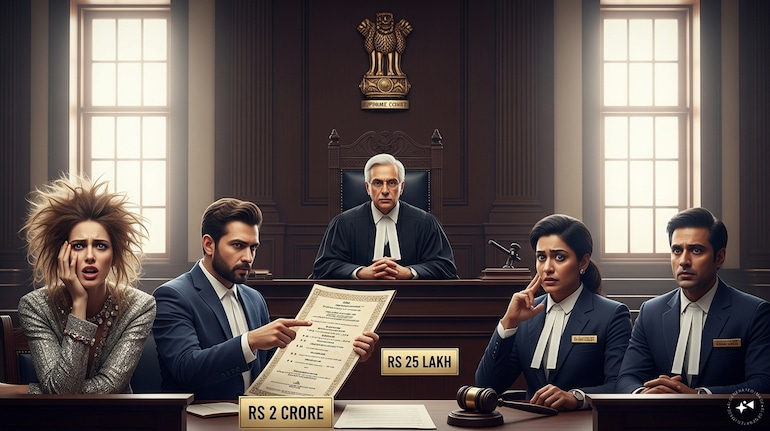

What began as a haircut at a five-star hotel in Delhi turned into a seven-year legal battle that has now finally concluded. The Supreme Court reduced the compensation awarded to the model from Rs 2 crore to Rs 25 lakh.
The Supreme Court held that damages cannot be awarded merely on presumptions or whims and fancies of a complainant, and more so, by relying upon photocopies of documents produced.
“The Court further noted that even if the provisions of the Indian Evidence Act, 1872 are not strictly applicable on the proceedings under the Consumer Protection Act, 1986, the Commission is bound by the principles of natural justice,” said Vivek Joshi, Senior Associate, PSL Advocates & Solicitors.
What is the case?
The case concerns a dispute between ITC Limited and a model, Aashna Roy over an alleged ‘deficiency in service’ during a haircut at the ITC Maurya hotel in New Delhi.
Aashna Roy visited the salon at ITC Maurya on April 12, 2018, for a haircut. She claimed that her hair was cut far shorter than instructed.
According to her, this caused her severe mental trauma and adversely affected her professional modelling and corporate career.
She approached the National Consumer Disputes Redressal Commission (NCDRC) alleging deficiency in service and medical negligence, seeking heavy compensation.
In the first round of litigation, the NCDRC held ITC guilty of deficiency in service and awarded Rs 2 crore as compensation. ITC appealed to the Supreme Court. The Supreme Court upheld the finding of deficiency in service but set aside the Rs 2 crore compensation, noting that there was no proper material evidence to justify such a huge amount. The matter was sent back to the Commission to reassess the quantum of compensation based on evidence.
Before the NCDRC, Aashna Roy enhanced her claim to Rs 5.2 crore and filed several documents, mainly photocopies of emails, modelling offers, certificates, and medical prescriptions to show that she had lost modelling assignments, film roles, and job opportunities due to the haircut.
ITC objected, arguing that these were unauthenticated photocopies, that no original documents were produced, and that it was denied a proper opportunity to cross-examine her or the authors of those documents.
In the second round, the Commission again awarded Rs 2 crore along with interest. ITC challenged this before the Supreme Court, arguing that the compensation was based on conjectures and unproven documents.
The Supreme Court held that while a deficiency in service had already been established, compensation of Rs 2 crore was not justified in the absence of reliable and admissible evidence proving actual financial loss. The Court observed that mere photocopies and general claims of trauma could not support damages running into crores. It ruled that compensation must be based on credible material evidence and not on assumptions.
“This could not be established by merely producing photocopies of the documents. Even the discrepancies in the photocopies produced on record by the respondent, as pointed out by the appellant, have been noticed above. Thus, even after remand, the respondent has not been able to make out a case for award of such huge compensation,” the judgment stated.
Accordingly, the Supreme Court reduced the compensation to Rs 25 lakh, which had already been released to the model in terms of earlier directions.
“The judgment reaffirms that consumer forums ought not to be misused to make exaggerated claims and the courts must apply the principles of natural justice to ascertain the strength of the claim even though the law of evidence is strictly not applicable to consumer cases,” said Supriya Majumdar, Partner, Elarra Law Offices.
What does this mean for similar cases?
“The verdict confirms that a salon or service provider can be held responsible for a deficiency in service under the Consumer Protection Act, but also emphasised that refunds are realistic; large damages require solid proof of actual loss,” said Gauhar Mirza, Partner, Saraf & Partners.
Can a common person also claim a refund from a salon for a wrong haircut?
A salon service falls within the ambit of ‘service’ under consumer law, and a dissatisfied customer can approach the Consumer Commission for a deficiency in service. “If negligence or deficiency is established, compensation or refund can be awarded. However, the extent of compensation will depend on proof of actual loss, inconvenience, or injury suffered. For minor grievances, compensation is typically modest and proportionate. The present case clarifies that while liability may arise, quantum must be evidence-based and reasonable,” said Kunal Maliramani, Associate, Accord Juris.
Discover the latest Business News, Sensex, and Nifty updates. Obtain Personal Finance insights, tax queries, and expert opinions on Moneycontrol or download the Moneycontrol App to stay updated!
Find the best of Al News in one place, specially curated for you every weekend.
Stay on top of the latest tech trends and biggest startup news.