
The Indian rupee–US dollar (INR/USD) forex rates offered by major banks on March 12 ranged between Rs 90.64 and Rs 92.01 for inward remittances (TT buying) and Rs 92.67 to Rs 93.99 for outward remittances (TT selling). For customers purchasing foreign currency through forex or travel cards, rates range roughly between Rs 92.45 and Rs 94.41, while cash dollar purchases can go as high as Rs 95.05, depending on the lender or travel aggregator. The RBI rate was around 92.35 rupees per dollar.
Foreign exchange rates offered by banks typically differ from the interbank market rate because financial institutions add margins and service charges. The rate also varies depending on the mode of transaction, such as inward remittance, outward remittance, forex card loading or cash purchase. As a result, customers transferring money abroad or buying foreign currency for travel often see different rates across banks.
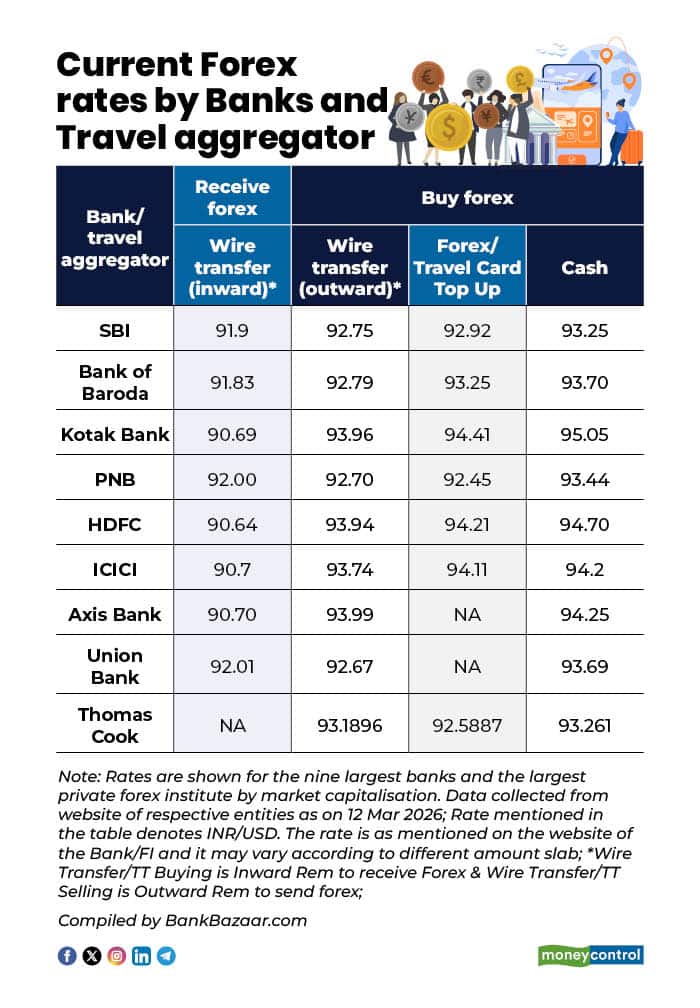
Below is a comparison of the latest forex rates offered by major banks and travel aggregators across various transaction types.
What is wire transfer (inward)
Wire transfer (inward), also known as TT buying, refers to the rate applied when a person receives foreign currency from abroad and it is converted into Indian rupees. This commonly happens in cases such as overseas salary transfers, remittances from family members or international business receipts. In the current comparison, banks are offering inward remittance rates ranging roughly from Rs 90.64 to Rs 92.01 per US dollar, depending on the institution.
What is wire transfer (outward)
Wire transfer (outward), also called TT selling, is the rate charged when an individual or business sends money overseas from India. This could include payments for overseas education, medical treatment, investments or business transactions. Banks apply a higher rate compared with inward transfers because customers are buying foreign currency. The rates in the comparison currently range between Rs 92.67 and Rs 93.99 per US dollar.
What is Forex/Travel Card top up
When travellers load foreign currency onto a forex or travel card, banks apply a card-selling rate that is generally slightly higher than wire transfer rates but lower than cash purchases. Travel cards are widely used for international trips because they allow users to lock in exchange rates and avoid carrying large amounts of cash. Based on the comparison, the rate for forex card top-ups ranges roughly between Rs 92.45 and Rs 94.41 per US dollar.
Cash transactions
Buying foreign currency in cash usually attracts the highest exchange rate among all forex transaction modes. This is because banks and forex dealers include additional costs related to currency handling, storage and logistics. In the current comparison, the cash selling rate ranges from around Rs 93.25 to Rs 95.05 per US dollar, depending on the bank or forex service provider.
Because forex rates vary across banks and transaction modes, comparing offers before making a transfer or purchasing currency can help individuals reduce the overall cost of foreign exchange transactions.
Discover the latest Business News, Sensex, and Nifty updates. Obtain Personal Finance insights, tax queries, and expert opinions on Moneycontrol or download the Moneycontrol App to stay updated!
Find the best of Al News in one place, specially curated for you every weekend.
Stay on top of the latest tech trends and biggest startup news.