

The assertion that a fund produced a 15 percent return over five years requires investors to determine what 15 percent means. The terms CAGR (Compounded Annual Growth Rate), Extended Internal Rate of Return (XIRR), and absolute return represent distinct performance measures.
For instance, absolute return simply measures total growth from start to finish. The absolute return is 75 percent, as Rs 1 lakh grows to Rs 1.75 lakh over five years. The statement does not explain how the money grew. The annualised growth rate, assuming constant compounding, is approximately 11.8 percent per year, based on CAGR. The investment method used in this study requires a one-time contribution.
Therefore, understanding mutual fund returns is crucial for investors to make informed decisions. There are three key metrics for evaluating mutual fund performance: Absolute Return, CAGR and Extended Internal Rate of Return (XIRR).
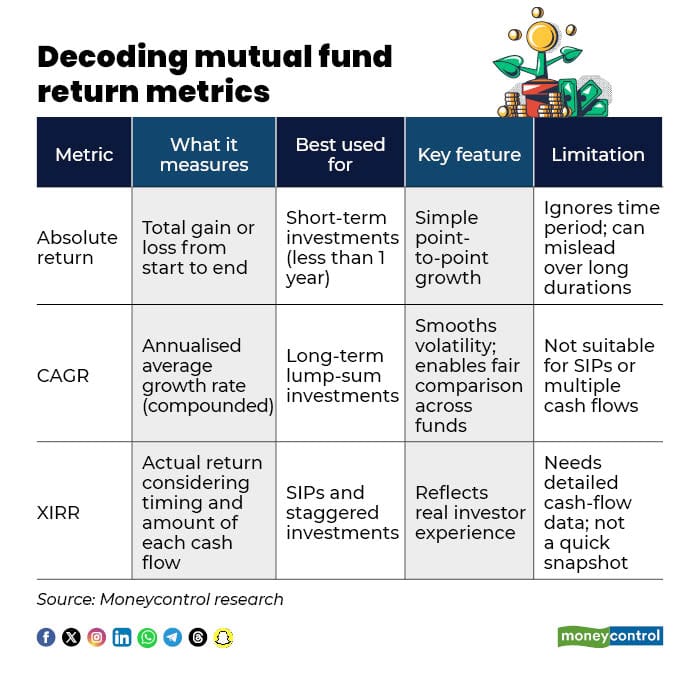
Sameer Mathur, MD and Founder of Roinet Solution, said, "Each metric serves a different purpose: Absolute Return gives a snapshot of overall gain or loss, CAGR smooths out volatility, ideal for comparing long-term investments, XIRR accounts for timing and amount of cash flows, reflecting real-world investing."
Absolute return
Absolute Return represents the total percentage gain or loss on an investment over a specific period, without considering time. It is ideal for short-term investments (less than a year).
Jiral Mehta - Senior Manager - Research, FundsIndia, said, "Absolute return measures the total percentage gain or loss from start to end, without annualising; simply, (final value - initial value) / initial value x 100. It is useful for short-term views like one-year performance, but it misleads over longer periods, as the same 100 percent gain looks different over 5 vs 10 years."
CAGR
CAGR shows the average annual growth rate of an investment, assuming steady growth over time. It's suitable for long-term, lump-sum investments (1+ year/s).
CAGR annualises returns for lump-sum investments, smoothing volatility via the formula: ((Ending Value / Beginning Value) ^ (1/n) - 1) x 100, where n is the number of years. For instance, Rs 1 lakh growing to Rs 2 lakh in 5 years yields about 14.87 percent CAGR, revealing true compounded growth that absolute returns hide. Use it for point-to-point comparisons but not SIPs.
XIRR
XIRR calculates the actual return by accounting for multiple investments or withdrawals at different times, making it well-suited for SIPs (Systematic Investment Plans) or irregular cash flows.
"The XIRR method is essential because investors make investments over multiple time intervals, including SIPs. The system determines actual investor earnings by analysing cash flow patterns because it tracks multiple investment timing intervals," said Piyush Jhunjhunwala, Founder and CEO, Stockify.
What should you do
Investors focus on headline figures that provide no insight into the measurement system. “The right way to evaluate returns is context-driven: use CAGR for comparing funds over similar time frames, XIRR for staggered investments, and absolute return only for quick reference,” said Jhunjhunwala.
The foundation of smart investing lies in a full understanding of returns rather than in seeking maximum financial gain.
"We advise investors, don't chase shiny absolute returns; use CAGR for lump-sum investments over multi-year periods and XIRR for SIPs to get the real picture," added Mehta.

Discover the latest Business News, Sensex, and Nifty updates. Obtain Personal Finance insights, tax queries, and expert opinions on Moneycontrol or download the Moneycontrol App to stay updated!
Find the best of Al News in one place, specially curated for you every weekend.
Stay on top of the latest tech trends and biggest startup news.