Just Keep Buying is a simple read, with simple solutions to complex personal finance problems.
At first glance, the title kind of suggests that the author may delve into data to help readers pick stocks or at least tell us which sectors and businesses to keep buying. And stock picking is anything simple. I wondered how he was going to do it.
The first chapter itself puts my doubts to rest. That’s where the simple 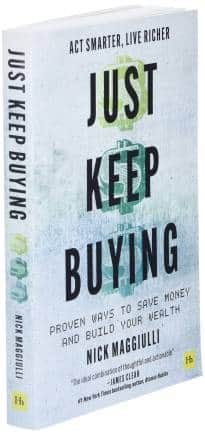 comes into play. Nick Maggiulli sets out to educate the reader about simple ideas around managing their money and their behaviour around money, by breaking the thought into two equally important parts — saving and investing. Moreover, the stated goal is to use data to search for the truth, wherever it may be. The book is rich in analytical data around different scenarios that can impact your savings and investing actions.
Roughly, the first 100 pages are about optimising savings and making the behaviour relevant to your reality. The next about 180 pages are dedicated to maximising your investment return. It’s not just about return though, the author is careful to elaborate on risks which are inherent to different forms of investing, stating clearly that “…. sometimes taking no risk is the biggest risk…. “.
Challenging the conventional savings wisdomThe first part of the book, which is on saving, focuses on all the key parts; how much you need to save, how you should save, how you can spend without feeling guilty, taking on debt, renting versus owning your house, and even how to plan for your retirement. All these actions do require you to think about how and how much you are saving.
The author also challenges a lot of the conventional wisdom around saving.
While admitting that he is not keen on setting random targets for savings and that one should save as much as possible, he is also saying that perhaps you need to save less than you think. Data, he has quoted, suggests that majority of retirees (in the US) withdraw less than what their investments earn, and only a relatively smaller percentage of people ever have to do a drawdown on their principal. Given this statistic, the idea is to focus on using your money towards current fulfilment too, rather than focusing on saving too much for the future.
Also read: Why 'investing more' works better than seeking 'higher returns'The parts that resonate well are where he talks about focusing on increasing income alongside building that savings habit. Both saving more and earning more are key to achieving future financial security.
The author also encourages spending guilt free and shares some practical ideas on how this can be done. One of these is to keep aside an equal amount as investment or for a charitable action if you are indulging more than desired on a whimsical purchase.
Also read: How to manage money in your 20sHe also advises on being careful about taking debt. One of the more useful reasons to take on debt, he says, is to generate returns greater than the cost of debt. Taking debt for personal consumption is never going to achieve this end. Hence, the message is to consider debt after careful evaluation.
The part which got a bit confusing, is where the author uses data to demonstrate that high savers need to save even more when they earn more. The assumption here is that lifestyle expenses also increase at the same proportion, and hence the retirement goal inflates too. However, empirically, we have seen that lifestyle doesn’t always follow earnings increases and because the satisfaction of that next higher spend is lower, at some point our lifestyle upgrade stagnates.
Also read: In your 30s? Time to get serious about moneyMoreover, the author has not touched upon how the structure of spending changes in retirement, once some of the larger expenses such as on dependent children and purchasing a house are all taken care of.
The biggest takeaway is the nuance about focusing on increasing income rather than always being pig headed about spending less in a bid to optimise savings.
Invest early, invest often, invest rightIntuitively, we know the author’s investing advice to be accurate. He further underlines the basic rules with data which fit the argument. It’s in this second section that the title of the book Just Keep Buying finds its feet.
Also read: How to manage your money in your 40sThere are portions on the benefits of specific assets, and the pros and cons of investing in them. There is a neat table which documents the comparison of returns across eight distinct assets, alongside the expected return from each. While some of these are not relevant to the Indian context, the idea is to show how you can measure the risk and return before committing large sums to one asset.
Also read: In your 50s already? How to make the most of the last decade of your working lifeAll the main ideas around long-term investing find their space in the book, with data-backed reasoning. Some of these are:
There was some conflict where he talks about the futility of waiting to buy the dip and reiterates the benefits of regular investing (just keep buying) in Chapter 14. But in a later chapter, he mentions the idea of using any investable cash during a market correction as it might be the best investment opportunity one gets.
Also read: How to have a fulfilling retired life in your 60s even if you haven't yet already planned for itThat’s easier said than done, though. You never know how long the markets would correct, when they slide downwards. In such a situation, while it may be mathematically accurate to add positions, behaviourally and practically this may not be the best approach.
One of the two ideas that stood out in this section is around reframing the upside, which touches upon this idea of investing during a market correction in the most unique way. The second idea is around rebalancing portfolios, not with selling an asset to reach a desired level, rather using any opportunity to buy more to balance a portfolio. The buying more approach is perfectly aligned with the central theme of the book and also presents readers with a far more effective and remunerative way in which they can regularly rebalance their asset allocation.
Overall, Just Keep Buying, is a book which formalises your thoughts with the help of data and analytics. It challenges your thoughts too, and whether or not you agree with the author’s conclusion, you cannot ignore the data. Read it to get the added perspective which will only help in making your personal financial decisions sharper.
Also read: 10 personal finance takeaways from 'Just Keep Buying', by Nick MaggiulliDiscover the latest Business News, Sensex, and Nifty updates. Obtain Personal Finance insights, tax queries, and expert opinions on Moneycontrol or download the Moneycontrol App to stay updated!
Find the best of Al News in one place, specially curated for you every weekend.
Stay on top of the latest tech trends and biggest startup news.