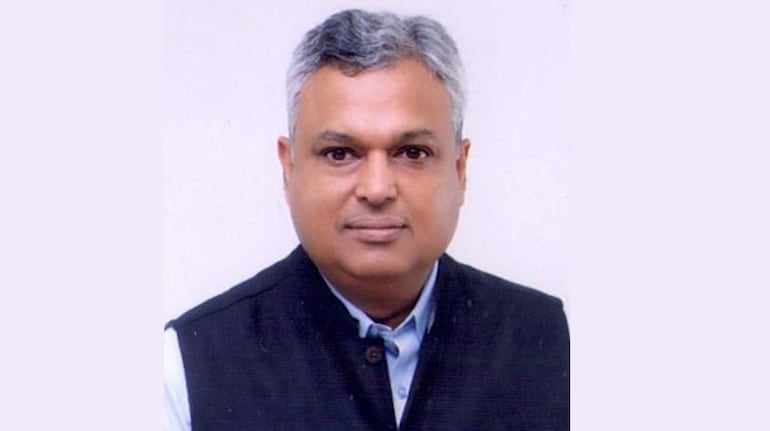

The new GDP series will largely address the concerns of the IMF, and as a result we expect that their assessment and rating of India's national accounts data will change, Statistics Secretary Saurabh Garg said in an interview before the release of GDP numbers with 2022-23 base on February 27.
The IMF in its November 2025 assessment had given India a 'C' grade for national accounts data.
"Base year (of GDP) is going to be revised to 2022-23. Single deflation has completely been done away with, replaced either with double deflation or single extrapolation. And the discrepancy is going to be minimised by integration of National Accounts Framework with Supply Use Table Framework," Garg said, adding that this will "largely address the concerns raised by IMF".
Garg further highlighted that discrepancies are also set to decline moving core GDP (minus discrepancies) closer to the actual number. Besides, he also noted that the government is a looking at a five-year revision for GDP in line with the international norm.
Edited Excerpts:Q. Will you be moving timeframe of GDP revisions?
For GDP base revisions, the international norm is approximately every five years, which is expected to be followed, subject to unforeseen circumstances.
Q. What new data are you incorporating in the new GDP series?
In the new series, level estimates of the household sector will be compiled through regular annual surveys such as ASUSE, PLFS etc. to ensure dynamism in measuring household sector. This is expected to improve accuracy. Besides, GST data will also be looked at to corroborate estimates compiled from other sources.
GST data will also be used for allocation of all-India estimates for private corporate sector in states and for purposes of cross validation in Annual accounts besides its extensive use in Quarterly National Accounts. e-Vahan data will be used in compilation of Private Final Consumption Expenditure (PFCE) of the road transport services. Public Finance Management System (PFMS) data will be used in compilation of estimates for central government and allocation of the same among states. This will help us using actuals in place of Revised Estimates (RE) at the First Revised Estimate stage itself.
Q. What studies is the new series incorporating?
Updated rates and ratios are being used in the new series on the basis of different studies. For example, (i) Grass and fodder related study conducted by Indian Grassland and Fodder Research Institute for agriculture; (ii) fisheries related study conducted by Central Marine Fisheries Research Institute & Central Inland Fisheries Research Institute, and; (iii) Study related to milk and milk products conducted by National Dairy Research Institute and study on transport services conducted by Jawaharlal Nehru University for use in Private Final Consumption Expenditure.
Q. Where have we reached in district-wise GDP data?
As of now, 26 States are preparing District Domestic Product. The ministry is now working on uniform guidelines to be followed by States.
Q. Will the new GDP series help in reducing discrepancies?
Supply Use Table (SUT) framework will be integrated with national accounts to address the discrepancy between GDP from production and expenditure approaches. SUT shows what industries produceand how products are used by industries or final consumers. Balanced SUT ensures that total supply matches total demand in the economy. So, integration of SUT frameworkwill help minimise discrepancy in new series.
Q. Can we expect the stark revision in GDP data to reduce in the new series?
National Statistical Offices world over are expected to provide estimates with more granularity on one hand and at a shorter time lag on the other. As a consequence, estimates are released with information available at an early stage which are revised subsequently when more data becomes available balancing the need for timeliness with progressively refined estimates.
GDP estimates are compiled on the basis of input data sourced from different agencies. We try impress upon the data suppliers to provide quality data with a shorter time lag. Nonetheless, many a times, provisional input data is used. At times, coverage is less than what we would ideally like to have. In such a scenario, revisions in estimates become inevitable. However, revision in estimates of a particular year is commensurate to the revision in source data which goes into the compilation of estimates. We are hopeful that going forward quality input data with improved coverage would be available at an early stage. Sources like GST might also help in bringing about improvement in this direction.
Q. Do you expect IMF’s rating to improve on the GDP data – post the introduction of new series?
IMF has mainly raised concerns about the continuance of outdated base year of 2011- 12, use of single deflation and sizeable discrepancy in GDP estimates between production and expenditure approaches. Besides, estimates related to unorganised or household sector have always been an area of concern. All the concerns are going to be addressed in the new series. Base year is going to be revised to 2022-23. Single deflation has completely been done away with, replaced either with double deflation or single extrapolation. The discrepancy is going to be minimised by integration of National Accounts Framework with Supply Use Table Framework. Use of annual surveys viz. ASUSE and PLFS will significantly increase the robustness of household sector as it was earlier estimated through extrapolating base year estimates using different indicators. This will largely address the concerns raised by IMF.
Discover the latest Business News, Sensex, and Nifty updates. Obtain Personal Finance insights, tax queries, and expert opinions on Moneycontrol or download the Moneycontrol App to stay updated!
Find the best of Al News in one place, specially curated for you every weekend.
Stay on top of the latest tech trends and biggest startup news.