
The assets under management (AUM) of the mutual fund industry stood at Rs 22.24 lakh crore as at October-end, up 3.8 percent compared to same period last year, as per data released by the Association of Mutual Funds of India (AMFI). On a sequential basis, AUM growth was almost flattish, growing by less than a percent in October.
The mutual fund (MF) industry witnessed a total inflow of Rs 35,529 crore compared to an outflow of Rs 2.3 lakh crore in September. While the income fund category saw redemptions, flows into liquid and equity funds, the two most awaited and important data points, were positive.
Structural growth in AUM AUM for the MF industry has grown more than two-and-a-half fold in a span of five years to Rs 22.24 lakh crore as on October 31.
The gradual but steady shift of household savings away from physical to financial assets and increasing share of MFs within financial savings are the key catalysts of AUM growth. The trend, referred to as 'financialisation of savings', or increased size of the financial sector, received a fillip after demonetisation, resulting in a sharp uptick in inflows for the MF industry.
The industry body sees AUM growing almost four-fold to Rs 94 lakh crore by 2025 on the back of increased distribution reach and strength.
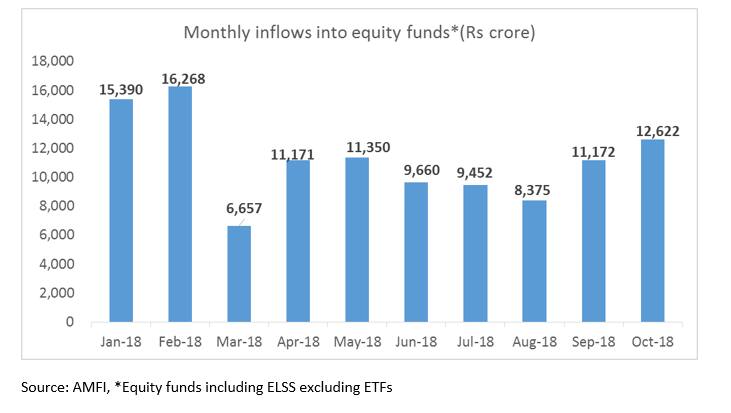
Strong equity flows aided by increasing SIP culture Despite the significant volatility and 5 percent fall in Nifty in October, equity inflows continued to witness a steady uptrend and was at an eight-month high in October. Net inflows into equity MFs, including equity-linked savings schemes (ELSS), was to the tune of Rs 12,622 crore, an increase of 13 percent over the previous month.
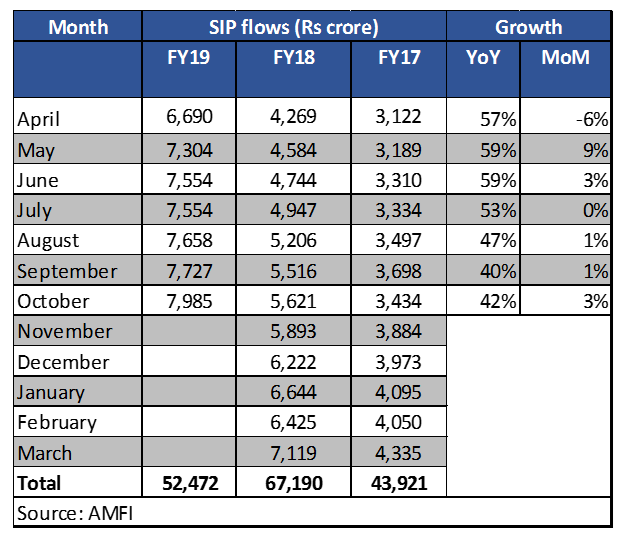
Investment in equity funds through systematic investment plans (SIPs) was the key highlight, which continued to show an improving trend. MFs mobilised Rs 7,985 crore of SIP funds in October as compared to Rs 7,727 crore in the preceding month, though growth in SIP accounts was a tad lower sequentially. Rising share of SIP contribution has been the key success story of Indian MFs as SIP flows are relatively stickier and improves persistency of equity AUMs.
The total number of accounts (folios as per MF parlance) as on October 31 stood at 7.90 crore, up 25 percent YoY. The bulk of which was fuelled by growth in retail folios, which increased 29 percent to 6.65 crore.
What are the key takeaways from equity flows? Monthly equity inflows have come off significantly from the high of Rs 20,308 crore seen in November last year. However, thanks to strong equity inflows of Rs 1,12,117 crore into MFs between January-October, the Indian stock market has endured outflows by foreign portfolio investors (FPI) to the tune of Rs 40,350 crore during the same period. In the absence of strong domestic inflows, FPI selling would have wreaked havoc.
Resilience of domestic equity flows will be put to the test in coming months as we head closer to general elections. The moot question is will the strong domestic equity flows sustain even if the equity market weakens further? While there is no clear answer to this, we are enthused by the fact that the current flows are still strong and holding up well. The granularity of the equity flows as reflected in rising SIP amount and higher share of individual investors in MF industry’s total AUM (53.3 percent as at September-end) are further encouraging.
Resumption of inflows in liquid funds Liquid or money market funds, which has been at the centre of the recent volatility in equity markets as well fixed income markets, saw inflows of Rs 55,296 crore in October. This comes as a big respite as liquid funds witnessed massive outflows of Rs 2.11 lakh crore in the preceding month. While there was a domino effect of the Infrastructure Leasing & Financial Services (IL&FS) episode on withdrawal of liquid funds, large chunk of outflows in September was a quarter-end phenomenon that included withdrawals to meet advance tax payment deadlines. Read: Large liquid fund outflows not as worrisome as posed by headline numbers.
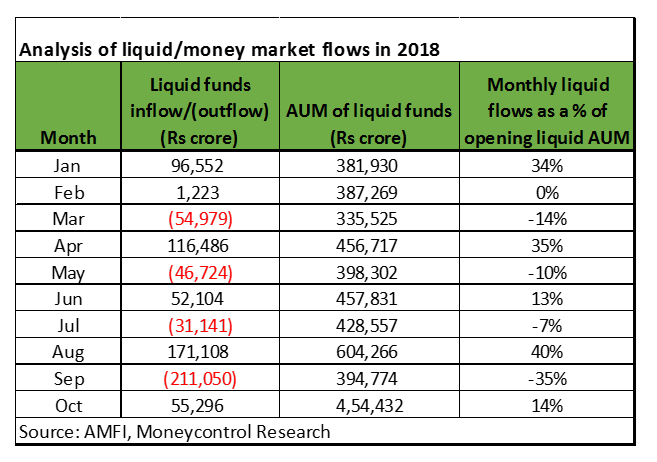
What are the key implications from liquid flows? October inflows indicate that money markets have started to stabilise after weeks of uncertainty. Liquidity has improved and as a result money market rates have also been coming off its recent highs. Does this mean that funding conditions have eased out for NBFCs that were adversely impacted by tightness in liquidity? Yes, but only marginally.
We expect liquidity to remain constrained in coming days, with large amount of debt papers of non-banking financial companies (NBFCs) coming up for redemption between November and March. Since the current situation is more a crisis of confidence, the improved liquid flows may not necessarily translate into better funding environment for all NBFCs as MFs are expected to be extremely selective. Top notch NBFCs, with strong parentage, will remain key beneficiaries as improved liquidity shift towards strong and top quality names.
For more research articles, visit our Moneycontrol Research page
Discover the latest Business News, Sensex, and Nifty updates. Obtain Personal Finance insights, tax queries, and expert opinions on Moneycontrol or download the Moneycontrol App to stay updated!
Find the best of Al News in one place, specially curated for you every weekend.
Stay on top of the latest tech trends and biggest startup news.