The Monetary Policy Committee (MPC) of the Reserve Bank of India will on April 6 make its first announcement of FY24. Market expectations are for a 25 basis increase in the repo rate, the rate at which RBI lends to the commercial banks. One basis point is one-hundredth of a percentage
The MPC, in the current rate hike cycle starting in May 2022, has hiked the repo rate by 250 basis points, taking the policy rate to 6.5 percent.
A majority of MPC members, in the last 4-5 meetings, agreed on the rate raises to keep inflation under check. Jayanth Varma is the sole member who voted for a rate pause in the last couple of meetings.
What did other members have to say over the last few rate hike decisions? What was their stance?
Moneycontrol looks at the last four MPC meetings and the stance adopted every member.
Shaktikanta DasAt its August meeting, the MPC raised the repo by 50 basis points. RBI Governor Shaktikanta Das, in his statement, said global and domestic issues could warrant further monetary tightening.
“Since the last MPC meeting in June 2022, there has been a considerable slowdown in the global economy and global inflation has hardened further. On the domestic front, though inflation has moderated and plateaued since its recent peak of April 2022, it remains unacceptably and uncomfortably high,” Das said.
Das, in his vote favoring the hike, said a new storm was originating from aggressive monetary policy tightening by central banks around the world.
Against this backdrop, the Indian economy presents a picture of resilience and financial stability, Das said. Economic growth is steadily improving. “There are, however, mixed signals and I vote for a 50 bps rate hike,” Das said.
Also read: In Charts: Key data movement since RBI's February 8 monetary policy decisionAt its December meeting, the MPC hiked the rate by 35 basis points after three consecutive increase by 50 basis points.
Das, in his MPC statement, said for the first time that the worst of inflation was behind, but added that a premature pause in monetary policy action would be a costly policy error at this juncture.
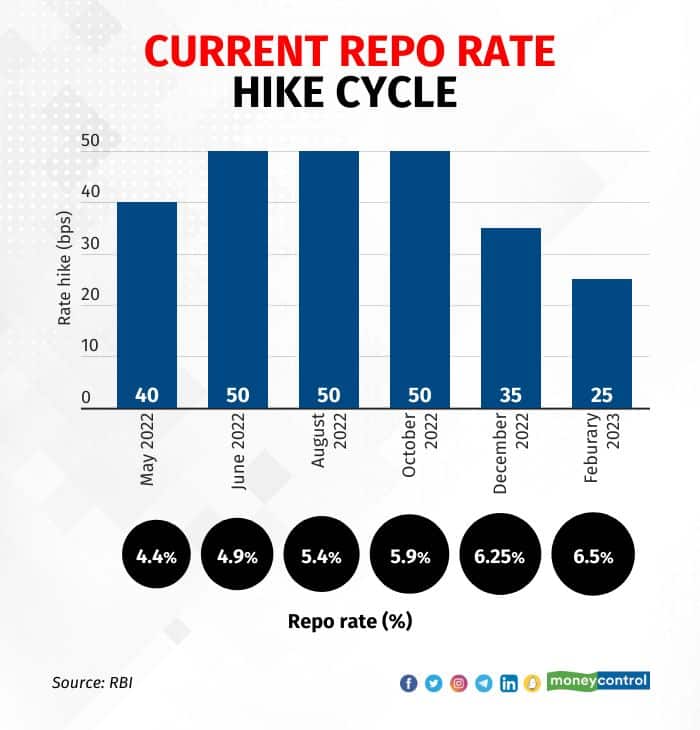 Repo rate hike since May 2022Michael Debabrata Patra
RBI Deputy Governor Michael Debabrata Patra in August voted for a 50 basis point hike. “Frontloading of monetary policy actions can keep inflation expectations firmly anchored, re-align inflation with the target and reduce the medium-term growth sacrifice,” said Patra.
In October, Patra noted that global central banks were racing in lockstep to raise policy rates by much more than their own historical experience. “Current levels of inflation haven’t been seen in decades, so are the banks overshooting, or overdoing it? Patra asked. "They are balancing the prospects of a recession against the risks of inflation remaining elevated and persistent.”
In December, Patra said warnings of a global slowdown were increasing the prospects of a drag on net exports from India in 2023-24. Patra suggested that a modest reduction in the size of the policy rate increase would provide the opportunity to weigh that assessment carefully. As a result, Patra voted for a 35 basis point hike.
Voting in favor of a 25 basis point hike in February, Patra said the stance of monetary policy will need to remain disinflationary until inflation returns to its targeted 4 percent, with a tolerance band of 2-4 percent.
Also read: Will US banking crisis cast shadow over RBI’s first MPC of FY24? Key indicators to watch“The Indian economy has demonstrated strength from global adversities and there is positive momentum underlying the steady emergence from the drag of the pandemic and the war,” said Patra.
Rajiv Ranjan“Underlying price pressures remain broad based in spite of some softening in core CPI items,” Rajiv Ranjan, executive director of RBI, said. In his August statement, he said: “Against this background, I vote for a 50 bps hike in the repo rate so as to reinforce the MPC’s commitment to price stability around the target.”
Ranjan, in the October MPC meeting, said India’s growth was resilient and inflation was slowing inflation, but a rate hike was imminent. “While a rate hike in this meeting is imminent, the choice between 35 to 50 bps is a close call. I would vote for a 50 bps hike to ensure that inflation remains within the target,” Ranjan said.
While highlighting the need to slow rate hikes from December 2022 , Ranjan warned that any change in MPC’s stance could be interpreted as a weakening its resolve to fight inflation; it will also impede monetary policy transmission.
“There is a strong case now to take the foot off the accelerator while keeping a sharp vigil on the inflation trajectory. An increase of 35 bps is felt appropriate at the current juncture,” Ranjan said.
In February, Ranjan, voting in favour of a 25 basis point rate hike, noted that inflation remained below 6 per cent for two consecutive months in November and December. But he said fiscal expansion around the Union budget and global central banks raising rates needed to be considered.
Jayanth VarmaVarma, a professor at the Indian Institute of Management (IIM)-Ahmedabad, voted for a 50 basis point hike in August.
“Inflation is at unacceptably high levels, and the projected trajectory is also above target during the entire forecast horizon. In this situation, there is clearly a need for front loaded-hikes in the policy rate,” Varma said.
After the October MPC meeting, Varma said that a pause was needed after this hike.
Also read: Jayanth Varma Exclusive Interview | Dissent is healthy; I approach MPC deliberations with a great deal of humility"RBI’s forecasts and the survey of professional forecasters show inflation falling to around 5 percent in the first quarter of the next financial year. Relative to this forecast, a policy rate of around 6 percent would not only be a positive real rate, but also likely above the neutral rate," Varma said.
In the December rate hike decision, Varma was the sole member of the MPC to vote against a rate hike. Varma, in his statement, said: “There are now clear signs that the global supply side shocks emanating from the pandemic and the Ukraine war are finally receding. All in all, there is much reason to be optimistic about global inflationary pressures easing.”
“I believe that the 35 basis point rate hike approved by the majority of the MPC is not warranted in this context of reduced inflationary pressures and heightened growth concerns,” Varma said, “and I therefore vote against this resolution.”
Seeking no rate hike in February, Varma said: “ I believe that a repo rate of 6.50 percent very likely overshoots the policy rate needed to achieve price stability, and further tightening is not desirable.”
Ashima GoyalGoyal, Emeritus Professor at the Indira Gandhi Institute of Development Research, voted in favour of a rate hike in August. Citing high inflation and global issues, Goyal said uncertainty and global risks to both growth and inflation remained high and policy has to carefully monitor incoming data and respond to developments.
In the October MPC meeting, Goyal did not vote for a 50 basis point rate hike and was in favour of a 35 point increase.
“Continuing supply-side action, global softening and transparent communication all help anchor inflation expectations. Hence, I vote for a 35 bps hike,” Goyal said.
Also read: RBI's FY24 growth forecast seems to be backward-looking, says MPC's Ashima GoyalIn the December MPC meeting, Goyal voted for a 35 basis point raise. “Multiple global risks continue, but as a growth slowdown threatens many countries, inflation and rate actions of major central banks are also slowing. Indian exports and manufacturing output are slowing with global demand; imports are also decelerating,” Goyal said.
But Goyal said a smaller raise of 25 bps would have been her preference, but 6.25 percent worked well as the focal rate.
Alongside Verma, Goyal voted for a rate hike pause in February. In her statement, Goyal said: “Intervention in forex markets has lowered rupee volatility and helped maintain independence from the Fed stance. It is better to give time for possible softening of both inflation and growth and effects of past monetary tightening to play out.”
Shashanka BhideA senior advisor at the National Council of Applied Economic Research, Bhide, in the August MPC meeting voted for a rate hike. Citing the global economic conditions, Ukraine-Russia war and the shadow effect of the pandemic, Bhide said that the hike is necessary to ensure that inflation remains within the target going forward, while supporting growth.
In his statement favouring a further hike in October, Bhide highlighted slow growth and adverse problems for Emerging Market Economies (EMEs).
“The global macroeconomic conditions have become adverse for growth and stability, particularly for the EMEs. While there are clear signs of slowing growth momentum in the economies across the world, inflation continues at much higher rates than the target for many countries,” said Bhide.
Bhide, in line with the December MPC decision of hiking the repo rate by 35 bps, said domestic growth was improving but globally there existed concerns. He said: “With overall domestic growth showing signs of resilience, the adverse global macroeconomic conditions require that domestic inflation rate is at moderate levels, within the tolerance band of the inflation target on a sustained basis. I vote for a hike.”
In the latest MPC meeting in February, Bhide voted for a 25 basis point hike and stated that domestic inflation pressures have persisted even with the decline in the headline inflation. Bhide warned that the slowdown in growth globally was evident in India's external sector in the slower pace of growth of exports and imports.

Discover the latest Business News, Sensex, and Nifty updates. Obtain Personal Finance insights, tax queries, and expert opinions on Moneycontrol or download the Moneycontrol App to stay updated!
Find the best of Al News in one place, specially curated for you every weekend.
Stay on top of the latest tech trends and biggest startup news.