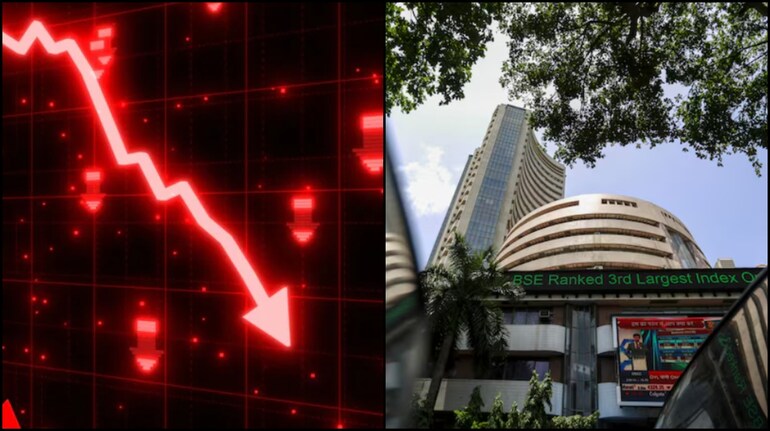

Indian stock markets crashed on February 1 after the Union Budget. India VIX, which measures near-term market volatility, jumped nearly 11 percent to 15.09.
After Finance Minister Nirmala Sitharaman concluded her Budget speech, Sensex crashed more than 2,370 points (around 2.9 percent) to hit an intraday low of 79,899.42. Nifty 50 meanwhile plunged nearly 750 points (around 3 percent) to its low of 24,571.75. During this time, India VIX jumped more than 18 percent to hit an 8-month high of 16.11.
The benchmark indices then staged a strong recovery, followed by sharp crash again. Vix too remained volatile during the session.
At close, Sensex fell nearly 1,547 points (around 1.9 percent) to end the session at 80,722.94. Nifty 50 meanwhile plunged over 495 points (nearly 2 percent) to close at 24,825.45.
A high VIX index after the Budget does not necessarily mean that further crash is imminent, but it does indicate that traders are preparing for volatility rather than a smooth ride, said Pranav Koomar, Founder and CEO of PlusCash.
“VIX measures the volatility of the market over a short term, and if it remains high, it indicates that there is uncertainty about the macroeconomic indicators, fiscal policies, and money flows,” the analyst explained.
While the Budget may have addressed key growth and fiscal priorities, a strong volatility index suggests investors remain cautious about near-term triggers such as global interest rate movements, earnings follow-through and geopolitical developments, said Kalp Jain, Research Analyst, INVasset PMS.
Koomar added that stock markets can witness extreme intraday movements in such a scenario. “For investors, this means that they need to focus on quality and stick to their stop-loss strategy,” he concluded.
“A persistently elevated VIX after the Budget signals that markets are still pricing in uncertainty despite the policy clarity provided,” said Kalp Jain, Research Analyst, INVasset PMS, adding that in such phases, markets often become more selective rather than directional.
“For equities, this typically translates into higher stock-specific volatility and sharper reactions to results or news flow, even if the broader trend remains intact,” he further said.
The analyst however explained that a firm VIX does not necessarily imply a bearish outlook, but it does indicate that confidence has not fully stabilised. “Until volatility eases, markets may continue to see rotational moves, with investors favouring balance-sheet strength, earnings visibility and defensiveness over broad-based risk-taking,” he said.
While presenting Budget 2026, Finance Minister Nirmala Sitharaman raised STT on futures to 0.05 percent from 0.02 percent. This was seen as a significant reason for the market crash today, as investors on the contrary had expected significant relief on this front.
For every Rs 1 lakh worth of futures sold, traders will now pay Rs 20 in STT instead of the previous Rs 12.50, explained Ashish Singhal, Co-founder of Lemonn. For a Rs 10,000 option contract sale, STT increased to Rs 10 from Rs 6.25, he added.
“As the current STT framework does not differentiate between various categories of users or the purpose of derivative usage, genuine hedging activity is subject to the same higher costs as speculative trading. This uniform treatment could discourage some investors from employing prudent hedging strategies, effectively increasing their exposure to market risk and making portfolio protection more expensive,” the analyst said.
"The steep increase in STT on futures and options, coming on top of last year’s hike, is likely to raise impact costs for traders, hedgers, and arbitrageurs. This could cool derivative activity and lead to a reduction in volumes. The intent appears to be volume moderation rather than revenue maximisation, as any potential revenue gain could be offset by lower derivative volumes," said Shripal Shah, MD & CEO, Kotak Securities.
The absence of significant incentives for foreign investors, who have withdrawn $23 billion from local equities since the start of 2025, also hurt sentiment. "At a time when India needs to deepen market liquidity and attract global flows, raising frictional trading costs sends the opposite signal," said Jimeet Modi, founder and chief executive at SAMCO Group.
Follow all LIVE updates on Budget 2026 here.
Disclaimer: The views and investment tips expressed by experts on Moneycontrol are their own and not those of the website or its management. Moneycontrol advises users to check with certified experts before taking any investment decisions.Discover the latest Business News, Sensex, and Nifty updates. Obtain Personal Finance insights, tax queries, and expert opinions on Moneycontrol or download the Moneycontrol App to stay updated!
Find the best of Al News in one place, specially curated for you every weekend.
Stay on top of the latest tech trends and biggest startup news.