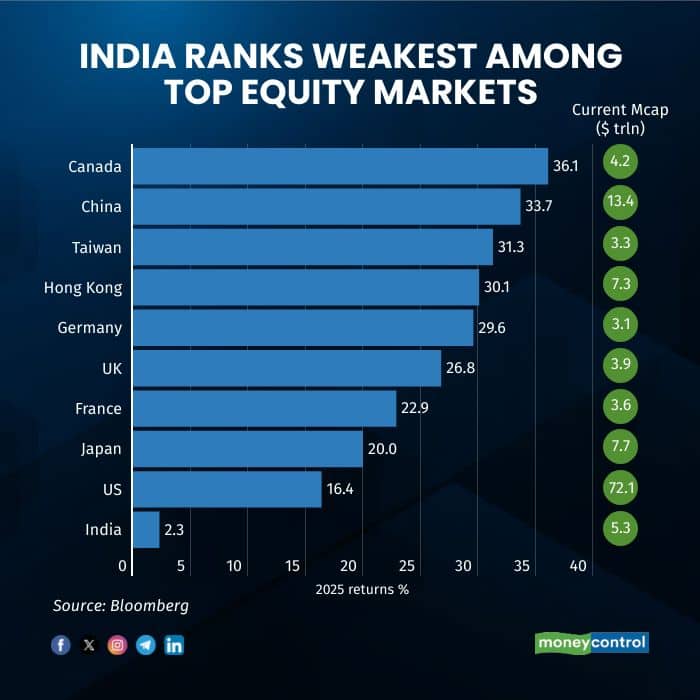
India emerged as the weakest performer among the world’s top 10 equity markets in 2025, as persistent foreign outflows, stretched valuations, softer earnings trends and global headwinds including tariff tensions weighed on sentiment.
India’s total market capitalisation rose just 2.3 percent during the year, its slowest pace in three years, to $5.27 trillion compared with $5.17 trillion at the end of 2024.
In sharp contrast, most global markets recorded strong gains. Canada led the rally with a 36 percent jump in mcap to $4.20 trillion, followed by China and Taiwan, which posted increases of nearly 34 percent and 31 percent, respectively. Hong Kong and Germany ranked third and fourth, each seeing mcap rise around 30 percent.
The UK and France followed with gains of 27 percent and 23 percent, while Japan and the US added about 20 percent and 17 percent. Overall, global mcap surged 22 percent to $151 trillion from $124 trillion a year earlier.
Through the year, India’s equity performance was constrained by elevated valuations, earnings downgrades and subdued growth expectations for FY26. Investor appetite was further tempered by weaker foreign portfolio flows, as global investors shifted toward markets offering better perceived value and earnings momentum. The domestic market’s relatively limited exposure to the artificial-intelligence theme — a key driver for several global indices in the second half of 2025 — also capped upside.
Despite this, the Sensex and Nifty continued to trade near record highs, supported by strong domestic inflows and resilient macro indicators. On valuations, the Nifty’s one-year forward price-earnings multiple stands at 21.5 times, roughly 4 percent above its long-period average of 20.8 times.
Broader markets remain more expensive: the Nifty Midcap 100 and Smallcap 100 trade at 29 times and 25 times, representing premiums of 26 percent and 50 percent to their respective long-period averages. This leaves large-cap valuations comparatively moderate following recent consolidation, while midcap and small-cap segments appear more selectively positioned, experts said.
Market strategists expect near-term foreign flows to remain cautious amid rupee weakness and tight domestic liquidity, a consequence of currency defence measures. They see potential volatility into early 2026 as investors weigh global risks and domestic funding conditions.
However, brokerage commentary notes that structural domestic inflows remain intact, supported by relatively low nominal interest rates and reduced tax incentives for debt mutual funds, which have lowered the appeal of fixed income for long-term savers. Unless markets see a deep and prolonged correction, analysts expect continued household participation in equities over the medium term.
Discover the latest Business News, Sensex, and Nifty updates. Obtain Personal Finance insights, tax queries, and expert opinions on Moneycontrol or download the Moneycontrol App to stay updated!
Find the best of Al News in one place, specially curated for you every weekend.
Stay on top of the latest tech trends and biggest startup news.