








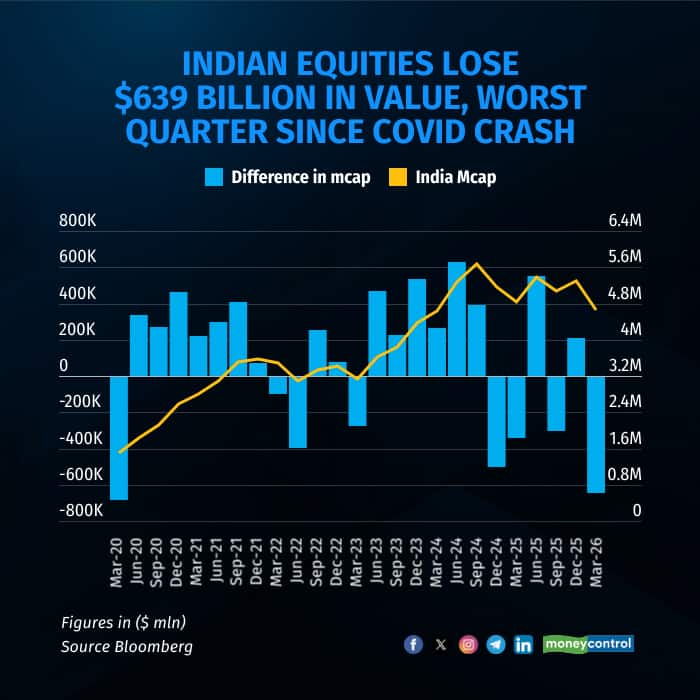
Indian equities have witnessed a sharp correction so far in 2026 amid heightened volatility and global uncertainties, wiping out significant market value across segments and marking the steepest decline in about 24 quarters.
India’s total market capitalisation (mcap) has declined by over $639 billion so far in the March 2026 quarter, the sharpest quarterly fall since March 2020, when Indian markets saw about $678 billion wiped out during the quarter amid the COVID-19 pandemic.
The erosion in India’s market value is larger than the entire mcap of countries such as Mexico, Malaysia, South Africa, Norway, Finland, Vietnam and Poland. It is also nearly double the market capitalisation of countries including Chile, Austria, the Philippines, Qatar and Kuwait.
The combined mcap of all listed companies in India currently stands at about $4.65 trillion, the lowest level since April 2025, down about 12.1 percent from around $5.3 trillion at the start of 2026.
Indian equities have remained volatile since the beginning of the year amid a series of negative developments. Continued foreign investor outflows, subdued corporate earnings, trade tensions and limited exposure to artificial intelligence-related sectors have weighed on market sentiment.
While trade tensions between the United States and India have eased, the US-Israel-Iran conflict has kept global equity markets volatile and extended uncertainty for Indian markets. The conflict has also pushed crude oil prices above $100 per barrel, raising concerns that higher energy costs could widen India’s current account deficit (CAD) by increasing the country’s import bill and adding to inflation risks.
Analysts warn that sustained high oil prices can worsen India’s balance of payments, which includes trade in goods and services, investment flows, remittances and financial transfers. According to analysts at Barclays, every $10 per barrel increase in crude oil prices could widen India’s current account deficit by roughly $9 billion, highlighting the country’s sensitivity to energy price shocks.
India’s benchmark indices Sensex and Nifty have declined about 10.8 percent and 9.5 percent respectively so far in 2026, while broader markets have also weakened. The BSE MidCap 150 index has fallen about 7.2 percent and the BSE SmallCap 250 index has declined about 9.5 percent during the same period.
Meanwhile, Iran has warned that oil prices could surge to $200 per barrel as escalating US and Israeli strikes continue to rattle global energy markets. Analysts say such a spike could add further pressure on oil-importing economies such as India.
The conflict has also led to gas supply disruptions in parts of India, with shortages reported in several states and some hotels temporarily shutting operations due to limited supply. Analysts caution that if the situation persists, it could further strain economic activity.
Amid these uncertainties, brokerage firm Morgan Stanley recently downgraded India to an “equalweight” rating, equivalent to a neutral stance, citing prevailing macroeconomic uncertainties and relatively high valuations. The brokerage said the downgrade reflects heightened geopolitical risks and India’s historical vulnerability to oil supply disruptions.
Morgan Stanley also noted that uncertainty around AI-related disruptions and relatively expensive valuations may delay international investors from increasing exposure to India until the technology cycle in markets such as South Korea and Taiwan peaks.
Discover the latest Business News, Sensex, and Nifty updates. Obtain Personal Finance insights, tax queries, and expert opinions on Moneycontrol or download the Moneycontrol App to stay updated!
Find the best of Al News in one place, specially curated for you every weekend.
Stay on top of the latest tech trends and biggest startup news.










